Posted on

How can I tell if my Vans are fake?

How to find fake vans

Legit Check: Vans Old Skool
Counterfeit vs. Real 

How do you know if vans are fake?Does zumiez sell real vans?
See inside authentic and counterfeit Vans sneakers.


10 ways to spot fake Vans Sneakers

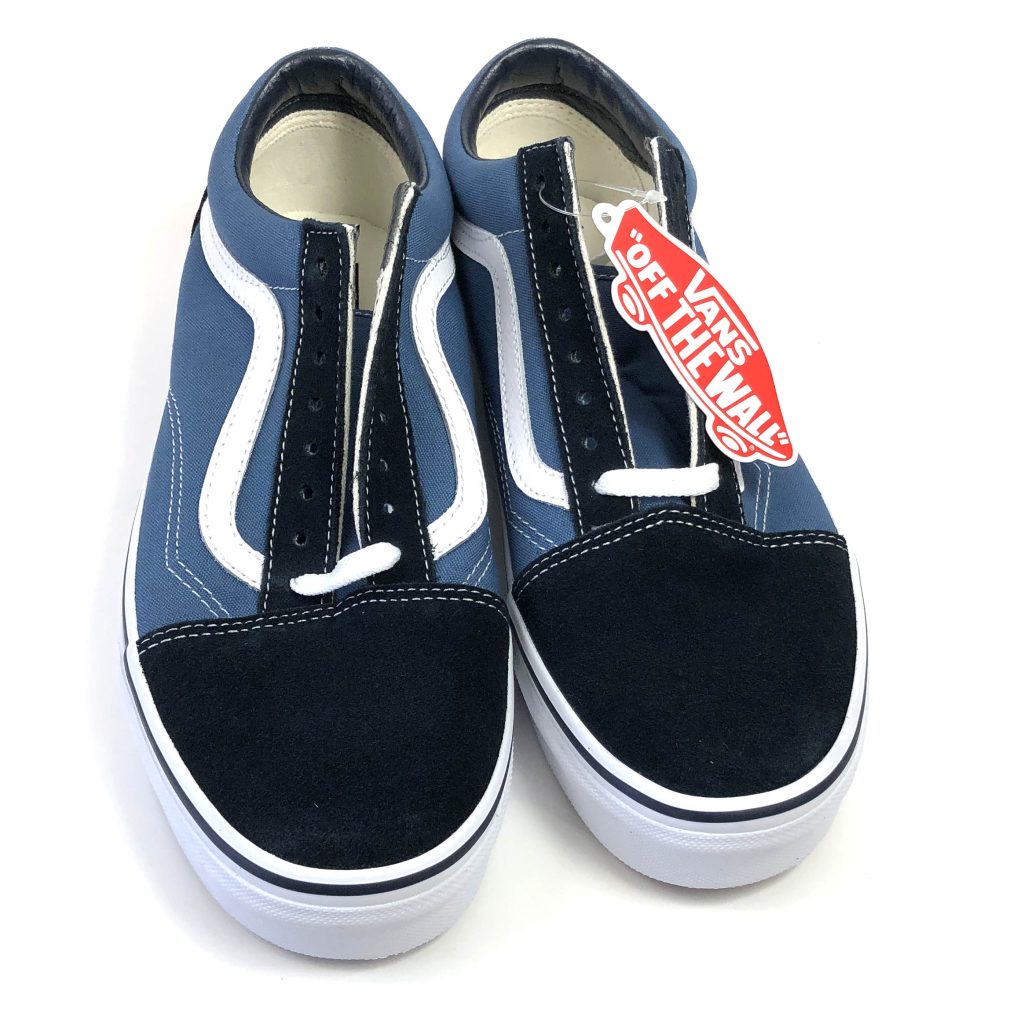
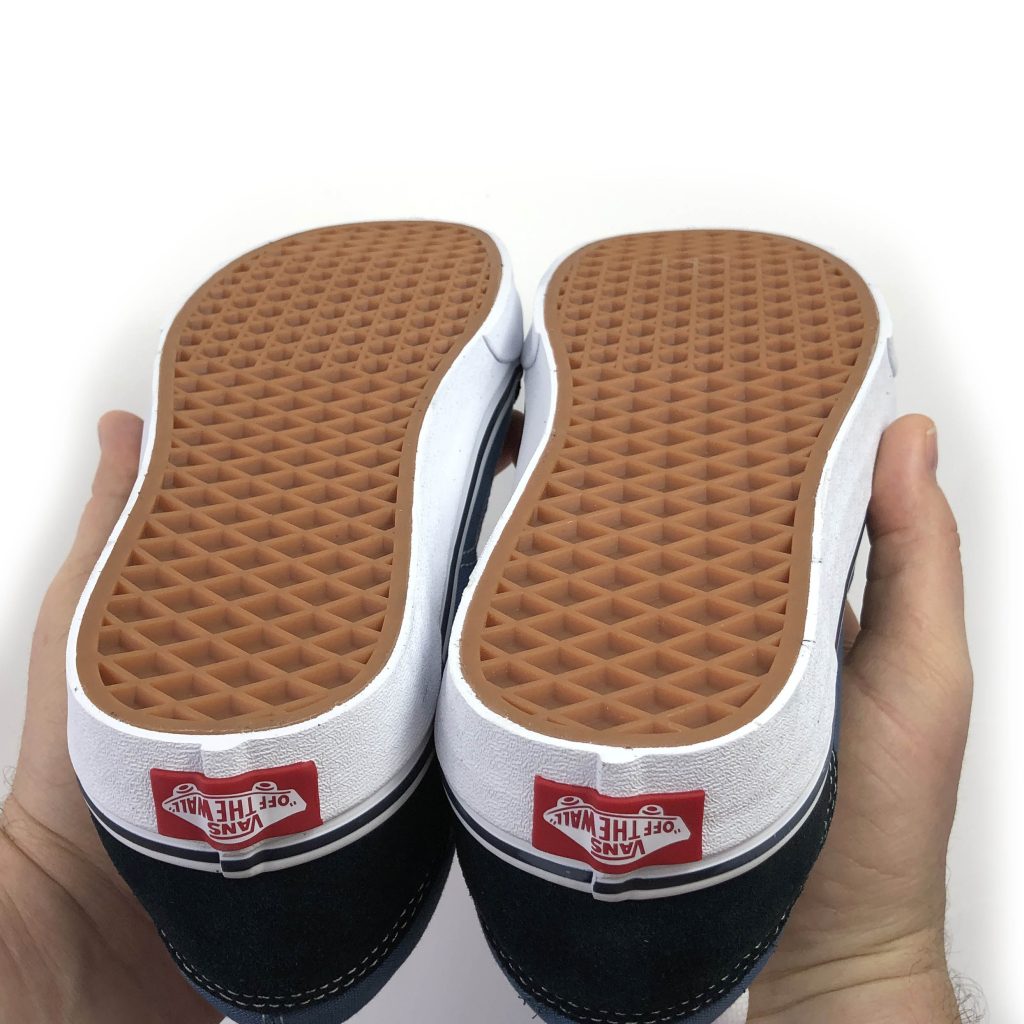
How do you know if Vans are fake? Today we have two pairs of Vans Old Skool sneakers: a real pair of Vans shoes purchased directly from the Vans Outlet and a counterfeit pair imported from South China. We will examine the small details that show the big story of counterfeit Vans, and you will learn how to tell if a Vans shoe is real or fake. The secret to a Vans sneaker authentification check is in the quality of the shoemaking and the vulcanized construction.

Is the price right?

When shopping for authentic Vans shoes you should expect to pay real Vans prices. If you find Vans at a price that is too good to be true… then it IS too good to be true. Low prices and beat up boxes are your first clue that you have a fake, copy, cloned, counterfeit or illegally smuggled-in B-grade Vans shoes.

Make any mail-order or E-Bay purchases from trusted retailers. Remember, slightly used does not mean the shoes were real Vans to start with.

Legit Check Your Vans Sneakers: What to look for?

Is the Vans stripe real or fake?

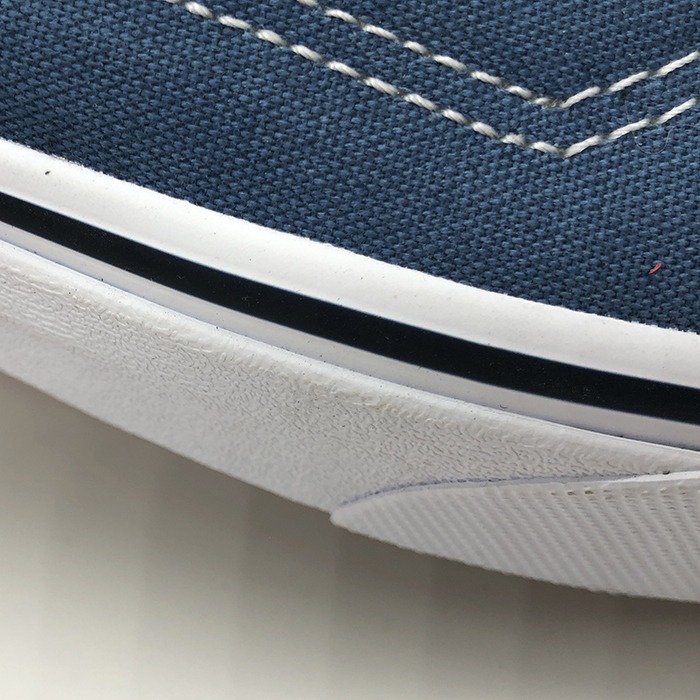
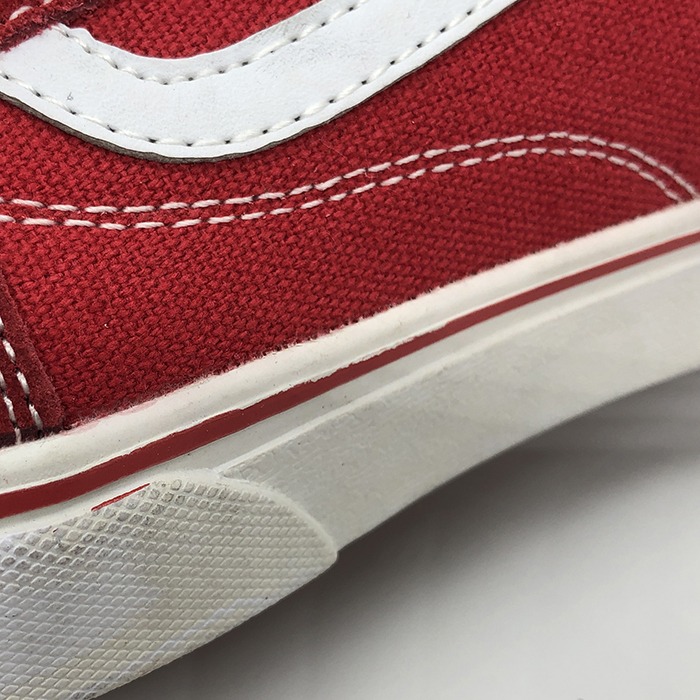
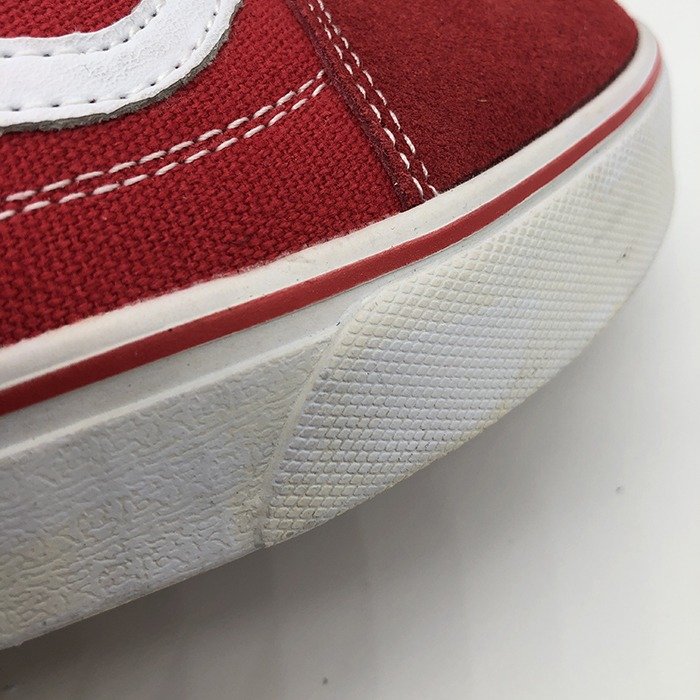
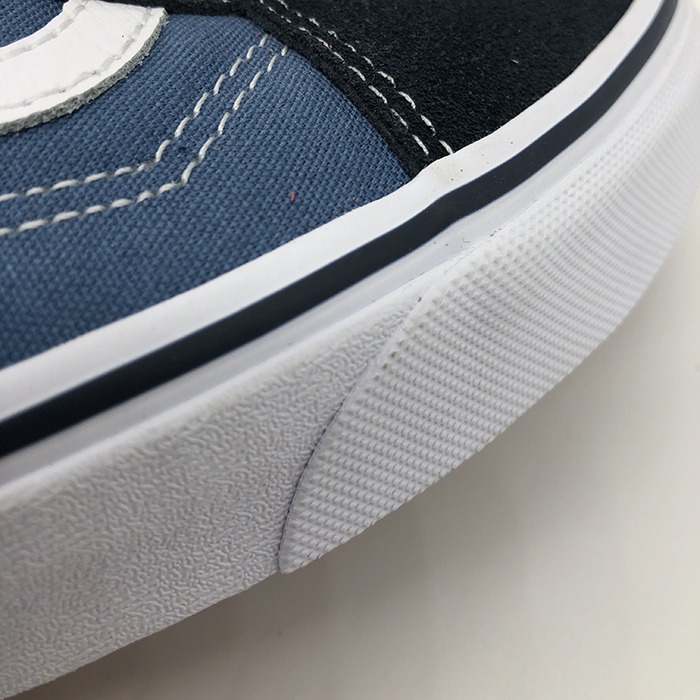
The first thing to look at is the sole stripe. The stripe on the rubber foxing tape is a trademark styling cue for the Vans classic. Study the stripe carefully; the authentic Vans shoe stripe is molded-in color. Vans makes the stripe with solid colored rubber that has clean and straight edges. The fake Vans have a painted stripe. You can see the paint job here is not perfect, and you can even see a dab of paint slopped onto the toe foxing.

Real Vans outsole foxing tape.

You can see where the toe tip rubber part is attached to the shoe on the authentic pair of Vans. Meanwhile, the counterfeit Vans sole has a very different surface texture, and the toe foxing is molded directly to the sole unit. This is very suspicious! This outsole may not have been made by vulcanization. On the real Vans shoe, you can see the tiny gap where these two parts come together. The authentic Vans toe tip is glued on, NOT molded together as one piece like the counterfeit Vans shoe.

Authenticate Shoes
Like a Pro

Learn how to authenticate shoes. We give the Nike Air Jordan 1 complete shake down. Piece by piece we will study every part. Don’t get burned!
Learn more
On Sale $39.99

Look inside authentic Vans shoes

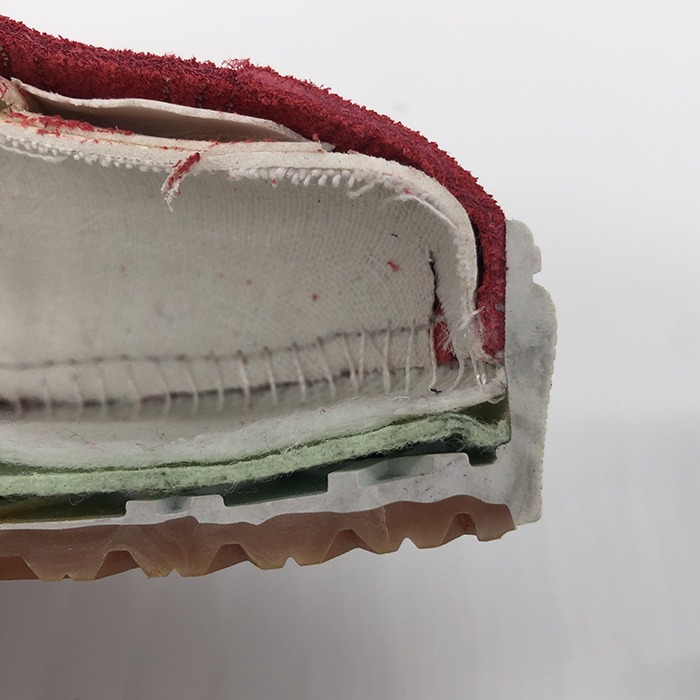
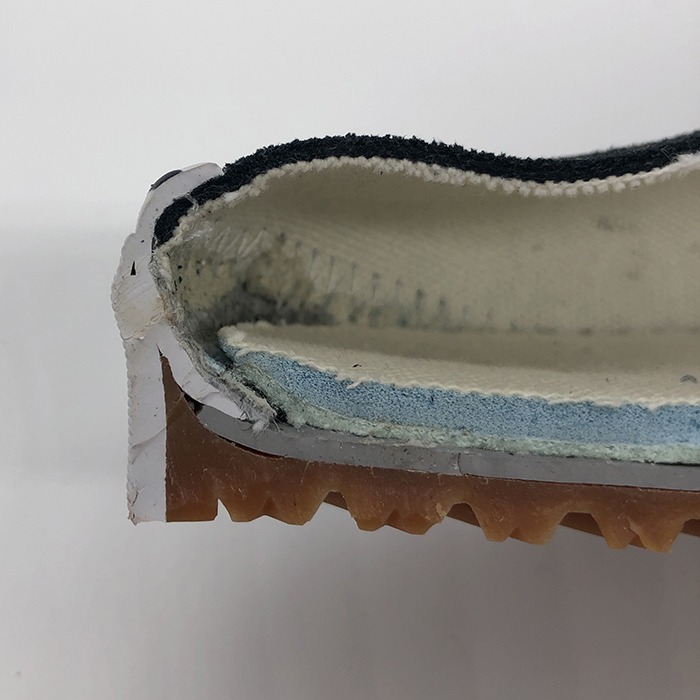
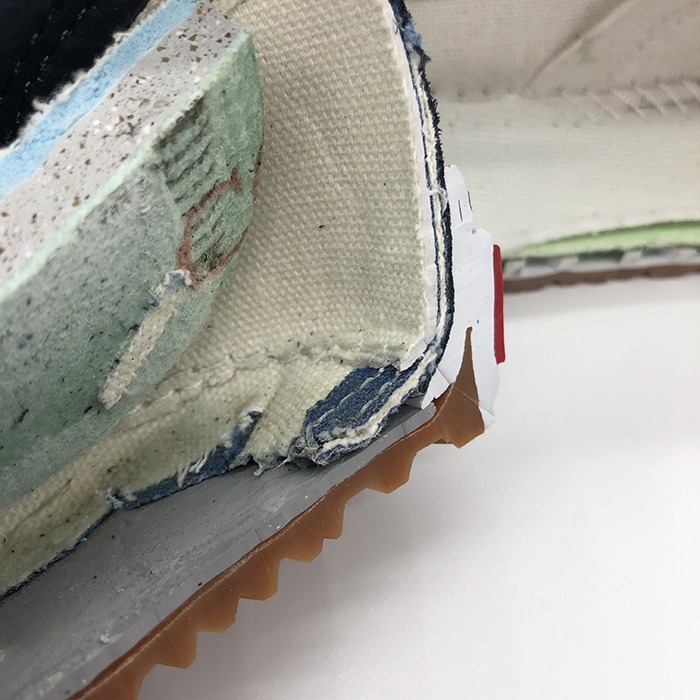
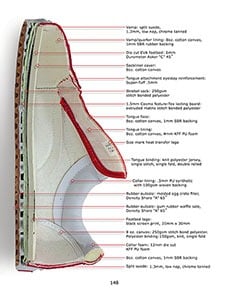
It is time to start cutting! Looking inside the real and fake Vans, you can see some huge problems! The counterfeit Vans are not made by the vulcanization process. The counterfeit Vans outsole is a one-piece rubber cupsole. The factory producing the copy Vans shoe is using the cold cement assembly process. The real Vans waffle sole is made from several assembled parts that have been bonded by vulcanization. (You can read about vulcanization here and in our book How Shoes Are Made.)

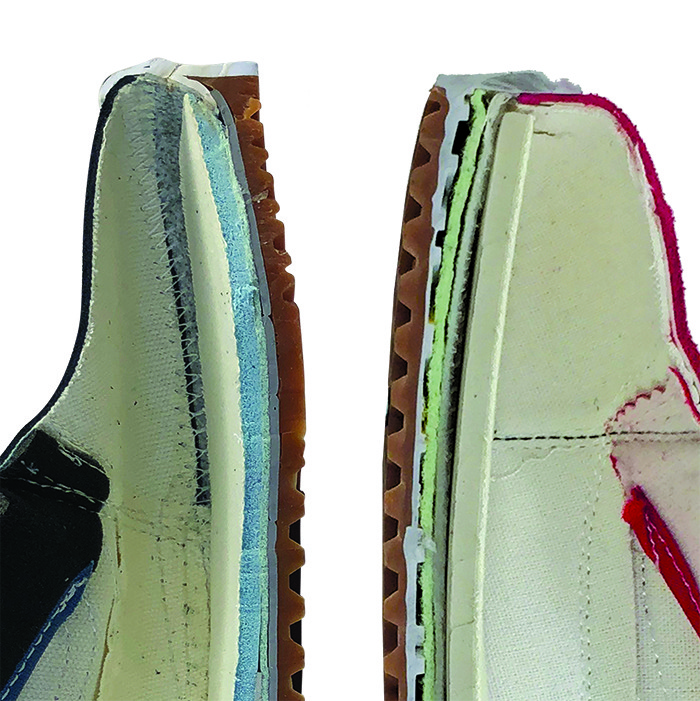
In this cutaway section of the Vans shoes, you see blue and grey sponge rubber inside the real Vans shoe. Inside the fake Vans, you see a green lasting board, white Strobel layer, and EVA footbed. Wrong!

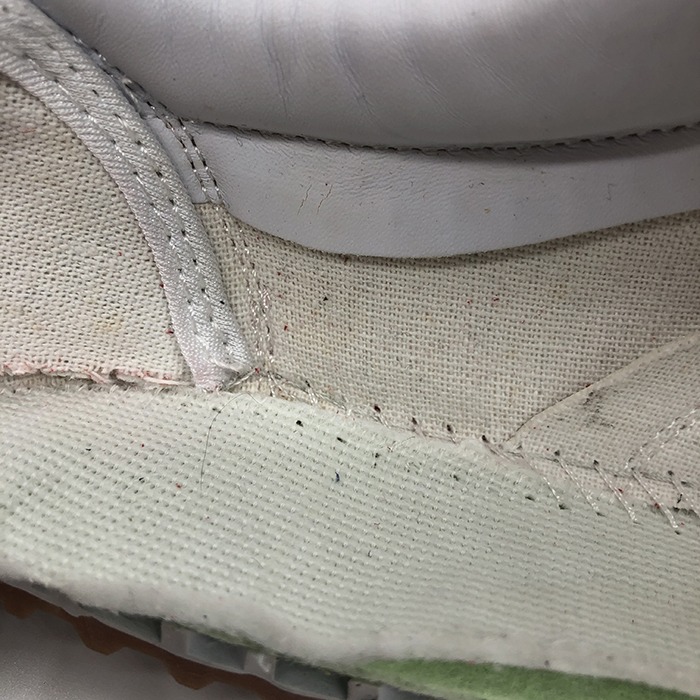
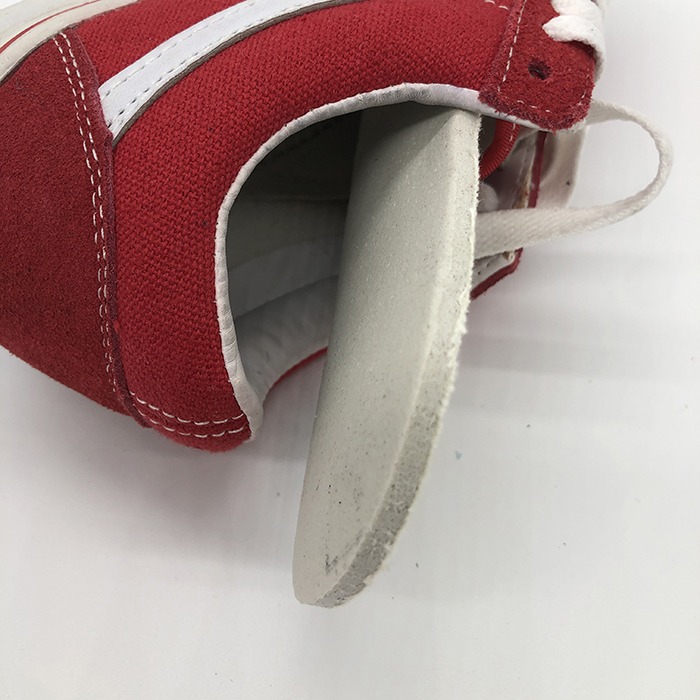
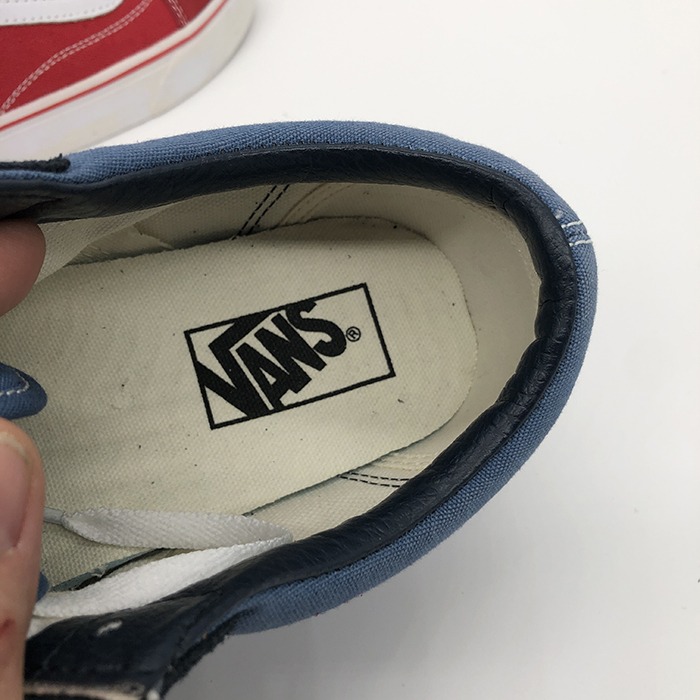
Inside the heels of the shoes, you can see the fake shoe is made by Strobel construction. This process is not bad; it’s just not how Vans classics are made! You don’t have to cut open your shoes to check this feature – The real vans shoe will have the footbed glued in securely. The counterfeit Vans may have a removable EVA footbed. In this case, a flat, die-cut piece of EVA.

You can learn more about counterfeit Vans shoes here:
The Counterfeit Report: Vans Shoes

Are these Vans Real?

Learn how to authenticate shoes. We give the Vans Old Skool a complete shake down. Piece by piece we will study every part. Don’t get burned!
Learn more
On Sale $199

Look inside authentic Vans shoes

It is time to start cutting! Looking inside the real and fake Vans, you can see some huge problems! The counterfeit Vans are not made by the vulcanization process. The counterfeit Vans outsole is a one-piece rubber cupsole. The factory producing the copy Vans shoe is using the cold cement assembly process. The real Vans waffle sole is made from several assembled parts that have been bonded by vulcanization. (You can read about vulcanization here and in our book How Shoes Are Made.)

In this cutaway section of the Vans shoes, you see blue and grey sponge rubber inside the real Vans shoe. Inside the fake Vans, you see a green lasting board, white Strobel layer, and EVA footbed. Wrong!

Inside the heels of the shoes, you can see the fake shoe is made by Strobel construction. This process is not bad; it’s just not how Vans classics are made! You don’t have to cut open your shoes to check this feature – The real vans shoe will have the footbed glued in securely. The counterfeit Vans may have a removable EVA footbed. In this case, a flat, die-cut piece of EVA.

Are These Jordans Real?

Learn how to authenticate shoes. We give the Nike Air Jordan 1 complete shake down. Piece by piece we will study every part. Don’t get burned!
Learn more
On Sale $199

Posted on

Inside a Fake Air Jordan 1

see Inside a Fake air Jordan 1 How To Spot Fake Nike Shoes: 10 Ways To Tell Real Nikes, How to Spot Fake Nikes, how to spot fake Air Max, legit check App
The Sneaker chop Inside a Fake air Jordan 1 see Inside a dismantled air Jordan 1 Fake
Let’s see inside a Fake Nike

A Fake Nike Sneaker Deconstructed!

Here at the Sneaker Factory, we love to see how shoes are made! We even wrote a book called How Shoes are Made. To really see how Nike makes shoes, it’s best to slice into a few pairs and see what’s going on inside. So, today we are slicing open a fake Nike Air Jordan!

Is Something Missing?

While the shoe looks decent for a Fake Nike Air Jordan, once you slice into it, you can see it’s missing something very important…the Air. This fake Nike from China is made with a simple EVA die-cut midsole. Likewise, the factory took care to profile the EVA, so the forefoot is thinner than the heel. This is a common sneaker production process, just not the one a real Nike Air Jordan would have.

A Closer Look Inside the Air Jordan 1

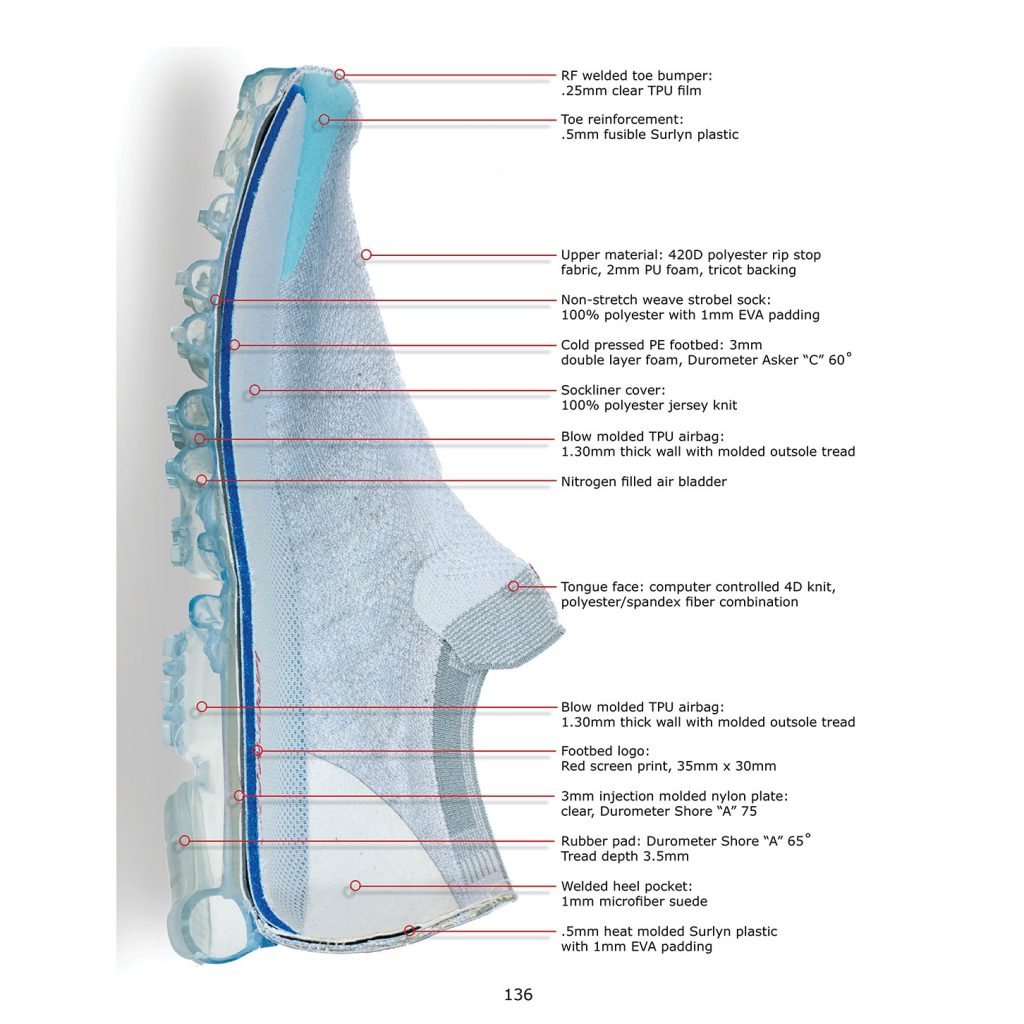
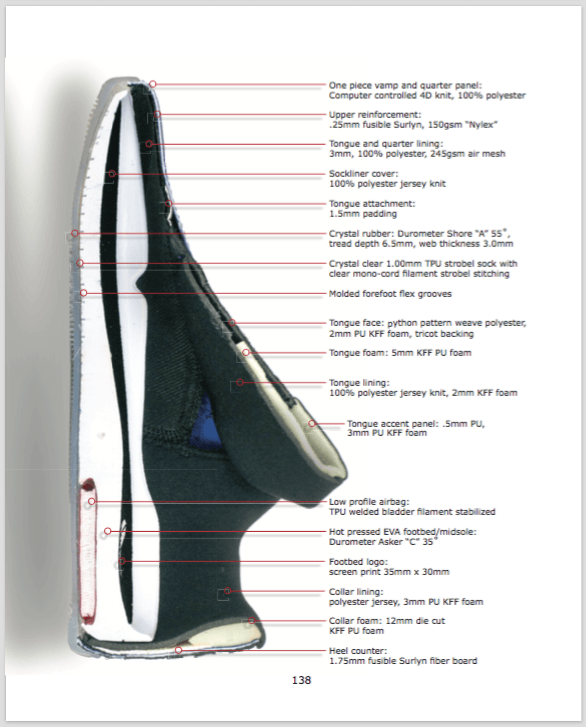
After we deconstructed this Nike Air Jordan 1, we took some time to detail all the parts inside and out. First off, this fake Nike Air Jordan is missing the Airbag and PU midsole, but the remaining parts are close to the original Nike Spec. Furthermore, the internal components are not exactly the same quality, but you can see the configuration is nearly right. The Air Jordan is not a complicated shoe to assemble. I guess this is what makes it a popular shoe to counterfeit.

Inside a cut nike air Jordan 1 Inside a cut nike air Jordan 1
The Nike Spec


See More Deconstructed Sneakers

Build Your DreamsAir Jordan DIY Kit
Last & Outsole

Stop searching! We have the classic Air Jordan style last and outsole in stock. Ready for your Air Jordan 1 restoration and DIY shoe projects. We have your size in-stock! Buy Now On sale $119

New Online Course
Sneaker Authentication

13 Authentication lessons.
3 hours of video instruction.
In-depth study of footwear inspection techniques.
Authentication textbook included.
Course Details enroll now $199
Posted on

Sneaker Factory Pro Pack 2023 Upgrade

Shoe Company Start-Up Pro Pack Download

The new 2023 Start-Up Pro Pack includes:

A must-have for anyone serious about launching a new footwear company! The Shoe Company Start-Up Pro Pack Download is all you need to get your shoe business off the ground. For 2023 we have upgraded the Sneaker Factory Pro Pack to include the newest book in our catalog, Footwear Pattern Making and Last Design.

The Start-Up Pro Pack will show you how shoes are made, how to select materials, and how to start a shoe brand. You will learn how to write product briefs, how to find a shoe designer, how to raise money, find a factory, import and market your shoes, and much more. Your success starts here! Four books, totaling 785 pages with over 1355 color photos!

Two options for Purchase

You can purchase the download edition for $79.99 or Purchase the printed version for $169.99 + shipping. As a special gift, the print version includes the complete Pro-Pack download. You can start reading today while you print books are mailed to you.

Instant download, start reading now!

What’s included in the Sneaker Factory Pro Pack? Everything!

1.   Print & Download Editions of How Shoes are Made, 224 pages.
2.   Print & Download Editions of Shoe Material Design Guide, 200 pages.
3.   Print & Download Editions of How To Start Your Own Shoe Company, 176 pages.
4.   Print & Download Editions of Footwear Pattern Making and Last Design, 200 pages.
4.   Cut-paper factory shoe pattern and Downloadable PDF and live vector .ai formats.
5.   Real factory shoe pattern in downloadable PDF and live vector .ai formats.
6.   Sample shoe specification drawing, 8 pages. PDF and .ai formats.
7.   Factory blueprint for an EVA & rubber running shoe outsole unit. PDF and a live vector file.
8.   Complete line item shoe specification in .xls format.
9.   3D print files for size 9 shoe last in STL format.
10.  Die-cut files to make a cardboard shoe last.
11.  Shoe size run calculator in .xls format.
12. Start-up shoe company profit margin calculator in .xls format.
13. The graded pattern for Arris running shoe. PDF and .ai formats.
14. The graded pattern for women’s T-Strap high heel shoe. PDF and .ai formats.

How Shoes are Made
Series: How Shoes are Made (Book 1)
Paperback: 224 pages
Publisher: Wade’s Place; 3rd edition (April 5, 2018)
Language: English
ISBN-10: 1519389574
ISBN-13: 978-1519389572
Product Dimensions: 8.5 x 0.5 x 11 inches

Shoe Material Design Guide
Series: How shoes are Made (Book 2)
Paperback: 200 pages
Publisher: Wade’s Place; 1 edition (December 26, 2017)
Language: English
ISBN-10: 099870704X
ISBN-13: 978-0998707044
Product Dimensions: 8.5 x 0.5 x 11 inches
Shipping Weight: 1.5 pounds

How To Start Your Own Shoe Company
Series: How shoes are Made (Book 3)
Paperback: 176 pages
Publisher: Wade’s Place; 1 edition (February 20, 2017)
Language: English
ISBN-10: 0998707015
ISBN-13: 978-0998707013
Product Dimensions: 8.5 x 0.4 x 11 inches
Shipping Weight: 1.2 pounds

Footwear Pattern Making and Last Design
Series: How shoes are Made (Book 4)
Paperback: 200 pages
Publisher: Wade’s Place; 1st edition (June 25, 2020)
Language: English
ISBN-10: 0998707074
ISBN-13: 9780998707075
Product Dimensions: 8.5 x 0.4 x 11 inches
Shipping Weight: 1.2 pounds3

Shoe Business Builder Pro Pack Bundle

A must-have for anyone serious about launching a footwear company. 4 text books, shoe business documents and downloadable content not available anywhere else! The Shoe Company Start-Up Pro Pack bundle is all you need to get your shoe business off the ground.
Learn more
Download Today

Posted on

जूते कैसे बनते हैं

जूते कैसे बनते हैं अब भारत में उपलब्ध मुद्रित!

अब भारत में उपलब्ध मुद्रित!
Now Available: Printed in India!

Hello to our shoemaking friends in India. Is it difficult to find the book How Shoes Are Made in India at a reasonable price? Not anymore! We have contracted with the local Indian publishing company Pothi.com to print this book for you.

The English edition of 
How Shoes Are Made
is now available for  
₹3,000 + shipping 


How Shoes are Made जूते कैसे बनते हैं
Now Available Printed in India! अब भारत में उपलब्ध मुद्रित!

पर्दे के पीछे एक असली स्नीकर फैक्ट्री दिखती है।
क्या आप सीखना चाहते हैं कि आधुनिक एथलेटिक जूते कैसे बनाए जाते हैं? कैसे जूते बनाए जाते हैं, आप देखेंगे कि बड़े ब्रांड किस प्रकार जूते का डिजाइन और निर्माण करते हैं। एक स्नीकर फैक्ट्री के माध्यम से सिर्फ एक निर्देशित दौरे से अधिक, कैसे जूते बने हैं यह आपको दिखाएगा कि आधुनिक खेल के जूते प्रारंभिक डिजाइन चित्र से नमूना विकास और विनिर्माण के जीवन में कैसे आते हैं।

A behind the scenes look at a real sneaker factory.
Do you want to learn how modern athletic shoes are made? In How Shoes are Made you will see how the big brands design and produce shoes. More than just a guided tour through a sneaker factory, How Shoes are Made will show you how modern sports shoes come to life from initial design drawings thru sample development and manufacturing.

Sneaker Design Books

Now Printed in India!


How Shoes are Made
Series: How Shoes are Made (Book 1)
Paperback:224 pages
Publisher:Wade’s Place; 3rd edition (April 5, 2018)
Language:English
ISBN-10: 1519389574
ISBN-13: 9781519389572

Shoe Material Design Guide
Series:How Shoes are Made (Book 2)
Paperback:200 pages
Publisher:Wade’s Place; 1st edition (December 26, 2017)
Language:English
ISBN-10: 099870704X
ISBN-13: 9780998707044

How To Start Your Own Shoe Company
Series:How Shoes are Made (Book 3)
Paperback:176 pages
Publisher:Wade’s Place; 1st edition (February 20, 2017)
Language:English
ISBN-10: 0998707015
ISBN-13: 9780998707013

Footwear Pattern Making and Last Design
Series: How Shoes are Made (Book 4)
Paperback: 200 pages
Publisher: Wade’s Place; 1st edition (June 25, 2020)
Language: English
ISBN-10: 0998707074
ISBN-13: 9780998707075

Shoemaking
TextbooksBuy Now
Shoemaking
SuppliesBuy Now
Shoemaking
CoursesCourse Details
Previous slide Next slide
Posted on

Footwear News Shout Out

Nicoline van Enter www.footwearists.com I am the founder and creative director of The Footwearists.
https://footwearnews.com/2020/business/opinion-analysis/footwearists-expert-advice-digital-design-skill-training-1203026819/

Nicoline van Enter of Footwearist is a dear friend of ours. She has been a great help to the Sneaker factory family! She has boundless energy and a creative mind that continues to push the future of footwear technology forward. We really appreciate the shout out, so back to you. Thank You Nicoline!

You can learn more about Footwearist and their footwear consulting, webinars, and events here.

Ask An Expert: Footwearists’ Nicoline van Enter on the Importance of Digital Design Skills

By Madeleine Streets

Nicoline van Enter www.footwearists.com I am the founder and creative director of The Footwearists.

The rate of change has never been greater — or faster — for the footwear industry, with new challenges popping up every day in nearly all corners of the business, from navigating cash crunches and supply chain issues to understanding the latest technological advances. In its “Ask An Expert” series, FN asks industry leaders — all solutions-based providers — to take on some of the most timely topics.

Despite being known for its slow adoption of technology, the footwear industry has undergone a rapid period of innovation in recent years. As brands develop cutting-edge products, footwear designers and product developers need to keep up with the latest digital tools in order to maintain their place at the forefront of the industry. Skill-building and technology training has never been more important.

CEO Nicoline van Enter of Footwearists, the membership-based innovation platform for footwear professionals, spoke with FN about the value of continued learning; the most critical skills for designers right now; and how to implement them in an impactful way.

Nicoline van Enter: The academic system is different from industry, and there’s not such a good connection [between the two]. A lot of people learn to make footwear by hand, for instance, which is interesting, but not really how things work in the industry. So as you transition from school to work, you need to learn a lot more. And then, especially over the past decade, so much has changed in product development, manufacturing, the materials. People are trying to catch up as they go along or have to rely on information that comes from their suppliers –— and sometimes that’s good information, but it can also be very biased because the supplier has an interest in sharing certain aspects. I would love to see us combine learning in the industry, as most people learn most effectively on the job.

FN: Are there any particular areas right now that you think would be valuable for workers to focus their attention on, or even be considered crucial for long-term success?

NvE: There’s basically one big area now: the whole process of digital transformation. We talk about digital transformation in a very broad aspect, from the ideation part of development and design, the manufacturing or even just essentially rethinking how we are making our processes most efficient, sustainable, creative. And it’s not about computers being a goal; they’re a means to an end. But now, because of the coronavirus, so many things that people before were very reluctant to do — work remotely, digitally — finally, they’re catching up. It’s very important for workers to make sure that they have the skills to be able to work digitally because it will greatly enhance their opportunities, either within the company they work for or to find a job. I don’t even have enough people coming out of my courses in digital 3-D design, for instance, to fill the demand that I’m getting from other companies.

FN: How can employers and managers help their employees in these learning initiatives? Are there particular resources that you think are valuable?

NvE: In general, the approach should be that people first look at this from an organizational and a management perspective, because too often when we talk about digital transformation, the first thought that comes to mind is, ‘what software do my designers need to learn?’ And it’s way more complicated than that. Essentially what you want to think about is ‘how can I organize my entire process better, and which tools are available?’ You first have to define that. I have been teaching digital design for many years now, and I noticed that people would take my courses, but then never use the software again. And I figured out that it had nothing to do with the courses not being good or the software not being user-friendly; it had everything to do with unrealistic expectations. I started teaching management about the transition toward 3-D design, and then we could get realistic expectations on either side to make sure that it would work.

FN: What are some ways that unemployed designers in our industry can discover new resources for themselves?

NvE: It would be really good for them to go through that thought process of ‘where are my strengths, what are things that I can really bring to the table and what software would then be most suitable for me.’ Because price-wise, there are several programs that are quite close together, so it depends more on the contents: What is it that you really want to learn? The software is a means to an end goal.

We changed our entire school system to make it as accessible as possible. We offer everything in small installments. Designers who want to start with 3-D design but have no budget, for them we started a course called Blender which is completely free, really good software; it’s not lesser quality, it’s open source. And if you have the time, again even if you don’t have any money whatsoever, there’s a website called SneakerFactory.net and they have a lot of different videos up there on how sneakers are made. There’s a lot available, really a lot. But you have to go and Google it.

FN: How would you recommend people maximize the time available to them right now?

NvE: I suggest for the unemployed workers to practice, practice, practice and start publishing. Start publishing your work because you have to get yourself out there. You have to get people to see your work to know what you’re doing, to see your skills. Look toward different markets, toward the Asian brands that are looking to hire designers and are still very keen on hiring designers from Western countries; you could potentially work remotely for them.

For anybody who is employed, it is a great opportunity to rethink your current process from scratch. All the companies that are still operational now, they will have to think about how can we improve our system, how can we cut back on costs, but in a smart way. You want to have training that you can use right away, so that whatever time you have to spend on training, it’s not seen as a cost – it’s a benefit.

Shoemaking
TextbooksBuy Now
Shoemaking
SuppliesBuy Now
Shoemaking
CoursesCourse Details
Previous Next
Posted on

Footwear Design and Development Certificate

Footwear Certificate program at Lasell University in Boston

Lasell University

Footwear Design and Development Certificate is a 12-week professional certificate comprised of 4 courses that provide students with a comprehensive overview of the footwear industry while developing the necessary skills that lead to successful product

Footwear Design and Development Certificate is a 12-week professional certificate comprised of 4 courses that provide students with a comprehensive overview of the footwear industry while developing the necessary skills that lead to successful product design. Industry partners and instructors with extensive experience in design, materials, and production of footwear will provide key elements from concept through marketing in creating functional and fashionable shoes for contemporary consumers.  

Who should earn this certificate?

Footwear Certificate program at Lasell University in Boston
  • Clothing designers, merchandisers, shoe designers, and accessory designers who want to expand their understanding of shoe design, marketing and production
  • Students and job seekers who want to update their portfolio to include provocative design boards using cutting-edge tools, materials and color development.

Register Here!

Skill-based approach

Learn about all phases of footwear design and production from introduction to design processes, to biomechanics, best practices, and trends and market analytics all lead to a holistic understanding of how the industry works. Upon completion of the certificate, students with design experience will have adapted their skillset to include a unique area of product design. Students without design experience will acquire an important foundation of the major components of shoe design, production and marketing.

What you will learn

  • Understand the anatomy & physiology fundamentals and biometrics of feet and ankles in the context of shoe design to produce stylish yet comfortable products. 
  • Shoe exploration covering everything from high fashion to everyday shoes, through performance
  • Create multiple footwear collection briefs using research, innovative thinking, critical analysis and personal style development while addressing the needs of a contemporary, diverse market.
  • Design product that reflects an understanding of the basics of human anatomy, contemporary materials, manufacturing processes and marketing strategies.
  • Research and articulate rising trends, customer identification and cultural shifts within the footwear industry.
  • Assessment of best business practices regarding ethical, moral and ecological impact on society through acknowledging maltreatment, waste and pollution issues found in manufacturing.

Available Courses

FASH910 – Shoe Design Basics (4-week course) Starts July 6
PreReq: 2-week Adobe Illustrator and Photoshop course titled: Beginner Adobe Illustrator & Photoshop 

FASH911 -Materials & Color (4-week course) Starts June 15

FASH912 – Production Management (2-week course) Starts September 21

FASH913 –  Trend Analysis & Marketing (2-week course) Starts August 3

Register Now!

Shoemaking
TextbooksBuy Now
Shoemaking
SuppliesBuy Now
Shoemaking
CoursesCourse Details

Previous
Next

Posted on

The Nike Rules for Shoe Designers

Nike Rules for Shoe design

This internal memo is from the early days of Nike. While not exactly about shoe design, these are 10 Nike rules we as shoe designers can learn from and aspire to. The Nike motto of “Just Do It” is a great marketing slogan but for the shoe design team inside Nike, they made these 10 rules. Of course inside Nike rules are meant to be broken!

1. Our business is change.

2. We’re on offense. All the time.

3. Perfect results count — not a perfect process.
Break the rules: Fight the law.

4. This is as much about battle as about business.

5. Assume nothing.
Make sure people keep their promises.
Push yourselves push others.
Stretch the possible.

6. Live off the land.

7. Your job isn’t done until the job is done.

8. Dangers
Bureaucracy
Personal Ambition
Energy takers vs. energy givers
Knowing our weaknesses
Don’t get too many things on the platter

9. It won’t be pretty.

10. If we do the right things we’ll make money damn near automatic.


https://www.youtube.com/watch?v=Min8JQyyzyI

The Shoe Dog explains what these rules really mean and how they can help you as a footwear designer. 

New Online Course!
Shoemaking for Designers & Brand Builders

Created for footwear newcomers and professionals alike, this course delivers the basic shoemaking knowledge you need to get your career and brand started faster and with fewer costly mistakes. Course Details Enroll Now $99
Online shoemaking course Shoemaking
TextbooksBuy Now
Shoemaking
SuppliesBuy Now
Shoemaking
CoursesCourse Details
Previous slide Next slide
Posted on

How to Become a Shoe Designer: 10 Steps

One of the most often asked questions we get at Shoemakers Academy is “where do I start?” We meet so many aspiring shoe designers looking to learn, improve, and advance their skills in order to find gigs and careers in footwear design. You want to design shoes for a big brand like Nike, Adidas, Converse, Puma, or Vans. You have dreams of making it big. You are not sure where to start. This article is for YOU.  
You can do it!

You can draw shoes

I’m going to be totally honest with you, landing a shoe design job at a top brand is difficult, but if you work hard and don’t give up you can get into the business. Don’t be afraid to start your professional shoe design career with a small company or work as a freelance designer. I landed my first shoe design job as a freelancer after spending four months unemployed. While searching for a job I spent over 50 hours a week drawing shoes.

10 steps toward your goal to be a shoe designer:

Learn to draw shoes…

1. Learn to draw shoes and everything else:
If you want to be a professional shoe designer, of course, you need to learn how to draw shoes. This will be your language, you need to know it well. Your shoe drawings are how you communicate your ideas. You have to be good, and your drawings need to show your passion and creativity to others. In a design meeting, the drawing that captures the imagination but also shows real possibilities will be the design that makes it all the way to production!

You need to master concept sketching and some rendering skills. Do you think hand drawings are old-fashioned? Think again. Check out the Render Demo series of books and videos. Pro tip: Make sure to spend time drawing outsole bottoms and midsoles. A designer that can draw outsoles will always be in demand. Work hard to draw shoes that are fresh, creative, and break the rules of shoemaking, however, you also must show that you know and understand the rules of shoemaking.

2. Go to school:
There are more and more school programs for shoe design and fashion design. Is a 4-year design school a must for shoe designers? Maybe not, but the skills and experience gained from a 4-year college or design school will really give you an edge. There are many great programs for Industrial Design or ID. Industrial Design is what you are looking for, NOT engineering. ID programs include classes on materials, drawing, human factors, etc…  In design school, you will work with many creative people and you will definitely be challenged. Design school will help you to become a shoe designer. 
We have new courses for all levels for shoemakers and designers. See Courses


You Can Design Shoes!

Aspiring shoe designers start here! How Shoes are Made is your entry into the world of modern shoe making. Tour a real shoe factory and learn the process from design to manufacturing.
Learn more
Download $19.99

Find a footwear mentor…

3. You will need a shoemaking mentor:
I have been very lucky in my shoemaking career. Along the way, I have met and worked with many great people. If you are not afraid to ask questions, and patient enough to listen, you will learn a ton from mentors and coworkers. I guarantee that while working in the shoe trade you will meet people from all around the world with many different experiences. I count a Canadian, an Englishman, and many Korean and Chinese men and women as my great friends and mentors in the shoe trade.

4. Learn computer drawing software: Start with Adobe Illustrator
There are many drawing programs you can use. Adobe Illustrator is easy to learn and is a great tool for refining and detailing your designs. While Illustrator is not a 3D CAD program, it’s still critical for you to master. If you are an engineer, use 3D modeling software. As a designer, you should start with Adobe Illustrator for drawing shoes. 

5. Build a great shoe design portfolio to get a foot in the door:
There are many ways to get noticed and get started but a great shoe design portfolio is your launching point. In this day and age, an online portfolio is a must. With an online portfolio, you can show hundreds of drawings. Let people see what you can do! Other tools? Surfing LinkedIn.com can get you some contacts. Reach out to footwear professions online, ask for a portfolio review. There may not be an open job, but feedback on your shoe designs can help!

PRO TIP:
Check out Nike’s online career website at jobs.nike.com. Nike and Converse combined currently have more than 1700 open positions. More than 200 of them contain the word “Footwear.” They also offer paid summer internships around the world in many fields of study.

Start Building Your Brand

A must-have for anyone serious about launching a footwear company. 4 text books, shoe business documents and downloadable content not available anywhere else! The Shoe Company Start-Up Pro Pack is all you need to get your shoe business off the ground.
Learn more
Download Today

Study

6. Study the classic sneakers:
Study the classics. Not the masterworks of Italian painters but classic shoes. Learn the modern history of shoes. There are many good books out there. Get to know the classic silhouettes from the big brands. Don’t be afraid to stand on the shoulders of the shoe giants! Study fashion shoes, sports shoes, and brown shoes. All of these types have unique shoemaking lessons!

7. Fill your mind with great designs:
To be a great shoe designer you need to look well beyond shoes. There is a multitude of great industrial designs out there. Fill your mind with images – Ferrari, Prada, Frank Gehry, Philippe Starck, Apple, Porsche, etc. There are many websites where you can see brilliant modern designs for products aside from shoes. Fill up your brain, and let your eyes drink up this design stew.

8. Books   Books   Books:
I have collected dozens of design, design history, manufacturing, architecture, branding, and packaging design books. Surround yourself. If I have a design problem I can’t solve, I just dive in and start flipping pages. The answer is always inside, you just need a new way to let it out. There are many good shoe design books for beginners.

9. Cut up old shoes:
You need to see how shoes are put together. Learn the hows and whys of shoe assembly. Brands like Nike and Adidas have masterminds of shoemaking at work, you can learn a lot by looking inside their shoes. You can see “inside” a variety of shoes that we have cut up and analyzed (including Nike and Vans) in our book, the Shoe Material Design Guide. A great drawing of a shoe that cannot be manufactured will never make it off the page. A stunning new shoe design that challenges your development team can be a winner. Invest in this book, it’s highly recommended.

Take chances

10. Fortune favors the bold: 
Take chances! Your shoe designs should pursue perfection no matter what kind of shoe it is. Do something new and different. Work hard to understand shoe design challenges, then attack from a new direction. Find a new material for your shoe design, use an old material in a new way. Visit the shoe factory and see what they can do, see what they can’t do. Don’t take no for an answer!

You can be a shoe designer. It takes a passion for product design and imagination to see something that can be. For me, this is the best part of being a shoe designer, seeing the future in my mind and working to create it.

New Course!
Shoemaking for Designers & Brand Builders

Created for footwear beginners and career changers alike, this course delivers the basic shoemaking knowledge you need to get you career in the shoe trades started.
Learn more
On sale $99

Posted on

Ask a Shoe Dog

Shoemaking questions answered

Answers to all of your shoemaking questions!

Thank you for visiting our shoemaking blog! ShoemakersAcademy.com started more than ten years ago with the mission to inform and educate shoemakers around the world. We strive to provide both basic and advanced shoemaking knowledge. Every day we receive shoemaking questions from our followers around the world. Here are our best answers to your most frequently asked shoemaking questions!

Please submit your questions to:
TheShoeDog@ShoemakersAcademy.com

How can I get a job as a shoe designer?

Great Question!  I can tell you how I landed my first job in the shoe business. After I graduated from Design school I made a portfolio and a small booklet of my product designs. I applied for every design job in San Francisco. I was turned down 20 times before I got a job designing sports bags and golf bags.

Was this my dream job, NO! But it was a start. Working 60 hours a week, I didn’t have much free time but I was gaining experience.  I learned how to handle customers and refined my drawing skills. Working nights and weekends I made shoe drawings, I put together a portfolio of just shoes. After a year making money designing sports bags and golf bags…I quit. I then set to work drawing on my own from 9 am to 5 pm every day. 

As each new job listing opened, I assembled portfolio pages specific to the job on offer. After several more months of job rejections, I landed a small contract for a single shoe design project. That one shoe project grew into two projects, those two projects grew into 5 projects. When these projects ended I was offered a full-time job. Awesome! It took me 3 years to finally land a shoe design job. 
That is how I got my start!  
I hope the books and online courses here can help you build your skills so you can land your first job!
Good luck!

Wade The Shoe Dog

Which part of a shoe is the last?

The last is NOT part of a shoe. The last is a metal or plastic form used in shoe development to make the pattern and in production to set the final shape of the shoe.
Read more here: About Shoe Lasts

How does Nike create their shoes?

This a great question and a complicated one. Nike has teams of shoe designers and footwear developers. Nike does not own any shoe factories. The shoe designers and developers work with the shoe factory teams to transform the designs into shoes.
Read more here: How Nike Shoes are Made

What leather are most shoes made of?

Most leather shoes are made with cowhide leather. Calf and pig hides are also commonly used to make thinner leathers for uppers and linings. Kangaroo leather is very elastic and is used to make soccer boots. White leather sports shoes are often made with “Action” leather, Pu coated cowhide.
Read more here: The Designer’s Guide to Shoe Leather Shoe Material Design Guide

What is Vans shoe construction?

Vans shoes are made by the vulcanized construction process. In the Vans vulcanized shoemaking process, the rubber shoe outsole parts are assembled onto the lasted upper before the rubber is completely cured. With the sole attached, the entire shoe must be heated in a vulcanizing oven. The shoe must be heated to around 110˚C for 80 minutes.
Read more here: How Vans Shoes are Made: Vulcanized Construction

Where is shoe mesh manufactured?

Another great shoe material question! Shoe mesh is made in many countries in Asia. The most mesh is made in China, followed by Taiwan, Korea Japan, Vietnam, and Thailand. High-end technical mesh is made the USA, Japan, and Europe.
Read more here: Textiles for shoe design / How to pick shoe materials

Can I make shoe specification drawings with Adobe Illustrator?

Yes! Adobe Illustrator is a great tool to make shoe specification drawings and shoe renderings. Adobe Illustrator can also be used to create, grade, and modify shoe patterns. Check out the online video course Adobe Photoshop for Shoemakers. Great for beginners and intermediate users.
Learn more here: How to draw shoes. How Shoes are Made. Download Illustrator shoe specifications.

What is the best shoe material for running shoes?

Another great question about materials for running shoes. For running shoes, the best materials for uppers are mesh, PU leather, and TPU. For the running shoe outsole, EVA foam is ideal. It’s lightweight, flexible, and durable. Materials NOT good for running shoes include leather and suede. For running shoe outsoles avoid TPR.
Read more here: Running Shoe Parts and How Running Shoes Are Made

What is shoe hand lasting?

Hand lasting is the traditional way to make shoes. With a wood last, lasting pliers, and lasting nails, the shoe upper is pulled into place and secured with tacks. In the article listed here, you can see lasting pliers in action. Read more here: Lasting pliers

How to make rubber shoe soles?

Rubber outsoles for shoes and sneakers are made by the vulcanizing process. The rubber components, both natural and synthetic, are mixed together in an uncured form. This gummy paste is then pressed into a heated mold to cure the rubber, transforming the paste into the tough elastic material suitable for outsoles.
Read more here: How rubber outsoles are made

Rubber outsole hardness standard for shoes?

Outsole rubber is measured in the “A” scale of hardness. The standard for athletic shoes is 60˚ to 65˚.
Read More here: Durometer Testing Rubber soles Shoe Material Design Guide

What raw materials does Vans use to make shoes?

Another great question about shoe materials. The classic Vans shoes like the Vans Era, Vans Old Skool, and Vans Slip-Ons are all made of the same basic materials. Vans shoes’ raw materials include suede, cotton, canvas, vinyl, and rubber for the foxing tape, midsolepadding, and outsole bottoms. Vans uses the vulcanizing process to make their shoes so the materials must be heat resistant.
You can learn more about Vans raw materials here: Vans Shoes

Did a slave make your sneakers?

Was slave labor used to make your shoes? It depends…
If your shoe carries the logos of Nike, Adidas, Puma, Van, or Under Armour, then most likely not. If you have discount shoes from a discount brand in a discount store then all bets are off!
You can learn more labor conditions in Shoe factories here: Nike Labor

What are the steps for manufacturing shoes?

The basic manufacturing steps can be broken down into cutting, stitching, and assembly. Of course, manufacturing a shoe is quite complicated, but these are the three departments you will find in every shoe factory.
Read more here: How a Shoe is Made

How much does it cost to produce a $200 Nike shoe?

Another great question about the cost of making shoes! Let’s work backward on this calculation. For a Nike shoe that retails for $200, the shoe store buys the shoe from Nike at 50% of the selling price, or approximately $100. Nike buys the shoe from the factory and must also pay the shipping costs, import duty fees, athlete royalties, and account for their own profit margin of approximately 50%. So, the cost to make a pair of $200 Nike shoes is around $40 to $45.
Read more here: How Much Does it Cost to Make a Shoe.

Is polyethylene used for shoe soles?

No! Polyethylene is not used to make shoe soles. Polyethylene, usually called PE plastic, is used to make stiffening boards. Called “PE board,” this PE board can be used inside soles but is not common. PE board is found in fabric sided luggage. Shoe soles are made of poly-URETHANE.
Read more about sole materials here: Shoe Material Design Guide

What kind of rubber does Converse use to make shoe soles?

Converse makes shoe soles out of vulcanized rubber. All rubber found in shoe soles is vulcanized. Vulcanizing is a process that uses heat and sulfur to “cure” the rubber. Curing is when the rubber molecules cross-link to transform sticky, gummy rubber into the tough, elastic material suitable for outsoles.
Read more about Converse shoes here: How the Converse All-Star is Made


What is the reflective material on shoes called?

The most common reflective material to use on shoes is Scotchlite™ Reflective made by 3M.
Read more about 3M: Here

How much does it cost to make a shoebox?

The basic shoebox costs about 65 cents. Die-cut and folded corrugated cardboard is the standard. 4-color processing and printing inside the box costs extra. A fancy box made of hand wrapped fiberboard can cost $5 or more!
Read More Here: Shoe Material Design Guide

Do you offer footwear development classes?

Yes! We offer a full curriculum of online shoemaking classes for all levels of shoemakers. On demand training for footwear designers, developers, brand managers, brand builders, and sneaker freaks alike. See the course offerings here or purchase the All Access Pass to get the full curriculum at the best price. Advance your skills today!

What is the best shoe drawing program?

I really like using Adobe Illustrator for designing shoes. Illustrator is a great tool for making 2D footwear renderings and making shoe specification drawings. There are also many other vector-based drawing programs less expensive than Adobe Illustrator.
Learn more here: How to draw shoes How Shoes are Made Download Illustrator shoe specification

What machines does Nike use in their factories?

First of all, Nike does not own any shoe factories. The factories that make Nike shoes will have a huge variety of equipment from many different places.
You can see the machines needed to make Nike shoes here: Shoe Factory Equipment

What technology is used to make Vans shoes?

Vans manufactures shoes using a process called vulcanizing. Raw, uncured rubber is glued to the finished uppers. Afterward, they cook the entire shoe in an oven. The vulcanizing process transforms the soft rubber into tough, flexible soles.
You can learn more about Vans here: Vans Shoes

How to become a shoe designer?

Here are 10 steps to become a shoe designer:

Learn to draw…. shoes and everything else.
Go to design school.
Find a shoemaking or shoe design mentor.
Learn computer software: start with Adobe Illustrator.
Build a great shoe design portfolio to get a foot in the door.
Study the classics of shoe design.
Fill your mind with great designs! Shoes, cars, clothing, bags, anything.
Books! Books! Books! Read your way to expertise.
Cut up old shoes. You will learn what is inside.
Fortune favors the bold.
Take chances! Your shoe designs should pursue perfection, no matter what kind of shoe it is. Do something new and different. Work hard to understand shoe design challenges, then attack from a new direction. Find a new material for your shoe design, use an old material in a new way. Visit the shoe factory, and see what they can do, see what they can’t do. Don’t take no for an answer.
Read more here! How to become a shoe designer

What materials does Nike use to make their shoes?

So what materials does Nike use inside their running and basketball shoes? The short answer is plastic, rubber, and leather. Plastic is the most common material in Nike shoes, as it can take many forms. Man-made foam, fabric, and synthetic are all made from different forms of plastic. Uppers, Midsoles, and laces are all plastic. The outsole bottoms are made of rubber, and can even be a mixture of both natural rubber and synthetic rubber. The famous Nike airbag is made of blow-molded TPU plastic.
Read more here: Shoe Materials

How to reinforce shoe eyelets?

Another great shoemaking question! For metal eyelets, there are many ways to reinforce eyelets depending on the style of the shoe and the eyestay material.
#1. Use a metal washer to reinforce the back of the eyelet. Very common on the top eyelets of army boots.
#2. For leather dress shoes, a double layer of leather and/or Canvas fabric.
#3. For sports shoes, Non-woven reinforcement fabric known as supper tuff is the standard.
Read more here: Shoe Material Design Guide Super tuff Reinforcements for Shoes

What is the medial side of a shoe?

The medial side of the shoe is the inside face of the shoe. When you are standing the medial sides of the shoe face each other, with the arch side of your foot being the medial side. The lateral side is the “outside” of the shoe.
Read more here: Medial Side

How is a shoe lasted?

How is a shoe lasted? Depending on the style, material, and price of the shoe, there are many different ways to last a shoe. Lasting is the operation of pulling the upper of a shoe tight.
Read more here: How to last a shoe. Footwear lasting operations

What materials does Adidas use in their shoes?

So what materials does Adidas use in their shoes? The short answer is plastic, rubber, and leather. Plastic is the most common material in shoes, as it can take many forms. Man-made foam, fabric, and synthetic are all made from different forms of plastic. Uppers, Midsoles, and laces are all plastic. The outsole bottoms are made of rubber, and often are a mixture of both natural and synthetic rubber. The synthetic rubber is made of the same compounds that are also transformed into plastic.
Read more here: Shoe Materials

What is a sockliner in a shoe?

The sockliner (also called insole or footbed) is the first layer of soft foam in which your foot rests on inside of a shoe. Sockliners are made of a soft foam, which offers cushioning along with making sure your foot fits comfortably inside the shoe. The sockliner will have a layer of fabric on the surface to absorb moisture and provide some friction to hold your foot in place.
Read more here: Learn more about Sockliners

Shoemaking
TextbooksBuy Now
Shoemaking
SuppliesBuy Now
Shoemaking
CoursesCourse Details

Previous
Next

Posted on

How to Inspect a Shoe : Vans Old Skool

Quality inspection of authentic Vans Old Skool

Vans Old Skool Inspection


Quality inspection of authentic Vans Old Skool

Today we are going to test our shoe inspection skills with a pair of classic Vans Old Skool vulcanized shoes. Here at the SneakerFactory.net we really like Vans! They offer great shoes and we know the guys that make them. However, shoes are made by people and people can make mistakes. So let us get started with our Vans Old Skool inspection.

We mail-ordered these shoes directly from Vans to ensure they are authentic Old Skool sneakers and not fake Vans. Knowing how to run a shoe quality inspection is a critical skill for shoe designers, developers, and product line managers. When a new shoe arrives it is critical to inspect the materials, assembly technique, and workmanship. You must know the correct footwear inspection procedure. As a buyer of shoes for personal use, it’s nice to run your own inspection before you buy it!

How to check quality Vans in shop?

Vans shoes are popular and comfortable for hanging out it, but are Vans quality shoes? When you shop for a new pair of Vans it’s nice to know if you are getting grade “A” shoes. You don’t need any special tools or much time.  In just a few seconds you can quality check a new pair of Vans sneakers in a store without damaging the shoe or hassling the store employees. Vans generally make high-quality shoes but if you see a problem pick a different pair.  Here is how to grade and inspect the Vans old skool like a professional!


Shoe inspection quality “A”, “B”, “C” – Grades

A grade shoes:
Shoes without any functional defects or cosmetic defects that will impair the marketability of the shoe are A grade. These are high-quality shoes, they look good and fit correctly. An A grade must follow the production specifications and match the approved confirmation sample.

B grade shoes:
Shoes without any major functional defects and which will not cause injury to the person wearing the shoes are B grade. B grade shoes may have cosmetic defects, production mistakes, or workmanship issues that cannot be properly repaired. These b grade shoes will be discounted and/or diverted to markets more tolerant of cosmetic defects.

C grade shoes:
C grade shoes have major functional defects that could cause injury to the wearer or major cosmetic defects that cannot be repaired. Shoes are also considered C-grade if they have poor workmanship or materials defects that could shorten the normal life expectancy of the shoe, or damage the companies reputation. These shoes should be destroyed.


Shoe quality checklist

The main points Vans Old Skool Inspection are as follows:
1. Is this the correct shoe, a matched pair?
2. Is the shoe clean?
3. Is the workmanship of high quality?
4. Is the shoe damaged in any way?

How to check the quality of a Vans sneaker!

Remove the Vans shoes from the packing box.
Do you have a left and right?
Are the shoes the same size and color?
Check the shoe tongue label information?
I know this sounds crazy but in the factory, it’s not hard to put a right size 7 and a left size 7.5 into the same box.

Holding the shoe, place the pair of shoes bottom to bottom.
Check them for symmetry. Does the pair really match in length? The size marks match but are they the same length?

Vans Old Skool Inspection
key issue : Symmetry

Now, holding the Vans from the bottom, roll the uppers together side by side. You are now checking the alignment of the shoe parts. Starting from the front, roll the shoes to align the parts, toe caps, vamps, overlays, eye stays, and eyelets. While you have the uppers side by side compare the finish and colors of each part.


Next, hold the Ols skool up looking at the heels. Make sure the shoes sit on the outsole straight. A shoe inspector checks to confirm the upper is not rotated off-center. Now, rolling the heels together, check that the back height and collar lines match.


Outsole quality is okay for authentic vans

At this point, study the Vans classic waffle bottoms. Do they match? Are the color blocks in the same location? Look over the foxing tape sidewall for wrinkles. Check the seam joining the foxing tape together. Look out for any extra glue on the upper. 2mm is the limit for “over gluing.” Also look for over buffing of the upper that can damage the leather.


Vans Footwear Inspection : Look inside!

To complete our Vans Old Skool Inspection check each shoe inside and out. Now that we looked over the outside it’s time to dive inside because a great looking shoe with defects inside is not salable. Look inside the shoe opening, Is the lining clean and free of wrinkles? For Vans Skate shoes, make sure the footbed is straight, level, and fitting correctly. If the footbed is too small it may slide around, too big and the footbed may wrinkle or curl.

Vans Old sckool quality inside top collar is good! Eyestay lining

Look inside the Old Skool opening, Is the lining clean and without wrinkles?


Vans Old sckool quality inside top collar is good!

Run your hand around the collar, feel for any lump, bumps or glue. For leather shoes, be on the lookout for any lasting nails or staples.


Final Words on Vans Old Skool Inspection

When inspecting, it’s critical to decide if the problems you see are a “one-off” mistake or a systematic problem that will affect every shoe? It’s very important to understand that Inside the factory the same worker completes one operation. If the vamp stitcher is having a bad day you may see lots of crooked stitching on a vamp.

Vans Old Skool quality - Some rough Suede

Some hairy suede and rough cutting, Not great but this is still and A-Grade Vans Old Skool.


Vans Old Skool quality - Heel bump

Yes, This looks horrible But this is a Vans trademark feature. The foxing tape overlap with heel bump is correct!


The pressing tool head may have been a little dirty, or not well padded. This is a typical flaw for any suede shoe, not just Vans sneakers. This flaw could also be from rubbing inside the shoebox during shipping.


The trimmed edge of the rubber is difficult to make 100% clean. This is the charm of vulcanized construction. Again a typical “flaw” or “feature” of this construction technique of an authentic Vans Old Skool sneaker.

Are Vans good shoes?

Yes! Vans shoes are well made and Vans uses high-quality materials. Vans is one division of the huge 14 billion dollar VF corporation. Van is just one of the many footwear brands controlled by VF. These brands include North Face, Timberland, Smartwool, Icebreaker, Altra, Vans Napapijri, Kipling, Eastpak, JanSport, Reef, Eagle Creek, Dickies, Red Kap, Bulwark, Timberland, Kodiak, Horace Small.

The point here is that Vans has all the people, expertise and capital to make great shoes.

See how Vans shoes are made

How Vans are Made

How Vans Shoes are Made:
Vulcanized Construction Do you want to know how Vans shoes are made? The Vans classic slip on and skate shoes are made by the vulcanized shoemaking process. The brothers, Paul Van Doren and James Van Doren, started The Van Doren Rubber Company in 1966. 
Check it Out.

Are these Vans Real?

Learn how to authenticate shoes. We give the Vans Old Skool a complete shake down. Piece by piece we will study every part. Don’t get burned! Learn more On Sale $199