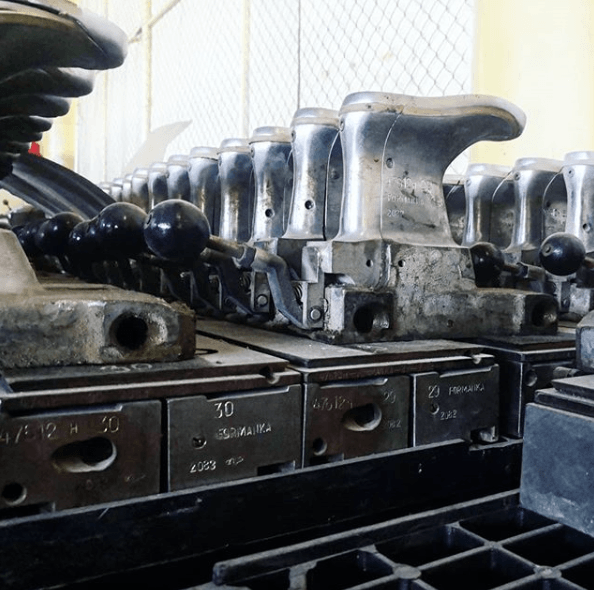
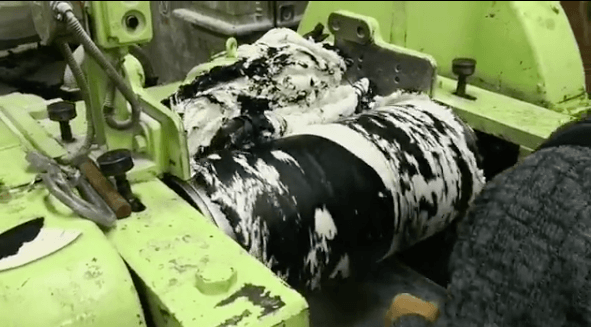
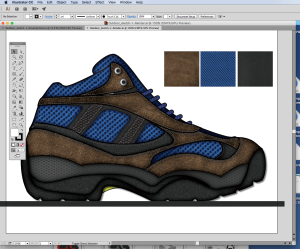
With your designs in hand, it is now time to find a factory…right? Wrong. With your new shoe designs in hand, take some time to show them around. Let your friends and family have a look, show them to your neighbors. This can give you some new insight and confidence to move forward. Most of all, when you show your designs, you will be practicing your sales pitch. This is a great time to have some people in the industry take a look. Try a local shoe store manager. If you have any contacts in the shoe business, go ahead, talk to them, and collect feedback.
Once you have your sales pitch polished, you are going to need working capital to get started. Shoe factories, agents, tooling shops, airlines, material suppliers, and shipping companies will require payment, in some cases, in advance of services. Make sure you have capital available. We will review capital requirements a bit later, but you need to be prepared to raise some. You will need to pull together a detailed business plan to show that you are ready to build and operate a business.
Are you ready to look for a shoe factory?
The shoe factory salespeople will be working hard to “qualify” you. They want to make sure you are serious and that there is potential in your project and potential in YOU! Make sure your sales pitch and business plans are complete before you start meeting with the factories.
Factory meeting checklist
Going into a meeting with confidence in yourself and a polished business plan will help you to present the professional image you want to project for your company. Make sure to have the following information:
1. Project Brief: A list of exactly what you want to accomplish. How many styles and colors, etc. 2. Designs: Complete detailed drawings with all colors, materials, and constructions. 3. Outsole designs: Must be complete in 2D drawing form. 4. Pricing: Target FOB, wholesale, and retail prices must be calculated. 5. Schedule: Dates for your retail release schedule. 6. Capital: Estimated capital requirements and a plan for raising it.
Finding a factory to make your shoes?
The real truth is that finding a factory for a new shoe project may be very difficult. If you are new to the shoe trade and don’t have any personal connections, it will be hard to find a factory that will accept your project. But don’t worry, there are a few strategies you can follow to get your project placed in the right factory.
Learn more about footwear sourcing:
Start reading today! How to Start Your Own Shoe Company Learn more about: Shoe designer contacts, internet searches for shoe factories, footwear agents, and footwear trading companies. Working with a footwear agent and The “right” shoe factory for your project. Shopping for a quality factory. What factory size is best for your shoes? Do factories help start-up brands?
There are hundreds, even thousands, of shoe brands in operation. Why start a shoe brand? Should you really follow your dream to start your own shoe company? The answer is…YES, you should!
If you have a fresh outlook and a way to solve a problem in an original way, read on! The world needs new companies, new ideas, and new personalities to face new challenges in unique and creative ways.
There is always a place for a new shoe company to get started. The billion dollar shoe brands must look for huge opportunities, leaving small brands free to serve niche markets. You can fill a special need or take a fashion risk. Go ahead and make something fresh!
What does a new shoe brand need to survive?
For your new shoe company to survive and thrive in the competitive world of shoes, you will need something special! Originality and uniqueness are a start. You will also need to package your uniqueness in a way that people can understand and appreciate.
What does your new shoe company bring?
Do you have an idea to improve the function of a shoe for a particular activity? Is there a better way to make a running, driving, logging, dancing, bowling or fencing shoe? If you have a fresh twist, go for it! Do you see an untapped market in a foreign country or in your own country? Or maybe you know a footwear buyer or a fashion store owner that has a special need?
Maybe you saw something while traveling that could be a hit at home? If you already own a business, maybe you are looking to expand? An open distribution channel is a good enough reason to make your own shoes. Let’s get started!
A new shoe idea
Having a great idea for a new shoe is a small part of what you will need to make a shoe company that will survive.
While you may want to focus on designing every detail of the shoes, you will need to spend more of your time on figuring out the supply chain, sales, marketing, distribution and financial arrangements that will turn your idea into a real functioning business.
This book will walk you through these challenges! How To Start Your Own Shoe Company is arranged in chronological order, following the shoemaking process from design, development, production and sales, on through marketing and distribution.
As you read you will learn how to design, source, market and sell your shoes.
Making your plans
Starting a new shoe company will be hard. You can expect to work long hours and late nights. You will meet challenges and you will need to make tough decisions.
We have done our best to explain the business requirements, detail the challenges, and describe your options. We hope you can make this journey with as few surprises as possible. If you have a good plan, you have a chance to succeed! Without a real plan, your shoe company may be doomed to fail.
Creating a shoe business plan
Creating a business plan for your new footwear company may seem like a daunting task. It will be hard to start a shoe brand but you can break your plan down into manageable parts. If you have partners, you may want to divide up the plan according to the expertise of each participant.
The master plan needs to cover:
Your brand identity Product plan Financial calculations Sales plan Distribution plan Marketing plan
How to Start A Shoe Brand: A Step-by-Step Guide
This book is for anyone with the dream of starting their own shoe company. You will follow the launch of two start-up shoe companies. Each has its own style of shoes and a business plan. In each chapter we will describe a requirement or process, then explain how each of our two new shoe brands will tackle this challenge. Learn More!
The short answer is “yes,” they do. The long answer is, it’s not easy. There is some irony to Nike’s ethical production issue, being that Nike takes all the heat from larger companies while they have one of the best records. In my personal experience making shoes in China (not for Nike), we purposely look for shoe factories that have ongoing Nike production.
Nike certified factories have better quality, better worker safety, Nike labor audits, etc. I worry more about the quality of the non-branded or off-brand shoe factories. Non-branded shoes are usually made by middlemen or agents who just don’t care. Now, I’m not saying the shoes you buy at Walmart are guaranteed to have come from a factory with ethical production problems, but I do know the Nike shoe will be from a better factory.
Shoe factory wages are based on local laws
Can we blame Nike for the wages paid to workers in their subcontracted factories in foreign countries? No. Blame yourself. As customers, we demand maximum value for our money, and Nike would soon be out of business if they were not competitive in the market. The wages paid in shoe factories are based on local laws. Nike is more likely to demand better working conditions over higher wages, and the best shoes are made by well paid, skilled workers, not minimum wage slaves!
Is slave labor used to make Nike shoes? No. You can’t make high-quality goods in substandard, abusive factories. It’s just not possible.
Is Nike making a huge profit from cheap labor?
Is Nike profiting off the backs of local workers? No. I’ve seen some blog postings that claim Nike makes $164.00 in profit from a $220.00 shoe. I’m sure they wish they did, but in reality, the profit is closer to $60 before marketing, etc.
Estimating Nike’s profit calculation
If we work the profit calculation backward from the $220.00 Nike MSRP sale price to the end-user this is what we get: The store buys the sneaker from Nike at around $110-$120. Expect Nike’s margin from the $110 sale price to the store to be 55%. That’s approximately $64 in margin dollars or profit from the sale. The shoe has cost Nike approximately $2 to ship, 20% import duty, another 8% or so for R&D expenses. In the end, Nike paid roughly $35.00 to the factory to buy each pair of shoes.
Of the $35.00 Nike paid to the factory, the factory profit is less than 10%. You can learn more about the profit margins, costing, duty calculations, etc. in our books How Shoes Are Made and How to Start Your Own Shoe Company.
Nike has strict requirements in its Code of Conduct prohibiting any type of forced, bonded, or indentured labor at supplier facilities. They know that such prohibitions by themselves are not enough; They also address key risks that collectively can contribute to a situation of forced labor.
At Nike, they believe they have a responsibility to conduct business in an ethical way. Nike expects the same from its suppliers, and focus on working with long-term, strategic suppliers that demonstrate a commitment to engaging their workers, providing safe working conditions and advancing environmental responsibility. This includes working to combat risks of forced labor, modern slavery, and human trafficking.
So, you ask yourself, “Can I start a shoe company?” Your next question should be “How do I start a shoe company?” What does it take to start a shoe brand? When we say, “start a shoe company,” we really mean a company that designs, markets, sources, and imports shoes. Not a factory that just makes shoes.
We think of Nike and Adidas as shoe companies but they don’t actually own the shoemaking equipment. Of the major athletic shoe companies, only New Balance owns its own shoe factories. In the case of New Balance, they also import some shoes from China and they import many shoe components from overseas.
Okay, what do you really need to get started with your shoe company?
How to create your own shoe design?
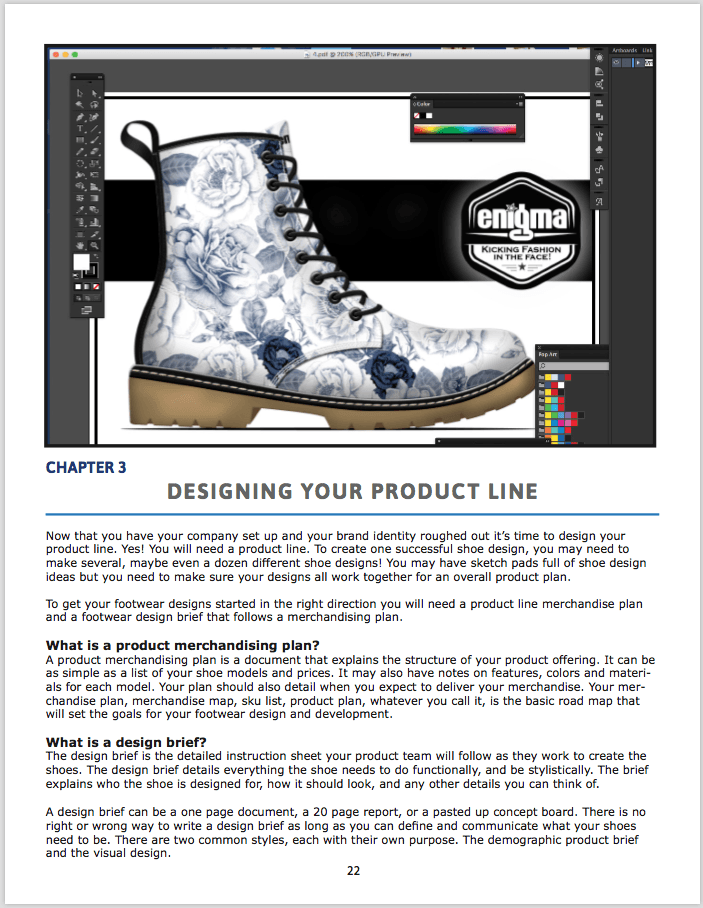
You will need something special, unique, and original to catch peoples attention. Billions of shoes get made, what makes yours better than the rest? Do you have designs or do you need to hire a designer to make one? You will also need clean shoe renderings that communicate your ideas to the factory, don’t be afraid to hire this out.
The shoe world has many designers for hire that can really bring your ideas to life, but without great designs, your new shoe company won’t go anywhere. Once you find a quality designer and plan out some great shoes, make sure to stand back and think about your brand. Does this shoe fit your brand and accomplish what you sought after when starting the design?
Sales and distribution plan for your new shoe brand:
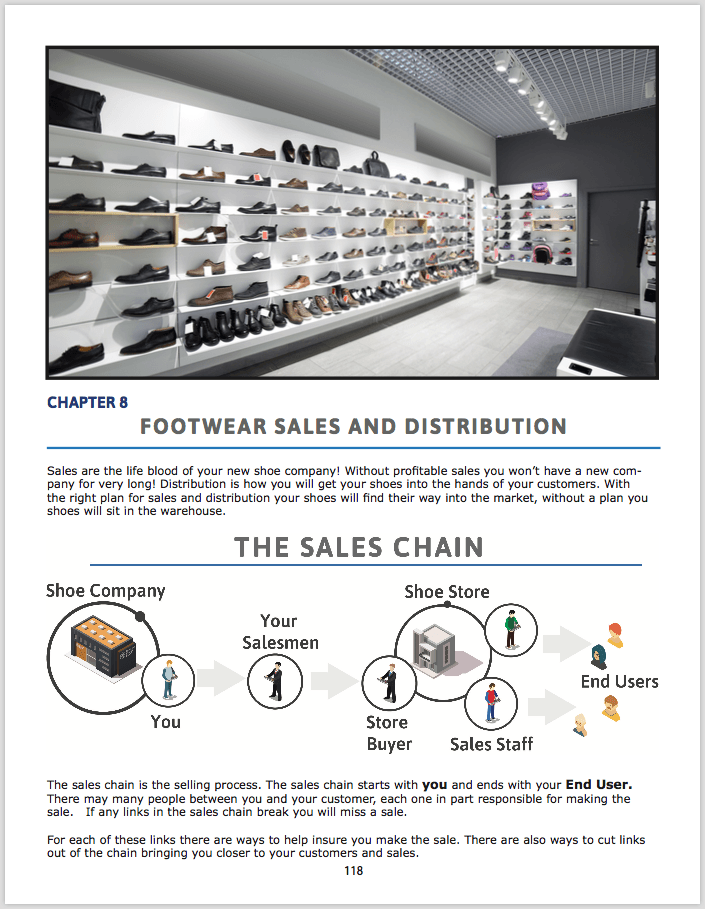
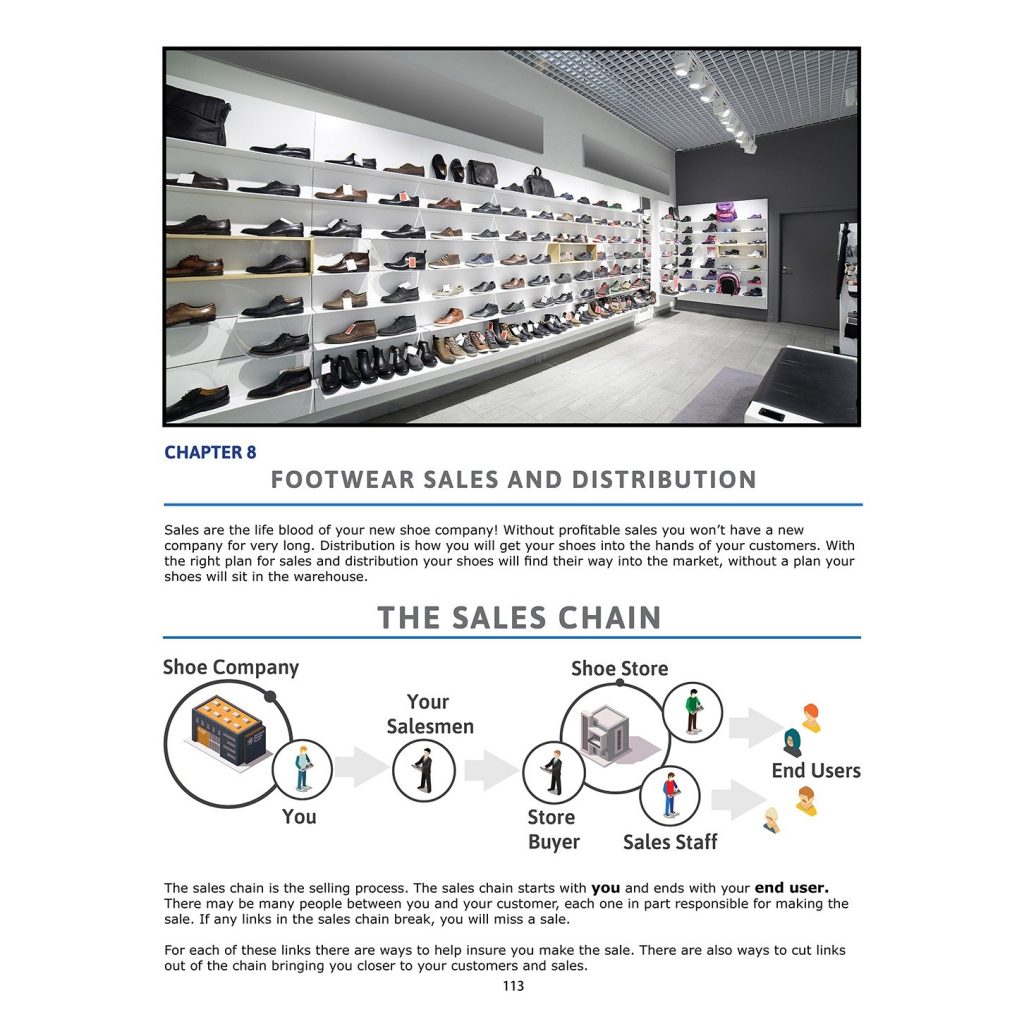
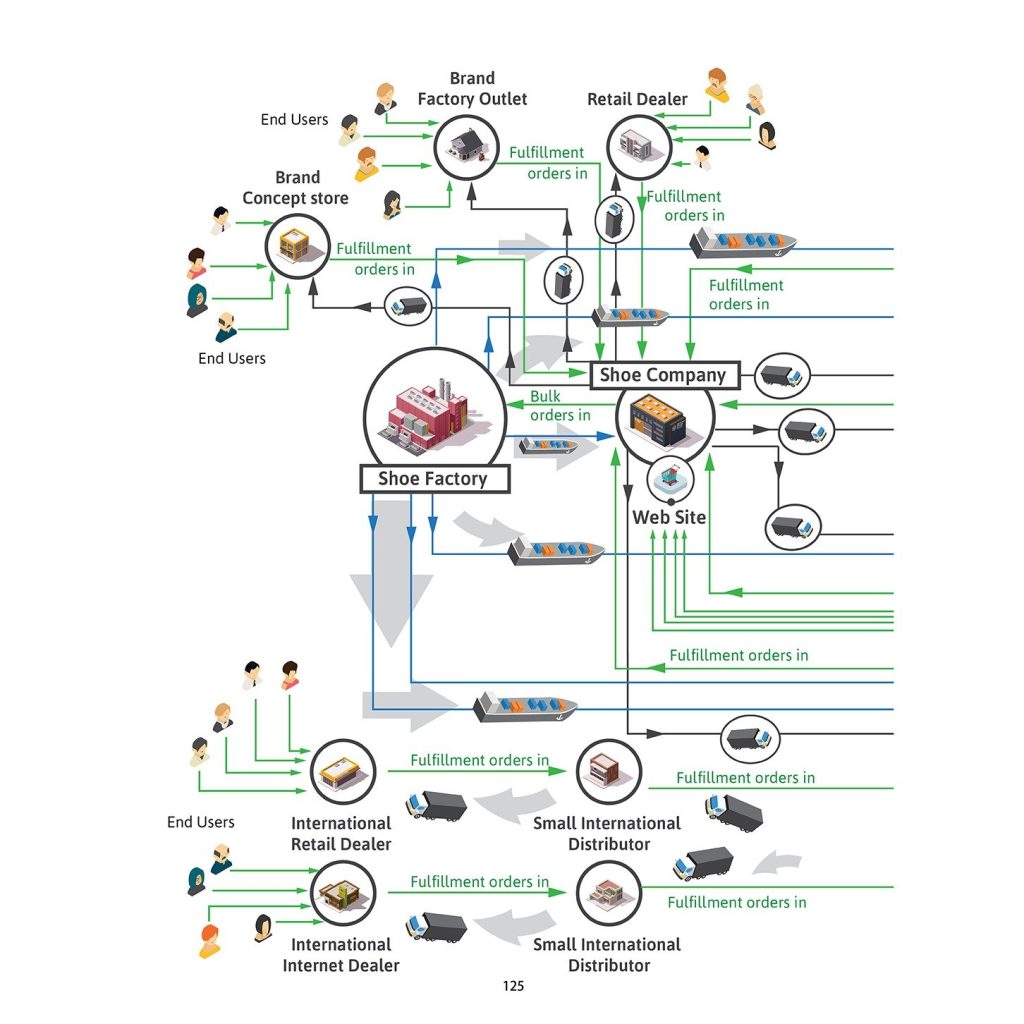
Making shoes is not the hardest part, finding customers for your shoes is! You need to have this figured out BEFORE you place a purchase order with the factory. The big shoe brands actually have orders in their hands for shoes before they produce the new models.
What is your intended selling market for your shoes?
Before you start a shoe company you need to know where the shoes are going and where the shoes will come from. Figuring this out may depend on the style of shoe or your marketing plan. Asia or Europe? Athletic shoes are almost always made in Asia. Leather shoes can be made in Asia, but high-end leather or “brown” shoes are made in Europe.
Who are your target customers?
Figure out who the end-users are for your shoes. Business executives? Punk rockers with tattoos? High school kids? Knowing your customer will let you set the price, look, and materials for your new shoe. What kind of shoe do you want to make? Casual, performance, fashion, or maybe something completely new!
Does your shoe brand have a name?
Based on your target customer it’s time to select a name for your shoe company. You will need to set up your shoe company by contacting your city hall to register your “DBA” or Doing Business As, which states the name of your company. Register your shoe company, get a vendors license, and a tax ID number. Don’t forget to check if your names are available on the web. If you can’t get a good website domain name that is close to your new shoes company’s name your customer may have a hard time finding you on the web! Remember, the shoe company name does not have to be the brand name. Many companies own several brands.
Research and more research on the footwear market:
Visit your target retailers and search online for the types of shoes your future competitors are selling and the prices they charge. Study the designs, logos, materials, and any features these shoes have. Ask yourself , “what will make my shoe brand unique?”
If you can’t answer this question, STOP. There are thousands of shoe companies, the world does not need another copycat brand!
Finding a footwear sourcing agent or shoe factory may be difficult. Search the web or ask me! There are many firms that can help you get started. Visit the major shoe trade shows. There is always an area set up with factories that are looking for new customers. The website http://www.alibaba.com/ can be a gold mine for finding factories.
Do you have any starting capital for your new footwear company?
Depending on what kind of shoes you plan to make, you are going to need a good bit of money to start. For the new brand getting started, you should expect to pay a minimum of 50% of the shoe price when you place your orders and 50% when the orders ship. Not to mention the tooling and development costs.
How much money will you need to get started on the first production order of shoes?
Do you need to hire a designer? This can cost $2,000 to $5,000 USD depending on the Scope of your Project. $4000 at least for travel to Asia or Europe also needs to be factored in, and that’s only one trip! A basic shoe can cost nearly $20.00 per pair (shipping and import duty included). Minimum Order Quantity (MOQ) per one model/colorway is around 500 pairs. $20.00 x 500 = $10,000 for just one style/color, and should you order shoes by the container, it’s most efficient to fill one container at 6,000 pairs! This is without even thinking about the prices for lasts and tooling.
You can see it adds up fast! So, yes, you can start your own shoe brand, but don’t expect to do it by yourself. You are going to need lots of help! It’s a full-time job.
How much does the shoe development and pre-production phase cost?
The answer depends on the style of shoe you want to make. Leather wingtips with a leather bottom require very little tooling. A fancy high tech basketball shoe with molded parts may be $10,000 per each size of outsole, midsole, welding, and emboss tooling. Then multiply that number by 12 sizes. Big bucks! Before you start a shoe company you need to think about where the money will come from.
Keep in mind that shoe factories need volume to make money. Small orders just can’t cover the time and expense of development. The development process for a 500 pair order is the same as for a 25,000 pair order.
Order minimums are based on the material minimums. Minimum order quantity (MOQ) for a material like suede leather may be 1000 sq feet. This is enough leather to make about 500 pairs.
How many pairs of shoes are made each day?
For each new shoe, many workers need to be trained on how to make it. A 500 pair order is finished within a day of work for a stitching line. For a basic sneaker, a smoothly running line can make 1500 to 2000 pairs a day. Those 500 pairs you spent a long time designing and ordering will be made before lunch. A big factory will agree to make small orders for an important customer. I’ve worked for companies that produce 5 million pairs a year, so if we asked the factory to make a small order they would do it as a service, but generally, they seek to avoid small orders.
Now, some factories will make small orders. They have smaller operations but will charge more. Materials will have to be bought from the local market and tooling will have to be “open” molds – you won’t have a great selection.
How much do shoe development samples cost?
For a shoe factory, every new customer has a chance to be the next Nike or the next flop. The factory sales manager has the task to figure out which you will be. Is your company new, or an existing company that already sells shoes or clothing? An established shoe brand will have no trouble getting samples made for free. The pattern development could be free, but tooling will always be billed. A sample tool could cost $1500 for a rubber sole to $5000 for a rubber and EVA midsole. A newcomer may need to buy samples. Again, each factory has a different policy. You could expect to pay 200% of the real FOB price plus all shipping charges for a sample. So if a basic shoe is $15 the sample would be $30, shipping could be another $50.
So, you ask yourself, “Can I start a shoe company?” Your next question should be “How do I start a shoe company?” What does it take to start a shoe brand? When we say, “start a shoe company,” we really mean a company that designs, markets, sources, and imports shoes. Not a factory that just makes shoes.
We think of Nike and Adidas as shoe companies but they don’t actually own the shoemaking equipment. Of the major athletic shoe companies, only New Balance owns its own shoe factories. In the case of New Balance, they also import some shoes from China and they import many shoe components from overseas.
Okay, what do you really need to get started with your shoe company?
How to create your own shoe design?
You will need something special, unique, and original to catch peoples attention. Billions of shoes get made, what makes yours better than the rest? Do you have designs or do you need to hire a designer to make one? You will also need clean shoe renderings that communicate your ideas to the factory, don’t be afraid to hire this out.
The shoe world has many designers for hire that can really bring your ideas to life, but without great designs, your new shoe company won’t go anywhere. Once you find a quality designer and plan out some great shoes, make sure to stand back and think about your brand. Does this shoe fit your brand and accomplish what you sought after when starting the design?
Sales and distribution plan for your new shoe brand:
Making shoes is not the hardest part, finding customers for your shoes is! You need to have this figured out BEFORE you place a purchase order with the factory. The big shoe brands actually have orders in their hands for shoes before they produce the new models.
What is your intended selling market for your shoes?
Before you start a shoe company you need to know where the shoes are going and where the shoes will come from. Figuring this out may depend on the style of shoe or your marketing plan. Asia or Europe? Athletic shoes are almost always made in Asia. Leather shoes can be made in Asia, but high-end leather or “brown” shoes are made in Europe.
Who are your target customers?
Figure out who the end-users are for your shoes. Business executives? Punk rockers with tattoos? High school kids? Knowing your customer will let you set the price, look, and materials for your new shoe. What kind of shoe do you want to make? Casual, performance, fashion, or maybe something completely new!
Does your shoe brand have a name?
Based on your target customer it’s time to select a name for your shoe company. You will need to set up your shoe company by contacting your city hall to register your “DBA” or Doing Business As, which states the name of your company. Register your shoe company, get a vendors license, and a tax ID number. Don’t forget to check if your names are available on the web. If you can’t get a good website domain name that is close to your new shoes company’s name your customer may have a hard time finding you on the web! Remember, the shoe company name does not have to be the brand name. Many companies own several brands.
Research and more research on the footwear market:
Visit your target retailers and search online for the types of shoes your future competitors are selling and the prices they charge. Study the designs, logos, materials, and any features these shoes have. Ask yourself , “what will make my shoe brand unique?”
If you can’t answer this question, STOP. There are thousands of shoe companies, the world does not need another copycat brand!
Finding a footwear sourcing agent or shoe factory may be difficult. Search the web or ask me! There are many firms that can help you get started. Visit the major shoe trade shows. There is always an area set up with factories that are looking for new customers. The website http://www.alibaba.com/ can be a gold mine for finding factories.
Do you have any starting capital for your new footwear company?
Depending on what kind of shoes you plan to make, you are going to need a good bit of money to start. For the new brand getting started, you should expect to pay a minimum of 50% of the shoe price when you place your orders and 50% when the orders ship. Not to mention the tooling and development costs.
How much money will you need to get started on the first production order of shoes?
Do you need to hire a designer? This can cost $2,000 to $5,000 USD depending on the Scope of your Project. $4000 at least for travel to Asia or Europe also needs to be factored in, and that’s only one trip! A basic shoe can cost nearly $20.00 per pair (shipping and import duty included). Minimum Order Quantity (MOQ) per one model/colorway is around 500 pairs. $20.00 x 500 = $10,000 for just one style/color, and should you order shoes by the container, it’s most efficient to fill one container at 6,000 pairs! This is without even thinking about the prices for lasts and tooling.
You can see it adds up fast! So, yes, you can start your own shoe brand, but don’t expect to do it by yourself. You are going to need lots of help! It’s a full-time job.
How much does the shoe development and pre-production phase cost?
The answer depends on the style of shoe you want to make. Leather wingtips with a leather bottom require very little tooling. A fancy high tech basketball shoe with molded parts may be $10,000 per each size of outsole, midsole, welding, and emboss tooling. Then multiply that number by 12 sizes. Big bucks! Before you start a shoe company you need to think about where the money will come from.
Keep in mind that shoe factories need volume to make money. Small orders just can’t cover the time and expense of development. The development process for a 500 pair order is the same as for a 25,000 pair order.
Order minimums are based on the material minimums. Minimum order quantity (MOQ) for a material like suede leather may be 1000 sq feet. This is enough leather to make about 500 pairs.
How many pairs of shoes are made each day?
For each new shoe, many workers need to be trained on how to make it. A 500 pair order is finished within a day of work for a stitching line. For a basic sneaker, a smoothly running line can make 1500 to 2000 pairs a day. Those 500 pairs you spent a long time designing and ordering will be made before lunch. A big factory will agree to make small orders for an important customer. I’ve worked for companies that produce 5 million pairs a year, so if we asked the factory to make a small order they would do it as a service, but generally, they seek to avoid small orders.
Now, some factories will make small orders. They have smaller operations but will charge more. Materials will have to be bought from the local market and tooling will have to be “open” molds – you won’t have a great selection.
How much do shoe development samples cost?
For a shoe factory, every new customer has a chance to be the next Nike or the next flop. The factory sales manager has the task to figure out which you will be. Is your company new, or an existing company that already sells shoes or clothing? An established shoe brand will have no trouble getting samples made for free. The pattern development could be free, but tooling will always be billed. A sample tool could cost $1500 for a rubber sole to $5000 for a rubber and EVA midsole. A newcomer may need to buy samples. Again, each factory has a different policy. You could expect to pay 200% of the real FOB price plus all shipping charges for a sample. So if a basic shoe is $15 the sample would be $30, shipping could be another $50.
A new shoe start-up is about to be born! You finished your shoe designs, you identified your target market, and your footwear marketing plan is complete! Now, all you need to launch your start-up shoe company is money. Unless you are wealthy, you are going to need seed money or investors to get your start-up footwear brand running.
STOP! Before you go looking for investors, there are a few critical steps you must consider.
Build your business and brand.
Before you look for investors for your new shoe company, you need to know HOW MUCH capital you will need and WHEN you will need it. The book, How to Start Your Own Shoe Company, Chapter 6: STARTUP COSTS AND RAISING CAPITAL, explains the first year finances for a shoe startup.
How to Start Your Own Shoe Company will help you to determine how much capital you will need to get started and what you will be spending it on. You will learn about footwear tooling costs, the capital calendar, product costs, development expenses, and shipping rates.
Keep your new shoe brand off the financial rocks!
Many footwear startups struggle to grow due to lack of capital. Where can you get seed money? From your family? A bank, crowdfunding, partners, or angel investors? If you borrow too much from the wrong person you may lose control of your shoe company just about the time you are ready to go big.
Don’t be tempted to offer shares or a percentage for startup services. The 10% you offer a shoe designer could turn into a million dollars if you are successful! That same 10% could ruin any plans for future investors or buyouts.
Every young footwear entrepreneur wants their startup shoe brand to be the next AllBirds, Rothy’s, or Tamara Mellon. With careful capital planning and research, you can put your new footwear company on stable financial footing from your first step!
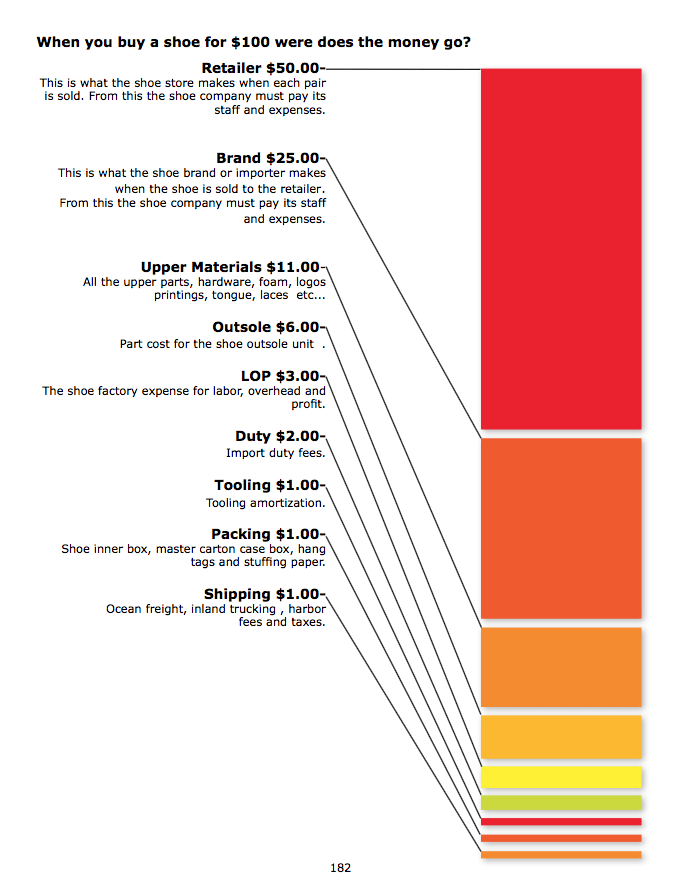
Come on, how much does it really cost to make a pair of sneakers? Nike must be making big bucks on those flashy sneakers. Why does it cost $100.00 to buy a shoe? What’s the actual cost of a sneaker? Here is how shoe pricing really works.
If you are looking for information about the costs to design, develop and build shoes READ MORE HERE
The cost to make a pair sneakers
Starting with a basic sneaker: US retail price $70.00.
The retail store buys the shoe from the shoe brand in bulk at the wholesale price, which is about $35. If this is a big retailer they may get a 3-5% discount or free freight.
There it is! BAM! The retail store takes 50% of the price right away. But, then they have to pay the employees, keep the lights on, advertise, and pay the rent. The store may also have to put the last few pairs on sale. If the shoe is a slow seller, many of them may go on sale. When you see a “40% off sale” that means the store is not making any money, in fact, after covering the overhead, it is a loss for the store.
Okay, what share does a shoe brand like Nike get? Remember, the shoe brand does not actually own the shoe factory. Of all the major sneaker brands, only New Balance has its own shoe factory. So, what did the brand pay for that $70.00 shoe?
The real cost to make a $70.00 shoe is about $15.00. Once the brand buys the shoe from the factory, the shoe needs to be shipped. Most shoes are shipped by ocean freight. Ocean freight from China to the USA is about $.50 per pair. A 40-foot shipping container, the size of a semi-truck trailer, holds about 5000 pairs of shoes. 5000 X $.50 = $2500.00
That price will get a shipping container from China to California.
Once the shoe arrives in the USA it must be legally imported. In the case of a leather sneaker, the US government requires an import duty of 8.5% of the F.O.B. price. So, add $1.32 to the cost. Also, add another $.32 for customs and insurance.
Now the shoe is in the warehouse: $15.00 + $.50 + $1.32 + .32 = $17.10
What is the shoe store profit?
Next, it’s time to sell it to the stores: $35.00 wholesale price – $17.10 = profit of $17.90
Actually, the profit is less than $17.90. The salesman gets a commission based on the wholesale price, usually about 7%. That’s about $2.45 on a $35.00 dollar shoe.
Now the profit is down to only $15.45 per pair.
But wait, what if this is a big retailer that negotiated a 5% discount? Take off another $1.75 to make the total profit about $13.70.
Of course, from that $13.70 the shoe brand has to pay the designers, product managers, developers, sales managers, marketing managers, advertisers, athletes, etc…
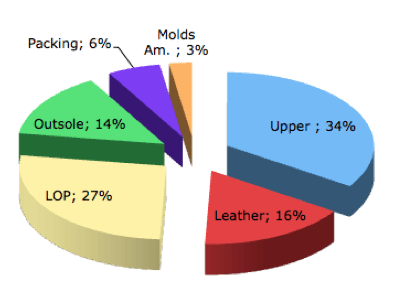
So, what makes a shoe cost $15.00? You need to know the anatomy of the shoe. Here is a rough break down of the cost to make a sneaker.
The cost of shoe parts
Shoe Upper 34%: All the upper parts, hardware, foam, logo printings, tongue, laces, etc…
Leather 16%: The leather outer of the shoe
LOP 27%: Labor, Overhead, and Profit
Outsole 14%: The shoe bottom unit
Packing 6%: Shoebox, case box, and hang tags
Mold Amortization 3%: If there is new tooling it can be paid to the factory per pair instead of buying the new molds all at once.
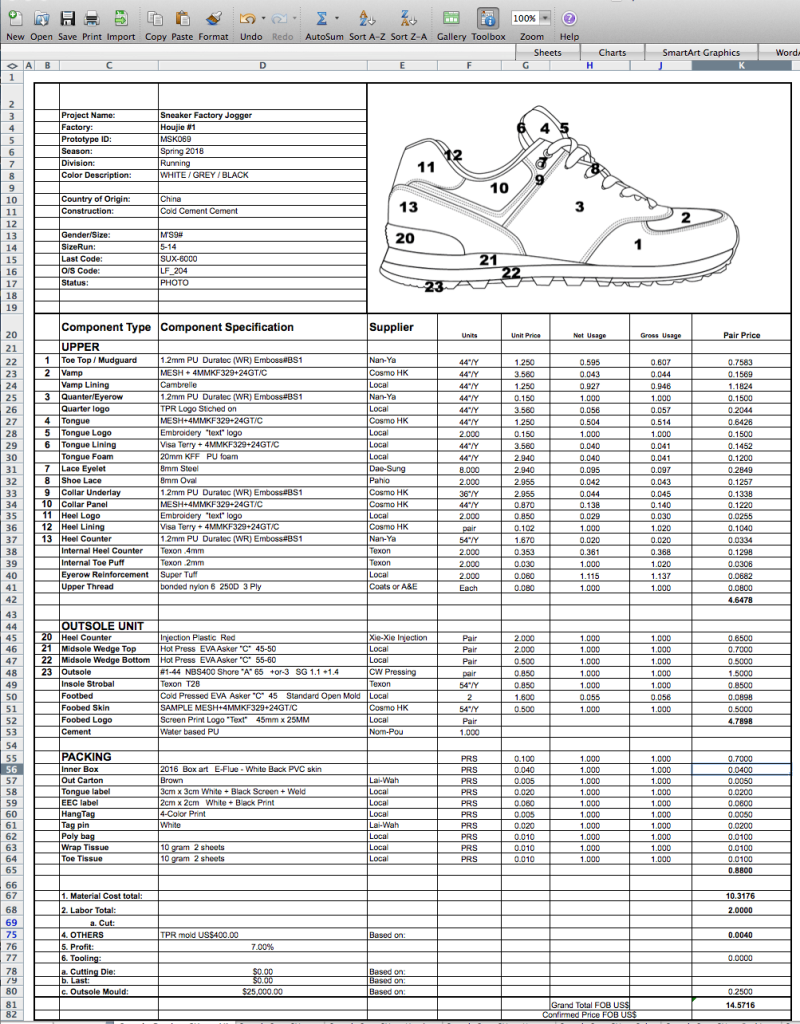
Once the shoe design is confirmed, the factory will take the specification sheets and detail the cost of each line item. This is the costing sheet.
The costing sheet will include every part of the shoe, including the packing box, stuffing paper, the silica gel pack, hang tags etc. Everything in the shoe box must be listed.
Each item will be listed with the cost per unit and the usage to make that part. The waste percentage will also be added. The waste percentage, or cutting loss, is the amount of scrap material left over once the parts are cut.
Yes! You have to pay for the scrap that is thrown away. For mesh fabric the loss is very small, less than 5%. But in the case of fine leather for an expensive shoe, the factory can’t use any leather with cuts or scars from the animal. The cutting loss can be up to 20%!
After listing the usage and waste percentage you will finally see the total cost per part.
With each part listed, the costing technicians can check the material price for each part and measure the material usage. This is time-consuming work, but if the production run is 500,000 pairs, pennies can add up fast. A diligent costing technician can save many thousands of dollars and more than their entire salary.
Shoe costing sheet
The shoe parts are listed on the left with a brief note of the material spec.
To the right side is the factory costing calculations per pair. In this case, the first component is the toe cap. It’s made of suede at a price of $1.25 per square foot.
The shoe requires .950 sq. foot to make the pair. When the leather is cut, 10% is lost to waste. The total for the pair of suede toe caps is $.8177. A costing sheet is a critical tool for the shoe developer and designer if they are designing a shoe to meet a price.
Start Your Shoemaking Career
Expand your skills and knowledge in modern shoe design, manufacturing, and sourcing with our online masterclass. We offer over 125 footwear lessons for all levels, taught by experienced professionals. Access 24 hours of on-demand video instruction and bonus materials including five shoemaking textbooks.
See Course Details
ALL ACCESS PASS
What shoe factory equipment do I need to open a real shoe factory? I’m going to walk you through a mass production shoe factory and detail all the shoe factory equipment you will need to do it right. If you are looking for hand tools for shoemaking click here.
I’m going to show you what you need to make a standard die-cut cold cemented sneaker. This is a simple shoe made with only die-cut parts. The outsole is a one-piece rubber cupsole with a die-cut midsole inside and channel stitching.
First, modern shoe manufacturing relies heavily on sub-contracted factories for many specialized operations. For example, the shoe factory technicians developed the outsole designs, but the outsole tooling is produced elsewhere, with the rubber parts also purchased somewhere else from a company that specializes in rubber pressing. The shoe factory then controls the components to ensure the uppers and outsoles all fit together correctly.
Shoe Material Cutting and Marking
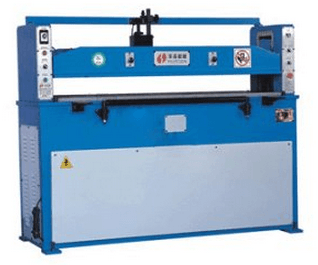
Inside the shoe factory, the first operations in the manufacturing process are the cutting and marking operations. The factory uses cutting presses, also called clicker cutting machines. The clicker press is one of the standard pieces you will see in every shoe factory, and they require cutting dies for each shoe pattern part.
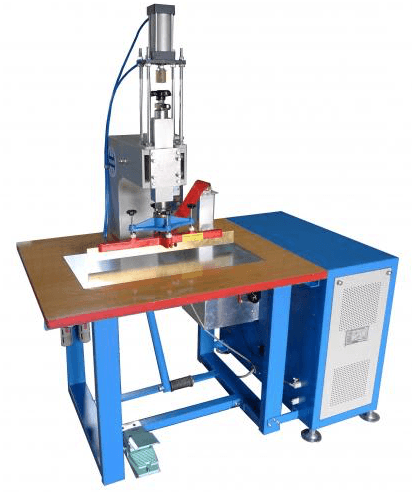
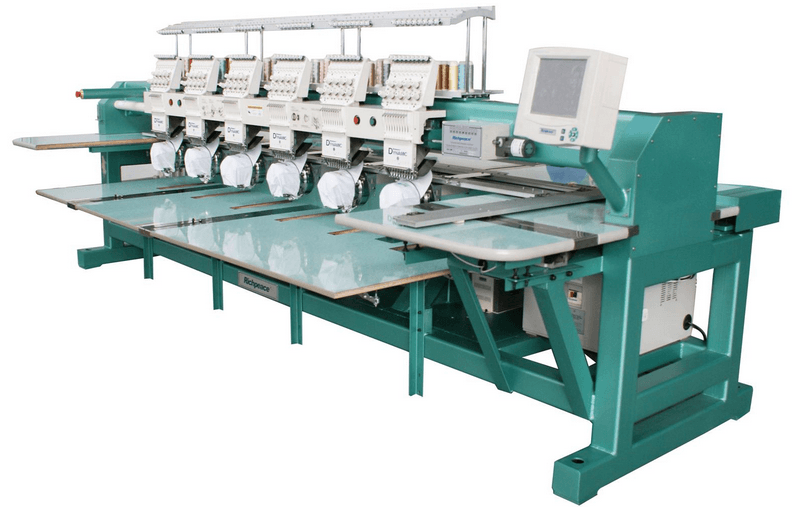
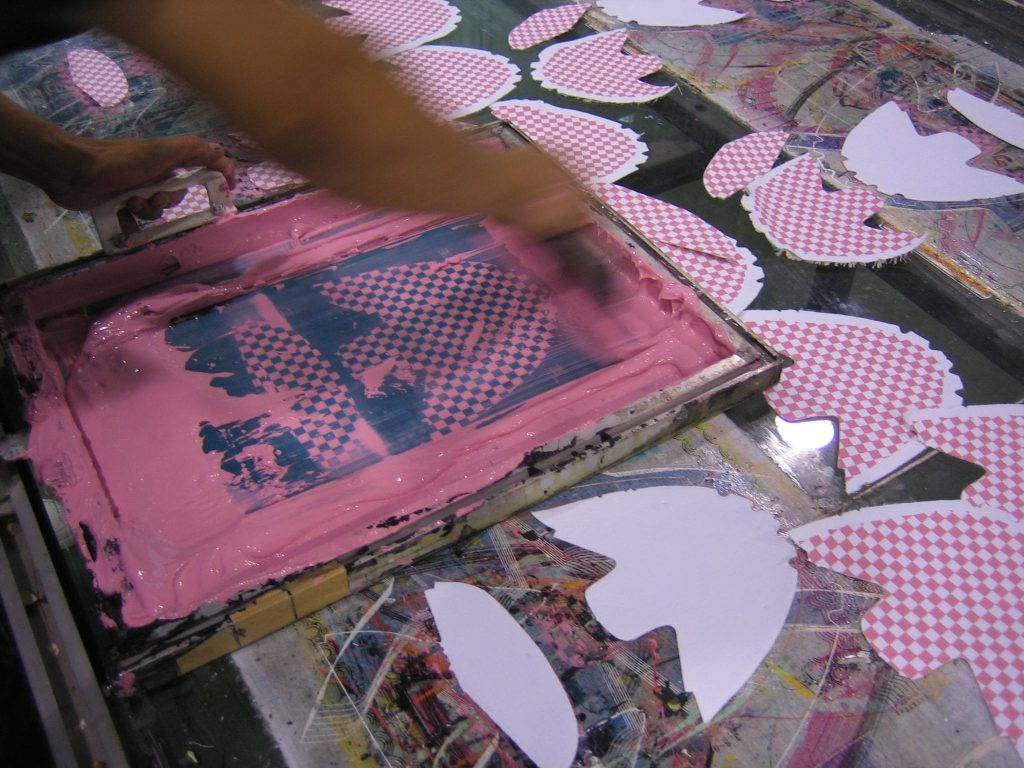
New technology for cutting is the computer-controlled drag knife cutter. These machines use a vacuum table to hold materials in place while the blade cuts all the pattern parts. This technology is critical for custom mass production. Once the shoe parts are cut they get processed, with alignment marks screen printed on the parts and any logos added. Logos can be silkscreen printed, radio frequency welded or embroidered on the cut parts.
Footwear logo application
After the shoe parts are cut and marked for assembly, they may need to have logos added. Logos are added by silk screen printings, embroidery, or heat welding.
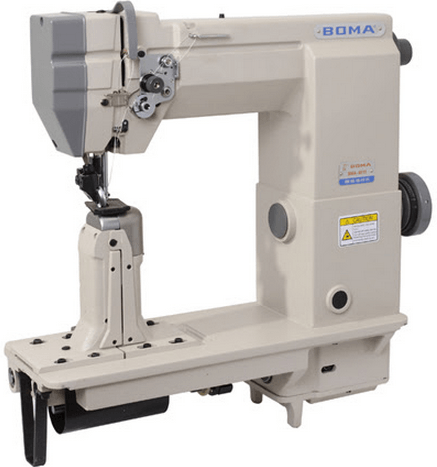
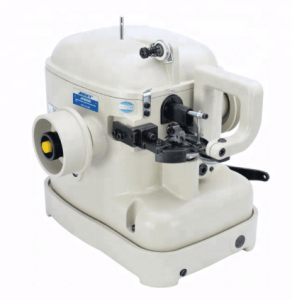
The sewing machines come in many types: post, long arm, short arm, etc. The stitching line will have hundreds of these machines, the amount depending on the complexity of the shoe design. The style of the machine will also change to fit the specific operations required to make each shoe design.
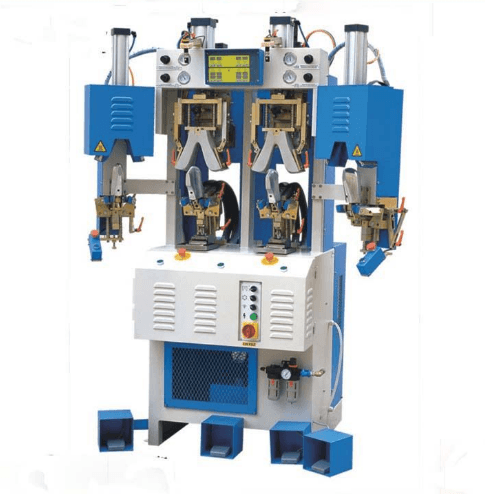
Once the stitching is finished, it is time to set the shape of the toe box and heel counters. These machines heat the thermoplastic counters inside the toe and heel, then clamp the shoe to set the shape.
With the upper almost complete, we will need a special sewing machine to finish it. The Strobel sewing machine was invented by a guy named…you guessed it… Strobel! This machine is used to sew the bottom fabric onto the upper, closing it. The fabric bottom or “sock” is marked with alignment lines to ensure the upper is straight and not twisted. Now the upper is ready for lasting and assembly.
With the shoe ready for assembly, it’s time to bring out the heavy equipment. The basic assembly line is about 100 yards long. On the front of the line, you will find a steamer to soften the shoe uppers, preparing them for lasting. The lasting machines are used to get the uppers pulled down tight onto the shoe lasts.
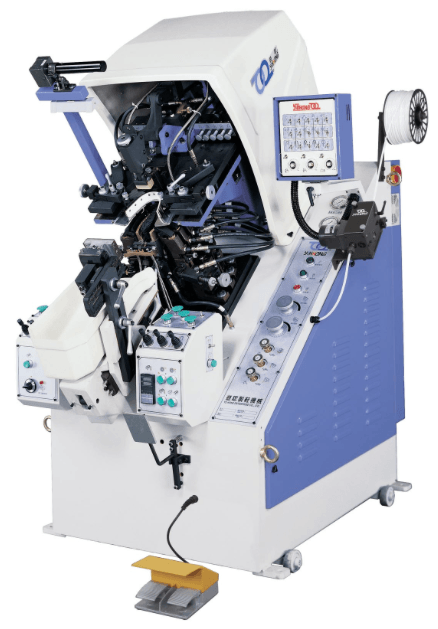
The toe-lasting machine is the centerpiece of the lasting equipment. This machine takes hold of the upper and physically pulls it down around the last. The machine simultaneously pulls the upper into place while injecting hot glue to fix the uppers into place on the last. Once the toe lasting is complete, the waist and heel of the shoe may also be pulled into place by either hand operation or machine processes. Following the lasting operations, the lasted upper is placed into the first of the tunnels on the line. These tunnels are cooling tunnels that shrink the upper down to adhere to the last even tighter.
Footwear Primer and Cement
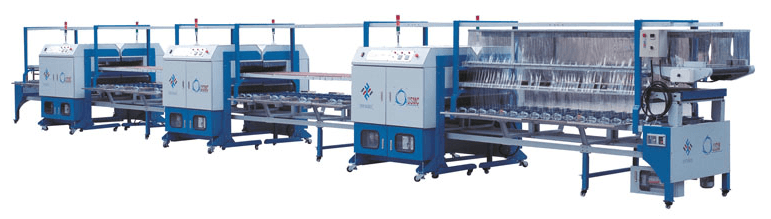
Now the lasted uppers and outsoles are on the conveyor line together, each receiving two coats each of primer and cement. After each application, the parts are placed back on the line to travel through a heat tunnel to dry the parts.
Once the parts are fully primed and covered with cement it is time to join the parts together. A worker takes the upper and sole in hand, fitting them together. Once the parts are fit, a pressing operation ensures the bonding surfaces are completely in contact.
Outsole pressing
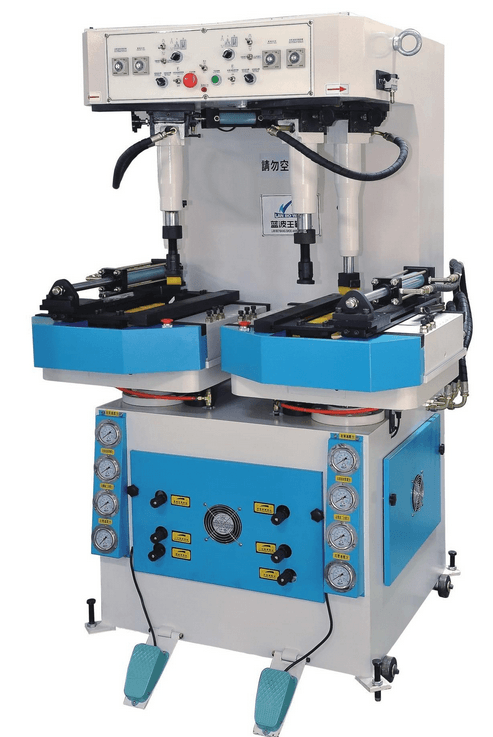
The pressing operation compresses the bottom, sides, and heel of the sole and upper together. To set the bond, the lasted upper with the bottom attached is often placed in a chiller unit. Once out of the chiller unit, the shoe is de-lasted by hand or by machine. Depending on the design of the shoe, there may be just a few operations left. A possible process is for a shoe to receive channel stitching from a special oversized sewing machine that can stitch through the rubber outsole and the entire upper.
Finally, the shoe may pass through a dryer oven and UV light tunnel to ensure there is no possibility of mold growth while the shoe is in transit.
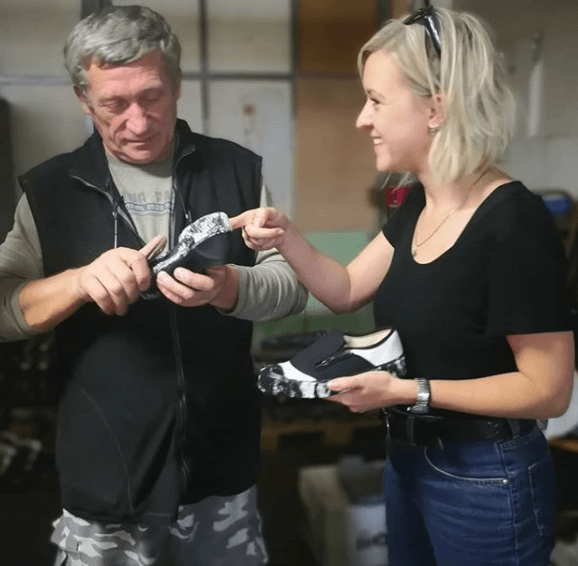
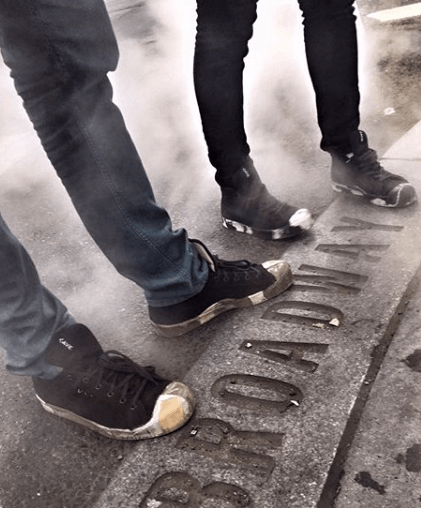
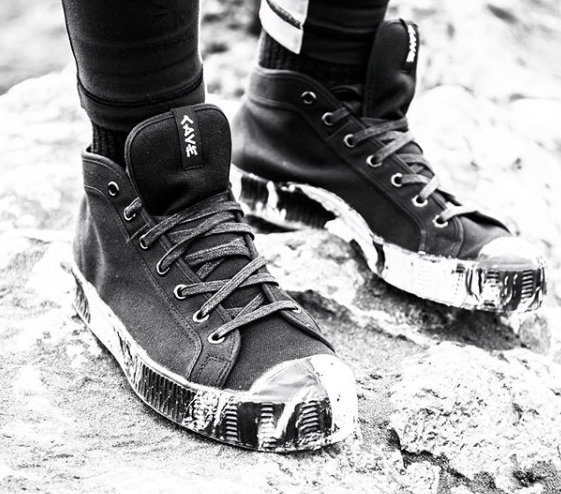
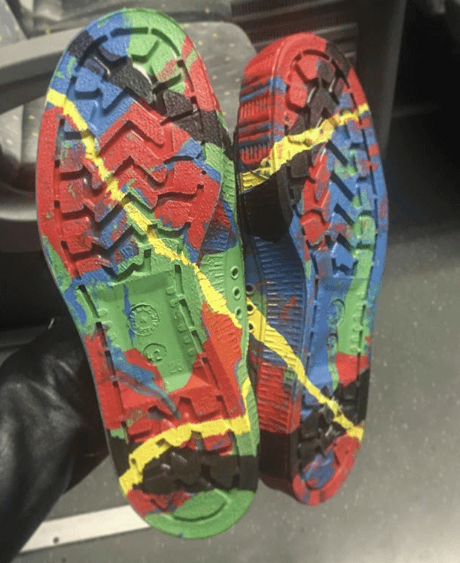
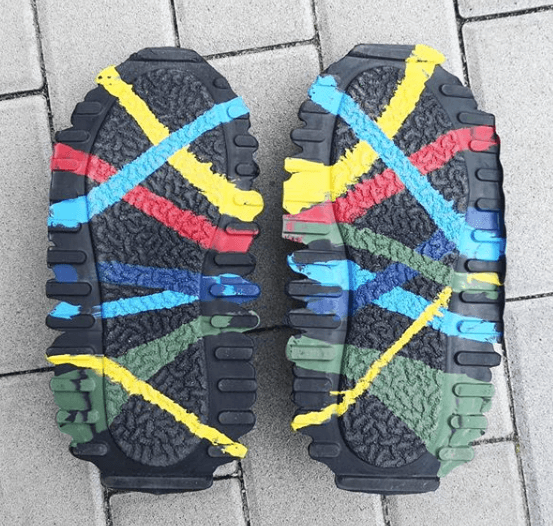
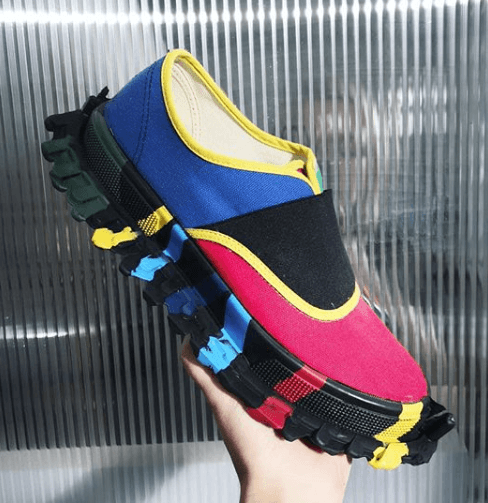
Today I want to introduce you to my friend Eva from the Czech Republic. She has created a remarkable new footwear brand that combines vintage shoe mass production technology with modern styling and adds a new twist to the eco friendly sustainability movement. Her brand is called Kave. The shoes are awesome, the classic vulcanized styles are retro cool, and Eva’s marketing reveals her unique and creative shoemaking personality! Check out Kave Footwear!
About Kave Footwear
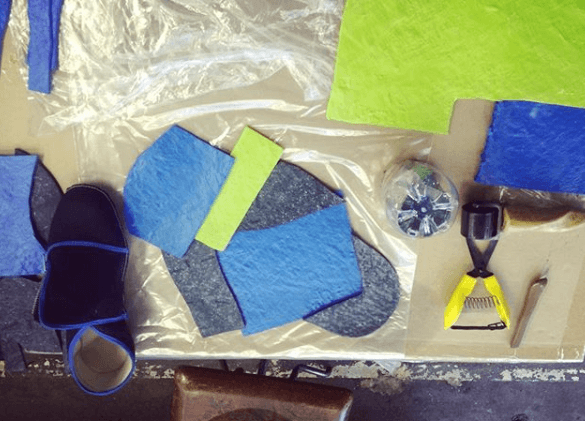
KAVE is a new creative platform that aims to change the footwear industry from the inside out by using only existing materials, tools and machinery to create fabulously surprising, yet wearable designs that have a much smaller ecological footprint.
Our world is filled with products that we don’t need but nevertheless we are still producing more and more. This is causing problems in society and nature. The start of new production requires a lot of energy, material and time. Lots of items are transported from various parts of the world and ecological footprint is growing. There are fully equipped factories all around the world so why create new equipment? Let’s use what we have in an innovative way. It is time to start thinking about design differently.
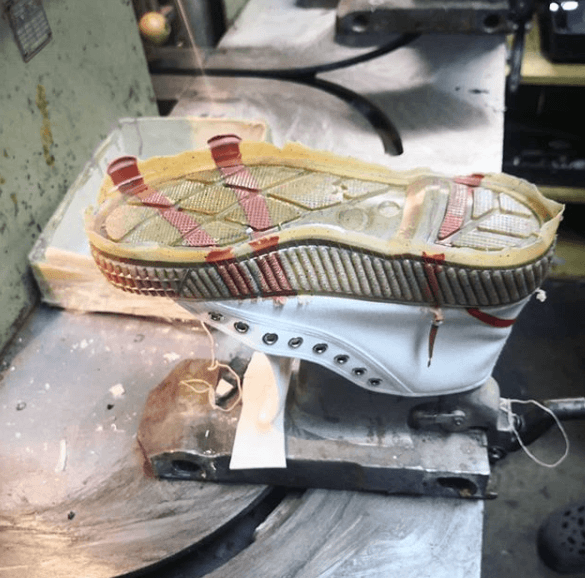
Vulcanized Construction
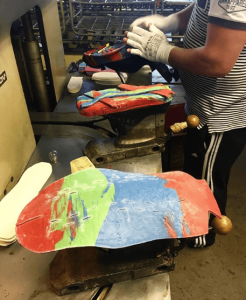
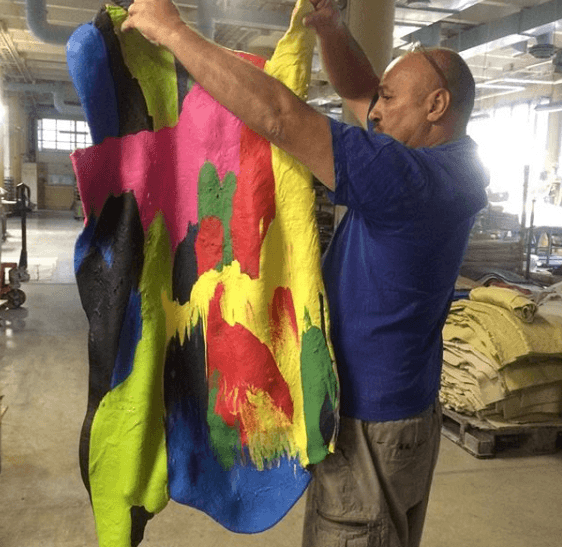
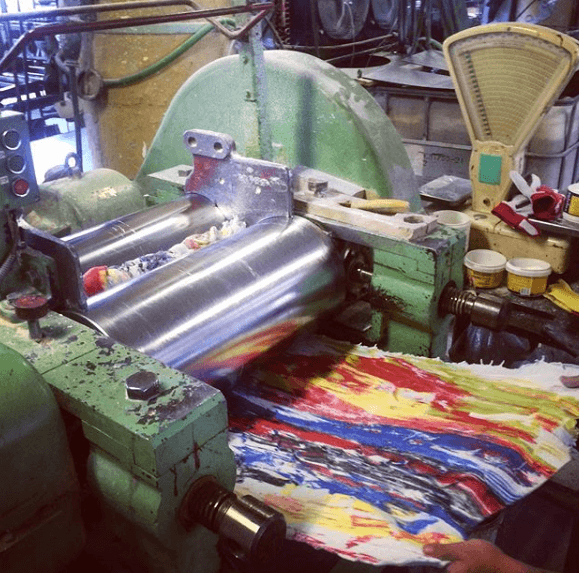
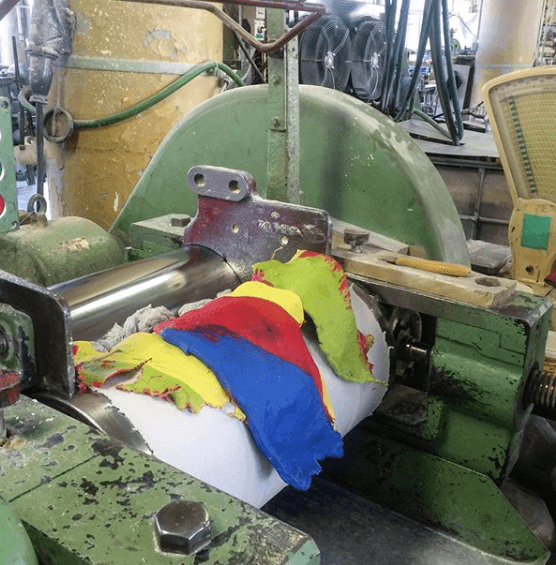
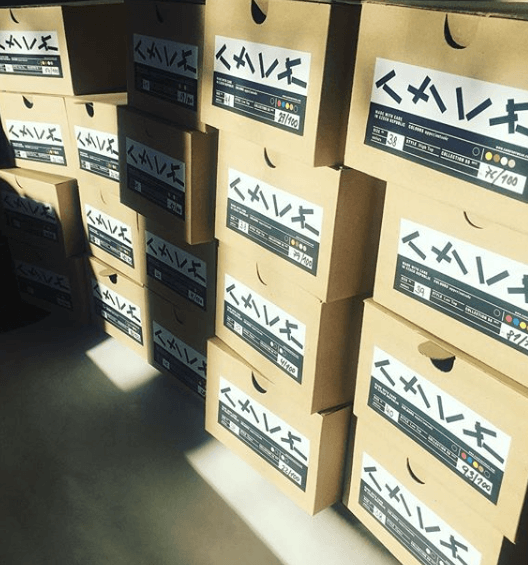
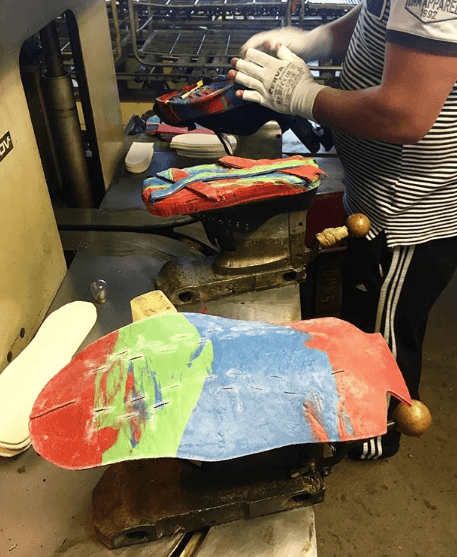
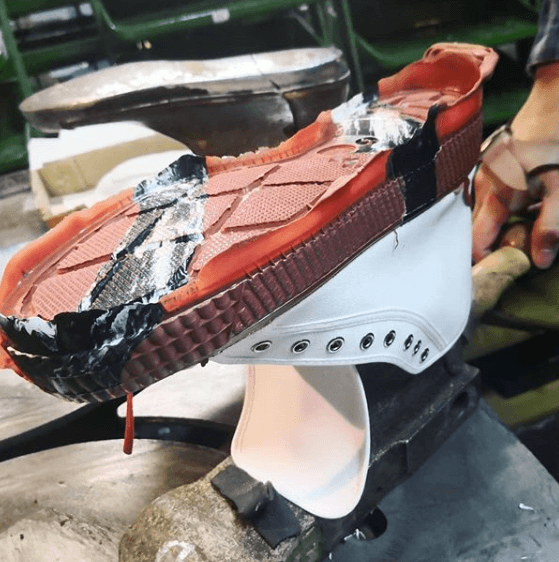
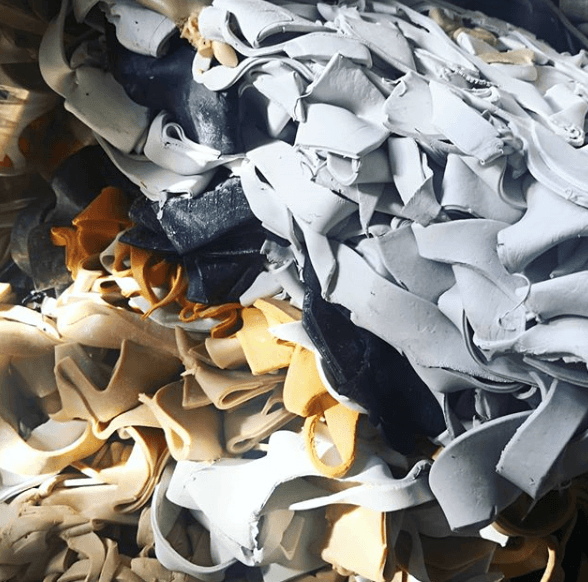
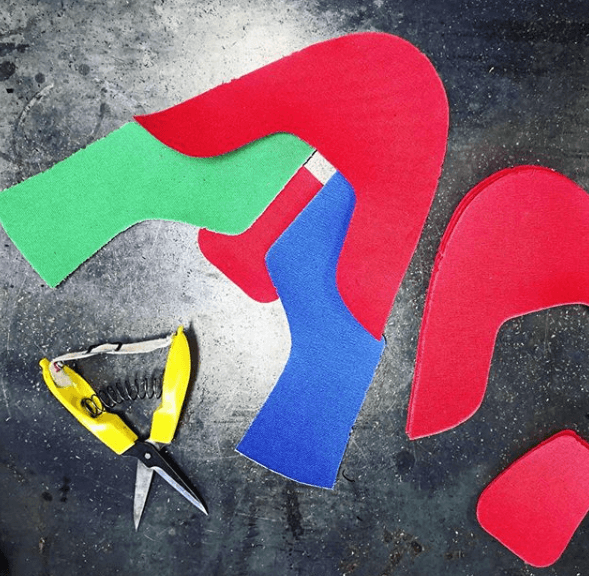
Kave shoes are made in small runs 100 pairs of each design. Each run is unique, based on the materials available in the factory when Eva arrives. The upper designs and colors are created on the fly with extra materials that would have normally been sent to a landfill. Kave is putting useless material leftovers to work by making functional fashionable footwear!
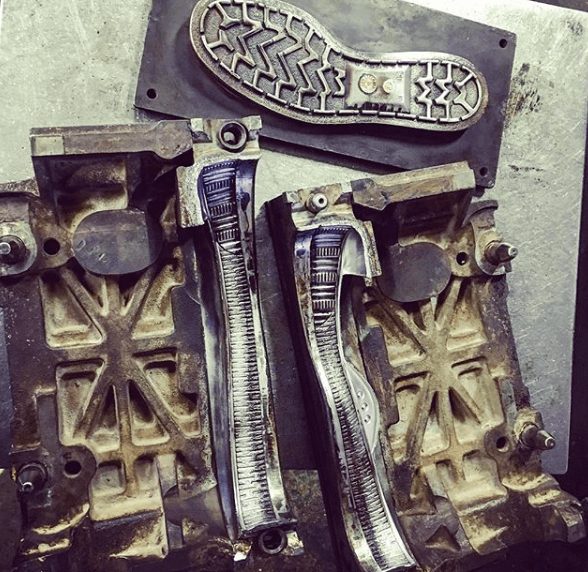
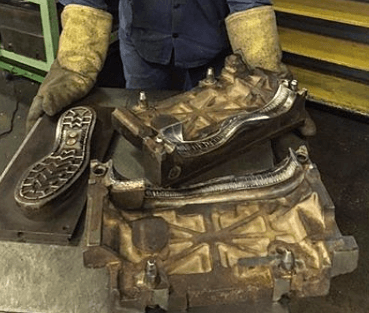
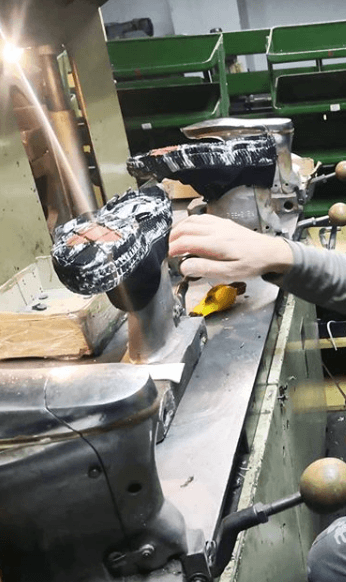
Kave footwear is made using a direct attach vulcanizing process. The uppers are prepared on a sturdy metal last, bottom up. The rubber sidewalls and bottom are laid on, then clamped in place with a three piece Metal mold. The mold is heated melting the rubber parts together. This is vulcanizing. The extra rubber is then trimmed away.
About Eva
Eva at work
Eva was born in Zlin in Czech Republic. Zlin is the town where the shoe making legend Tomas Bata built in those times the biggest shoe factory in Europe.
Eva’s grandparents worked in this factory their whole lives. She started studying design from tender age of 15. Out of all different sides of design, she found passion in shoes. She learned about their production when she worked as an intern in one of the companies within the Bata factory.
Later when Eva started studying and traveling abroad, with her experience from production in mind she realized the stark contrast between the senseless global movement of goods and the forgotten local production possibilities.
She decided to change this. Today she combines unusual design and traditional technology to create great quality shoes which challenge the view on global shoe production. Visit KaveFootwear.com
The Shoemakers Academy.com is pleased to announce reduced book and pro-pack shipping to Europe and the UK. Our publisher is now offering direct shipping from printing plants in Europe! At the Shoemakers Academy.com our goal is help educate shoemakers not profit off shipping charges. We are passing the shipping reduction directly to you!
Shipping cut from $22.50 to $12.00
Order directly from Shoemakers Academy.com or Amazon
With your designs in hand, it is now time to start manufacturing shoes…right? Wrong. With your new shoe designs in hand, take some time to show them around. Let your friends and family have a look, show them to your neighbors. This can give you some new insight and confidence to move forward. Most of all, when you show your designs, you will be practicing your sales pitch. This is a great time to have some industry people take a look. Try a local shoe store manager. If you have any contacts in the shoe business, go ahead and talk to them, and collect some feedback.
Once you have your sales pitch polished, you will need working capital to get started. Shoe factories, agents, tooling shops, airlines, material suppliers, and shipping companies all require payment, in some cases in advance of services. Make sure you have capital available. We will review capital requirements a bit later, but you need to be prepared to raise it. You will need to pull together a detailed business plan to show that you are ready to build and operate a business before you worry about manufacturing shoes.
Are you ready to look for a shoe factory?
The shoe factory salespeople will be working hard to “qualify” you. They want to make sure you are serious and that there is potential in your project and potential in YOU! Make sure your sales pitch and business plans are complete before you start meeting with the factories.
Shoe factory meeting checklist
Going into a meeting with confidence in yourself and a polished business plan will help you to present the professional image you want to project for your company. Manufacturing shoes is complicated you need to prepare. Make sure to have the following information:
1. Project Brief: A list of exactly what you want to accomplish. How many styles and colors etc.
2. Designs: Complete detailed drawings with all colors, materials, and constructions.
3. Outsole designs: Must be complete in 2D drawing form.
4. Pricing: You need to calculate Target FOB, wholesale and retail prices.
5. Schedule: Dates for your retail release schedule.
6. Capital: Estimated capital requirements and a plan for raising it.
Finding a factory to manufacture shoes?
The real truth is that finding a factory for a new shoe project may be very difficult. If you are new to the shoe trade and don’t have any personal connections, it will be hard to find a factory that will accept your project. But don’t worry, there are a few strategies you can follow to get your project placed in the right factory.
Designer contacts
If you selected an experienced shoe designer or footwear developer to work with, then he or she should have many contacts. In just a few years working in the shoe trade, a footwear designer may have worked for several different brands and a dozen different shoe factories.
Shoe designers and developers with some overseas experience will know footwear agents, trading companies, or people that know people. The shoe business is built on relationships and personal contacts. Shoe factories and material suppliers are always working together, and one contact can lead you to other contacts.
Internet searches
Google is not a bad place to start your search for a shoe factory. However, your average shoe factory in China or Italy may not have an easy-to-find website. If you are looking for a factory in China, you should head directly to Alibaba.com™. Alibaba has listings for thousands of factories. You can search by product, county, and province.
You will find dozens of listings, but beware, many are not actually factories. They are trading companies or agents. These firms are not necessarily bad, but you should dig deep into the listing to make sure you know what you are dealing with.
Business network and social media sites
Websites such as LinkedIn.com™, Coroflot.com™, Malakye.com™, or even Facebook.com™ can provide you with leads for footwear factories or footwear sourcing agents.
The shoemaking world is a huge network of friends, co-workers, associates, and acquaintances. One contact in the trade can lead you to another. Keep looking!
Footwear agents and shoe trading companies
Another way to find a factory is to NOT look for a factory, but instead look for a footwear agent or trading company that will present your project and help you find the right shoe factory.
Search engine research is not a bad place to start looking for an agent. Again, Alibaba.com™ is a great place to start your search. You will find there are many firms that list themselves as “trading” or “sourcing.” These firms will have many contacts. They may also offer quality control help or provide a review for a factory you may have found online. Most importantly, you need to make sure they have footwear experience. It pays to get references when shopping for an agent.
Working with a footwear agent
There are some basic terms you need to expect when working with agents.
You will need to sign confidentiality agreements. Your agent will protect your project from the eyes of competitors. A busy agent may be working with several shoe brands, and may even be working with your competitors.
Sample delivery charges will be your responsibility. FedEx and UPS bills are not cheap for shoes shipping from Asia to the USA or Europe. Plan accordingly.
Costs for shoe outsoles or upper molds are expensive and must be paid for in advance.
The cost of your shoe samples must be paid before shipping from the factory.
Monthly product management or product development fees may be required, depending on the agent. Development costs may vary wildly, you should shop around.
The production minimum order quantity will vary from 500 to 6000 per style, and 500 to 1000 pairs per colorway. You can expect production lead times of 90 to 120 days. Then add time for shipping. For any new customer, the production shoes must be paid for in full before shipping.
Finding the right style factory to manufacture your shoes
You will need to find the right factory for your project. Most shoe factories have a particular expertise. The skills and equipment required to make sports shoes are very different from the skills and equipment required to produce women’s high heels or leather work boots.
A factory’s assembly line and equipment may be set up for cold cement or vulcanizing process but seldom both. A hiking boot factory will have equipment suited for cutting heavy leather and waterproof sealing, while a factory for snowboard boots will have oversized assembly line equipment suitable for tall boots.
There are factories that specialize in women’s fashion shoes, sandals, and men’s dress shoes. Each factory will have relationships with material suppliers and mold factories appropriate to their specific expertise.
Where will you find the factory for your shoes? The style of shoe you plan to make will help determine where in the world your shoes will be made. Athletic shoes are almost always made in Asia. The shoe factories in China, Vietnam, Indonesia, Korea, Taiwan, and Thailand have easy access to the labor and high tech materials required for modern athletic shoes. This type of shoe is generally not made in Europe.
High fashion leather shoes can be made in Asia but high end, high style, high-quality shoes are made in Europe.
Shoe factories in South America are very capable of making leather casual and fashion shoes. South American leather hides are exported to Asia and Europe for manufacturing shoes.
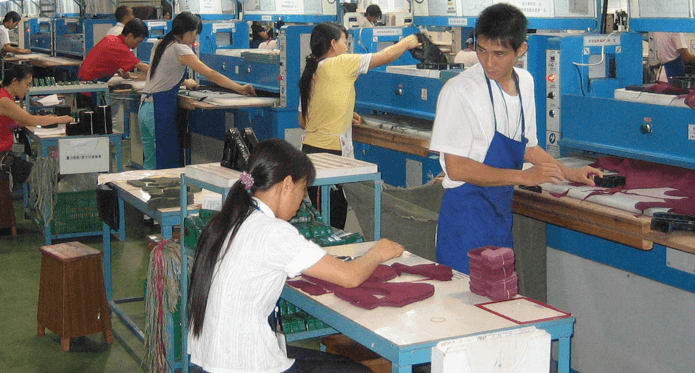
Shoe factories come in all sizes, from just one or two lines squeezed into a single story building, to huge 20 or 30 line factories that look more like a small town or college campus. In China, there are shoe factories with over 20,000 workers in one facility.
What factory size is best for your shoes?
Small factories may be hungry for orders but may lack the internal product development expertise to make complicated shoes. These factories may not have all the expensive machines that a monster factory will have, but the small factory will have an owner that you can meet. If you can build a personal relationship with the owner, you can get your project placed.
You might think that large shoe factories would ignore small brands but this is not always the case. While you may never meet the owners, and you may not get the most experienced technicians working on your project, large factories do support some small brands. The small brands may be served by junior staff members and may have to accept “fill in” or off-season production times, but you may find yourself sharing production space with Nike™ or another super brand.
Shopping for quality
The quality of product coming out of a shoe factory does not usually vary. If you are in a big factory with Nike™ shoes, great! You will be able to enjoy the same high-quality standards. Are you in a factory with “No Name” cut-price brands? Watch out!
When selecting a factory, one of your first questions to ask should be, “who else do you make shoes for?” If you don’t have a chance to visit the factory in person or cannot send a representative to walk the line, then your next bet is to look at what they make for other companies.
If they cannot send you a photo or won’t tell you any other brand names, you may need to look for a different factory.
Do factories help start-up brands?
Shoe factories need volume to make money. Small orders just can’t cover the time and expense of development. The development process for a 500 pair order is the same as a 25,000 pair order.
However, every new customer has a chance to be the next Nike™ or the next flop. The factory sales manager has to decide if your new company is a winner or a loser. Is your company new? Is your company an existing company that is already selling shoes or an existing clothing brand looking to expand into the shoe trade?
Shoe factories prefer to do business with established companies but new companies can get service if they approach a factory correctly. Factories are always looking for orders. With a successful funding platform campaign, like Kickstarter™, you may have orders in-hand when you approach a new factory. 1000 or 2000 pairs is not a big order but it will put you ahead of most other footwear start-ups.




 The short answer is “yes,” they do. The long answer is, it’s not easy. There is some irony to Nike’s ethical production issue, being that Nike takes all the heat from larger companies while they have one of the best records. In my personal experience making shoes in China (not for Nike), we purposely look for shoe factories that have ongoing Nike production.
 Can we blame Nike for the wages paid to workers in their subcontracted factories in foreign countries? No. Blame yourself. As customers, we demand maximum value for our money, and Nike would soon be out of business if they were not competitive in the market. The wages paid in shoe factories are based on local laws. Nike is more likely to demand better working conditions over higher wages, and the best shoes are made by well paid, skilled workers, not minimum wage slaves!
 Is slave labor used to make Nike shoes? No. You can’t make high-quality goods in substandard, abusive factories. It’s just not possible.