Posted on

The Designers Shoe Specification Drawings

shoe specification drawings

Footwear Design Tech Pack
tech pack for shoes
Product Specification For Shoes.

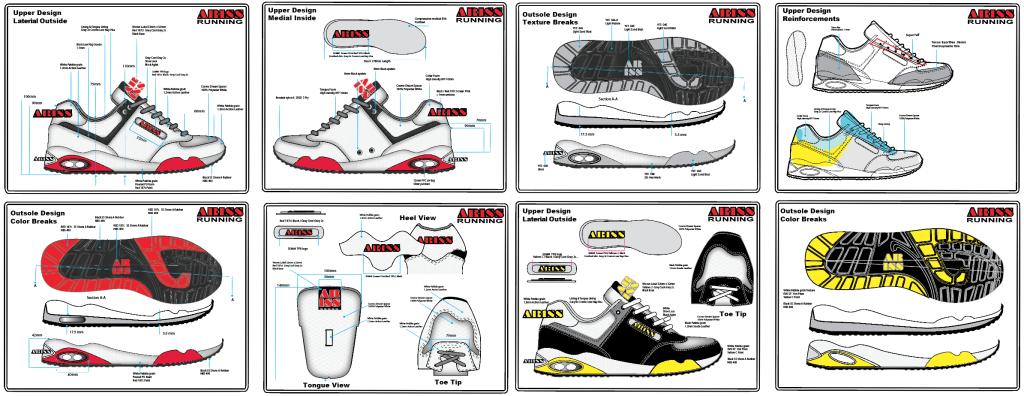
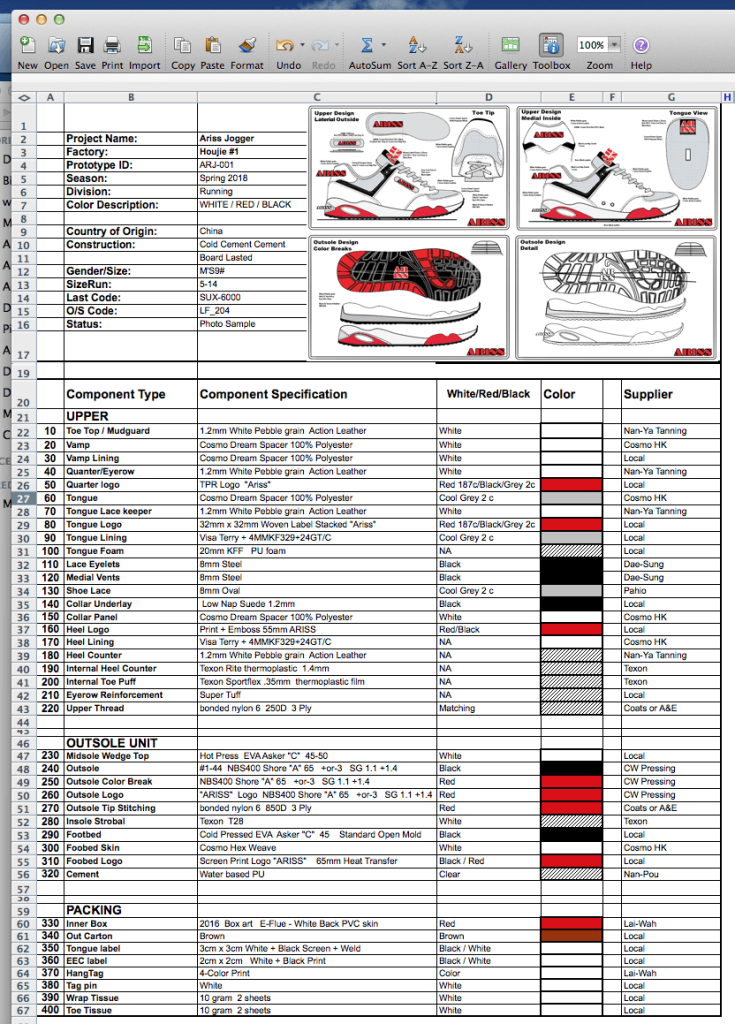
Once a new shoe design has been approved for development the shoe designer and developer will work together to create a detailed set of specification drawings or “tech pack” or  “specs”.   The shoe technical drawings may be done by the designer alone but often a developer will fill in the technical details.   These drawings and documents detail every part of the sneaker from the upper to the outsole bottom.  The line item specifications include the name of each part, the material, material vendor, thickness, and color reference.  The Spec includes the shoe last information, logo art, design details, emboss effects, etc.  The spec may also include sample shoes, material swatches, photos, or any other notes to help build the samples.  All of these items together make a complete footwear design tech pack.   You can see a complete line item shoe specification here.
shoe design tech pack
Spec sheet for Ariss Trainer .xls format download

The Spec drawings and line item spec may be e-mailed, sent by courier service, or hand-carried by the developer to the factory.  At this point in the process, the shoe developer is responsible for getting the sample sneakers built.

A complete shoe specification drawing will contain the following items:

Footwear design tech pack
Shoe Design Tech Pack

Lateral view (outside of the Shoe)
Medial View (inside of the shoe)
Heel View (view from the back)
Tongue View (showing any logo art)
Vamp View (looking down on the toe)
Detail views of any small plastic parts
Material Map of the upper
Color map of the first sample colorway to be made.
Outsole Side Profile
Outsole Bottom View
Outsole Top net View
Detailed view of injection parts
Cross-section view of the sole
Diagram of Internal parts
Diagram of Internal reinforcements
Color map showing future plans for color breaks


Shoe Specification Pack Download

This shoe specification drawing pack is all you need to get started detailing your own shoe designs. This footwear spec pack contains a technical specification drawing for a fully detailed shoe design, ready for your creative touch.  Upper views, outsole designs, material specs, colors. This is how a pro prepares a shoe design for the factory.  This 8 page drawing set is in Adobe .pdf format and Adobe Illustrator .ai live vector file. $9.99 Download

New Course
How to Select Shoe Materials

14 Shoe material lessons.
Over 4 1/2 hours of video instruction.
In-depth study of leather, textiles, synthetics and plastics.
Material Design Guide Text Book included.
Learn more enroll now $399
Posted on

The Sneaker Factory OnLine Shoe School

This is a book about shoemaking

Shoemaking Courses: Learn How to Make Shoes

This is a book about shoemaking, learn how to make shoes

Shoe School

Yes! You are in the right place. The Sneaker Factory offers options to suit your level. Self-paced online learning for free, supplemental books and shoemaking materials, live virtual classes, and private consulting with the Shoe Dog. Free shoe school is outlined below. Please send us an email for more information on the live classes and consulting with The Shoe Dog.

Shoe school – Free and Self-Paced: We have pulled together an online curriculum of shoemaking articles in a sequence that will take you from the basics of shoe design and shoemaking to advanced material selection topics. Step-by-step you will learn how to design shoes. This collection of articles teaches shoe making for beginner students of the trade.

Learn how to make shoes with this short online course where you study the basics of shoe design and techniques for mass production. Get a firm grasp of shoemaking terminology, shoe patterns, and construction. Our shoe making tutorial takes just a few hours to read. Of course, we also offer additional books and instruction for shoe designers.

Welcome to the Sneaker Factory Online shoe school, let’s get started!  We have taken great care to make learning easy! Throughout our articles you will see many shoemaking terms like “last” and “eyestay,” are highlighted in blue. Simply move your mouse over the highlighted terms to see the definitions. So easy! You can also see all the shoemaking terms together in our Shoe Terms Dictionary.

Our shoe school course is free! If want to learn how to make shoes you are in the right place!  This short online course will cover the basics of shoe design and techniques for mass production and give you a firm grasp of shoemaking terminology, shoe patterns, and construction. Our shoe making tutorial takes just a few hours to read.  Of course, we have books for shoe designers.

Welcome to the Sneaker Factory Online shoe school, let’s get started!  We have taken great care to make learning easy! Throughout our articles you will see many shoemaking terms like “last” and “eyestay,” are highlighted in blue.  Simply move your mouse over the highlighted terms to see the definitions. So easy! You can also see all the shoemaking terms together in our Shoe Terms Dictionary.

Part 1:  Learn The Basics of Shoemaking

In this part of our shoemaking course, you will learn the basics of shoemaking and construction step-by-step. You will learn what a shoe last is and how it determines the shape of your shoe. More importantly,  you will learn the parts of a shoe. If you want to learn how to make shoes…you are in the right place!

What does it really take to make a sneaker?
How Does a Factory Make Shoes?
The Shoe Last
How Shoes are Made: The Basics
Shoe Parts Diagram
Shoe Pattern Parts
Running Shoe Parts Terminology
How a new Shoe is made: Shoe Development Process
How Shoes are Made Video
How to become a Shoe Designer 10 Steps
Shoe Terms Dictionary

Part 2:   Learn Shoe Construction Techniques

Now that you understand the basics we can move on to the details of shoe construction, shoe lasting, and what is inside the guts of your shoe. We will cover the two most popular styles of shoe construction: Cold Cement and Vulcanized construction.

Shoe Lasting
What’s inside Shoes? Shoe Reinforcements
Cold Cement vs Vulcanized Shoe Construction
How Converse All-Stars are Made: Vulcanized Process
How are Nike shoes made: Cold Cement Construction
Shoe Outsole Tooling
Shoe Construction Techniques


Part 3: Learn How to Design Shoes

Once you have read through parts 1 and 2 you will have enough basic shoemaking knowledge to get started designing your shoe projects. In part 3 of the course, you will learn how to design shoes. In this part, we will review how to go about drawing shoes and how shoe patterns are made.

The Shoe Design Brief
How to Draw Shoes
Shoe Patterns
Shoe Designer Vs Shoe Pattern Maker
How to Become a Shoe Designer: 10 Steps
What is a Shoe Pattern
How to make a shoe pattern
How to Design Shoe Outsole Tooling Part 1
A Shoe Designers Tools
Shoe Design: Logos for Shoes

Part 4:  How to specify your Shoe Design

With your new design drawn up, let’s dig deeper and learn how to make a real factory ready shoe specification. A detailed shoe specification, (or Spec sheet,) will allow the shoe factory to create just what you are looking for. This section of the shoemaking course will teach you the language and give you the tools to create a proper and professional shoe design specification.

Is my shoe design ready for production?
The Shoe Design Specification Drawing
How to Make a shoe production specification
How to Select Footwear Materials
The Designers Guide to Shoe Material Suppliers
How to spec shoe colors……The Pantone Book!
Nike Air Jordan 1 Design Review: Shoe Edges
The Designer’s Guide to Shoe Leather
How to Design shoes – Synthetic Leather
Textiles for Shoe Design
Shoe Design: Know your Footbeds
How much does it cost to make a sneaker
The Designers Guide to Shoe Materials 

Part 5:  Continued  Reading

There is always more to learn in the field of shoemaking!  In this section of the course, we have a few more articles that will help you on your way to becoming a real shoe pro!

Jobs in The Shoe Trades: Working for a Shoe Brand
Download a Shoe Last for 3D Printing
Finding Shoe Agents & Shoe Development Contracts
Can I start a shoe company?
How to Start Your Own Shoe Company
Shoe factory equipment: What do I need to make shoes?
Can I get custom made shoes? Yes!
How Shoe Lasts are Made By Tsubo
What about shoes made in China?
Shoemaking Books On Amazon
Shoe Design Books available on Amazon NOW!
Hand Tools for Shoemaking
How Shoe Lasts are Made
How New Balance Shoes are Made

books for shoe designers shoe design a handbook for footwear designers If you want to learn more we have written three books that every young shoe designer should read.

How Shoes are Made: Covers the basics of shoe design and manufacturing. Everything you need to know if you are starting in a shoe design office. This is a shoe design handbook for footwear designers.

Shoe Material Design Guide: This will complete your shoe design book library. This book is a master class dedicated entirely to the selection and sourcing of shoe materials. An ideal handbook for footwear designers and manufacturers.

How To Start Your Own Shoe Company: This book is written for shoe entrepreneurs young and old. Not just for shoe designers, How To Start Your Own Shoe Company is a perfect training aid for footwear product line managers and shoe company brand managers.

Posted on

Finding Shoe Agents & Shoe Development Contracts

Footwear Sourcing agent

Shoe Agents: What to expect in a shoe development contract

Question:  Do I really need a shoe sourcing agent to start my own shoe business?   If you are new to the shoe trades you are going to need some help!  The answer is YES!

Question: What will it really cost to develop my shoe ideas and get them into production?
Read on!  This is the question we will be answering.

A trusted Shoe Agent will be your partner:

Have you heard horror stories of a factory in China shipping a load of rocks instead of shoes?
YES, so have we, but we have friends on the ground in China so that can’t happen to us!!

If you are ready to start a shoe company but don’t have shoe design, development, or manufacturing experience, you are going to need a footwear sourcing agent. The shoe manufacturing agent can help you make contact with a shoe factory suitable for your project and help you manage your shoe development projects. Footwear buying agents will have relationships with several shoe factories, sample rooms, and outsole mold suppliers.  A qualified shoe sourcing agent will have technicians that help develop your design and make your ideas into a real shoe.

Finding a shoe manufacturer is very hard but you are lucky! Having been in the shoe trade for many years, I have worked with many fine people inside the major shoe brands. Some of my friends now have their own shoe sourcing businesses in China. I’m happy to make introductions. But only if you are ready.

Footwear Development contracts:

Here are the terms of a typical footwear development agreement or contract. You need to remember, footwear production setup charges are high and MOQ (minimum order quantities) will be required by the factories. These charges are:

Outsole Molds

Shoe Outsole Molds, 1 set (per size) $1500-2000 for rubber, $2000-2500 for EVA compression molds.  You will need a minimum of 10 molds to cover the standard shoe sizes. During development, a samples mold will be needed to confirm the design before the set of production molds is opened. Prototype parts may be made from cast rubber or foam before a steel mold is made.
Factories may offer “open” molds but please note there are very few suitable for quality shoes. To ensure your shoes fit and function correctly we will not work with these “open” molds.

Footwear Sample Development

Sample development charges paid to the factory:  To make your design come to life, plan on 3 samples stages, 45 pairs of samples, the total cost of $5000. This includes factory time and the shoemaking sample materials.  The shoemaking expertise of pattern makers and mold technicians does not come for free.

Project Management Fees

Product Management time will be around $2000 per month for the project. This covers the agent’s development team following up with the shoe factory, last factories, material vendors, and outsole suppliers. This puts your representative in the factories working for you. A standard development project is expected to be around 6 months.  This is enough time to make the pullover, samples, and tooling.  Very complicated projects may require more time.

Basic terms you need to expect:

Confidentiality agreements will be signed. Your agent will protect your project from the eyes of competitors.

Sample delivery charges will be your responsibility.  Fed-ex and UPS bills are not cheap for shoes shipping from Asia to the USA or Europe. Plan accordingly.

Costs for shoe outsole or upper molds must be paid in advance of tool cutting.

Costs for samples paid before each shipment.

Product Management Fees will be paid at the beginning of the month of development

Once you place your Production Orders a 9-month retainer fee of US$5,000 will apply.

This will see your shoes through pre-production and provide you QC and logistics support once your shoe production order is complete.  The Project management time fee of US$2,000 will be waved for development from this time.

Production, MOQ 6000 per style, 1200 pairs per colorway.
Production lead time, 120 days. Then add time for shipping.

For any new customer, the shoes must be paid for in-full before shipping.
You will need a Letter of Credit or a Wire transfer.

So are you ready?

If you have made it this far you are one step closer to starting your own shoe company!  Before I introduce you to an agent, we need to make one more cost calculation.

What is the purchase price of 6000 pairs of shoes?

HTS Importing shoesThis is the hard part!  You are going to need some capital to bring your shoes home from the factory.  Friends, family, kick starter- you are going to need some money. The shoe factory and agent will not give you delayed terms. You will need to pay the entire amount to get your shoes shipping. Roughly, your shoes will cost about 25% of the selling price to import from Asia.  So, if your shoes will cost $100 in the store, plan on $25 for the shoe with shipping and import duty included.  So….$25.00 X 6000 pairs = $150,000!!!!!
We have detailed the cost of a shoe in the article: How much does it cost to make shoes?

How To Start Your Own Shoe Company PDFYour next steps:

Check out our book:  How to Start Your Own Shoe Company
Read these articles:  Can I start a shoe company?  and Finding a Shoe Sourcing Agent. 
Please visit our: Online Shoe School. 

Posted on

Jobs in The Shoe Trades: Working for a Shoe Brand

the shoe assembly Process

Can you get a job in the shoe world?

Do you want a job at a shoe factory?  Probably not in a shoe factory.  More likely you want a job at a shoe company or shoe brand that designs, markets and sell shoes!  You want to work for a brand like Nike, Adidas, Puma, Vans or DC shoes.  You want to be a sneaker designer not a sneaker sewer!

So, what kinds of jobs can you get at a shoe company and what do you need to know?

There are many shoe making jobs which do not require sitting in front of a sewing machine in Asia. I’m going to list a few of the common jobs you would find in a typical shoe development office at Nike or Vans.

Shoe Designers:
Someone has to draw the shoes. Depending on who you ask, this is the easiest part or the hardest. The shoe designer has to draw what people want on their feet.

To be a shoe designer, art school would be a great help. There are many great design schools with ID, merchandising and fashion design.   A degree in Industrial or Product design is a great place to start. But that said, if you can draw shoes like a bandit who needs higher education?   The designers draw the shoes, then works with the developers to make the prototypes just right. Picking color trends and knowing what is cool are critical skills.

Shoe Design Manager:
A successful shoe designer with best sellers in his or her portfolio will soon be asked to lead a team of designers.  If you are a great shoe designer and have a talent for organization and leadership, you to can be a design manager.  The footwear design manager is responsible for the training and guidance of younger designers and may also work to allocate projects, arrange inspiration trips and work to motivate your team.  The Shoe Design Manager must also work closely with sales and marketing departments to review design briefs and schedules.

Shoe Developers:
Not a designer but critical to getting the shoes made. It’s the developers job to take a nice drawing and make it into a real shoe you can wear on your feet. The developer is the guy that writes the technical specifications, checks the blue prints, and communicates with the shoe factory.
The developers job is to get the shoe made and keep the free thinking designers from making a beautiful shoe that is cruel to wear. Developers are the shoe prototype engineers and schedule keepers. To be a developer you may start as a designer, an intern or assistant. Be ready to travel!
Landing a job as an assistant shoe developer is a great way to get started.  You don’t need any experience to started so if you are willing to learn, travel and work late calling Asia this is an awesome jumping off point!

The #1 Textbook
For Shoe Designers

Aspiring shoe designers start here! How Shoes are Made is your entry into the world of modern shoe making. Tour a real shoe factory and learn the process from design to manufacturing.
Buy Now
Download $19.99

Footwear Development Manager:
With a few years of experience as a shoe developer you may be asked to take on more responsibilities.  The Development manager will be responsible for allocating projects to developers, selecting factories for projects, schedule development operations, solve technical shoemaking problems, Design tooling, manage advanced technical projects, source new materials and handle price negotiations.

Advanced Technology Developer/Design:
Shoe designers and developers with talent for technical details and a special imagination may join a team working on advanced technology projects.  These projects may not be on any production schedule but will allow the shoe company to create new and unique designs.  The  Advanced Technology team will do patent research, visit new suppliers and trouble shoot new production processes.

Footwear CAD Technician:
The shoe design department will need some Computer Aided Design support.  All the tooling will need to be modeled to make molds.  The shoe designers usually do not create the 3D CAD models, but instead will provide 2D and or hand drawings to the Footwear CAD Technician.  Depending on the focus of your company you may have CAD Technicians in your office or rely on your factory partners to create the CAD models.

Footwear Product Managers / Product Line Managers:
The Product Manager or “PM” is the person that sets designers and developers in motion. It’s the PM’s job to figure out what shoes to make. The PM will tell the designer what kind of shoe to make. PM’s responsibility is to work with the sales team and customers to find out what they need. The PM is also tasked with looking forward. What will people need next year? What color shoes will be trending? Experience in retail or sales is a big help. Shoes Designers and developers are often promoted to this position.  A marketing degree will help.

SMU Product manager / SMU Developer
The SMU (Special Make Up) or MTO (Made To Order) manager works with salesmen and big customers to make special production runs.  Most often the SMO or MTO is a new color or logo treatment, Not a new shoe design.  If the orders big of course the SMU Product manager will pull in a designer to help make a new shoe.  SMU projects are a great way for designers and developers to get started on as product managers.

Start Building Your Brand. Get the Start-Up Pro Pack.

A must-have for anyone serious about launching a footwear company. 4 textbooks, shoe business documents, and downloadable content not available anywhere else! The Shoe Company Start-Up Pro Pack is all you need to get your shoe business off the ground.
Buy Now
Download Today

Sample Coordinator:
A busy development office will have hundreds of shoes coming and going. The Sample Coordinator is the traffic cop that tracks where the shoes are. Are the samples still in China? When is the factory going to ship them? Does Fed-Ex need more paperwork to manage the import?  Did the new sample get to the designer for study?  When is the SMU customer going to see their samples.  The sample coordinator position is a great entry level position for learning the operations of shoe development.

Sales Representative and Sub Rep:
Selling shoes is great way to get involved. The sales force is exposed to many aspects of the shoe trade. An active sales rep can help shape the product line. On the front line selling the shoes, the salesmen know first hand what customers are looking for. A salesmen can get promoted into a Product Line Manager position.

Working at a shoe store:
Believe it or not, working in a shoe store is a great place to start for a high school or college student. Learn about shoes, meet the local sales reps and sit in with the buyers when they review the new shoe lines.

Footwear Retail Buyer:
Working you way up in shoe retailer you could move from selling shoes on the retail floor to buyer that fills the store.  The retail buyer is responsible for making sure the store has the right assortment of the right shoes at the right price and right time!   The footwear buyer for a sporting goods store will plan to have sandals and water shoes in summer, Boots in winter and fresh deliveries of shoes for the start of Baseball in the spring and Football in the fall.  The buyer must study sales figures, have a eye for trends and skills to negotiate discounts.  Buyers start out as assistants responsible for small categories then move up if the shoes sell through fast with no closeout sales.

Footwear Import Duty Classification Specialist:
Any firm that imports shoes will need someone to help the development team and designers with product HTS duty classification.  Without a classification specialist on hand,  a shoe design could be 37.5% duty instead of 9% or 0% duty. The Classification Specialist works with the development team so they understand the rules to avoid high duty classes if possible.

Footwear QC Inspector:
A proper footwear inspection program will have QC Inspectors reviewing the shoe making process from the beginning to end.  While 90% of the inspections should be done in the factory, Inbound QC is done when the shoes arrive. This QC inspection will insure there has been no damage during shipping and catch any problems that may have slipped through in the factory. Usually a trusted warehouse worker is given some basic training, then works with the development staff if there are any questions.  These inbound inspectors quickly learn what a makes a quality shoe and will develop a knowledge of shoe construction.  From this position it’s just a small step to become an assistant developer.

New Online Course!
Shoemaking for Designers & Brand Builders

Created for footwear newcomers and professionals alike, this course delivers the basic shoemaking knowledge you need to get your career and brand started.
Course Details
Enroll Now $99

Posted on

Nike Air Jordan 1 Design Review: Shoe Edges

Shoe Construction Review: Material Edges

No doubt Nike makes great shoes, but today we are going to take a critical look at the Nike Air Jordan 1.   Rather than review the styling from “Sneaker Freak” perspective or the performance of the shoe for actually playing basketball, I want to do comparison of the construction, materials and assembly the Original Air Jordan 1, the Retro Air Jordan 1 and the Nike ID Air Jordan 1.

A lot has been written about the Air Jordan 1, but I’m looking at a specific detail.  The edges!
How the shoe designer handles the material edges is critical to the look, costing and construction of a shoe design.   Today we are looking at 3 different versions of the same Classic Nike Air Jordan 1.  Each model of this shoe the Original Air Jordan 1, the Retro Air Jordan 1 and the Nike ID Air Jordan 1, all have a different edge treatments.  These three version of the Nike Air Jordan 1 each show the common material  edge treatments raw cut, rolled or turned out seam.

Raw Cut or Die Cut edges:

original air Jordan 1 design

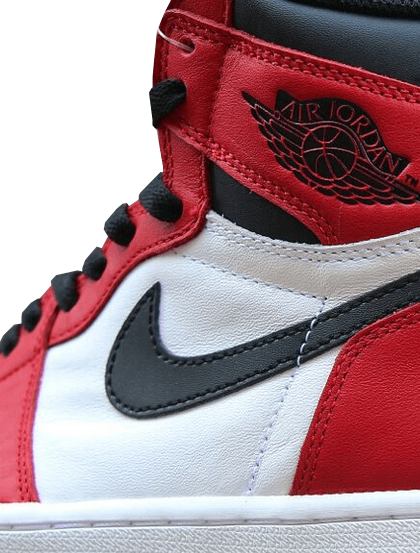
The most common way to treat a material edge is to do nothing, just cut it.  For real leathers and PU synthetic leathers a clean-cut is usually okay.  If the material backing is color matched to the skin and the backing material is not rough or fibrous a clean-cut edge is perfectly acceptable for high-end performance or fashion shoes.  In fact an exposed contrast color edge can be a neat design element.  The down side is the raw edge is more susceptible to wear or fraying and may show wear sooner.  The die cut edge may also be painted or sprayed to cover a backing material not dyed through.
This original air Jordan 1 is made from PU coated “action” leather.  The edges are die cut clean.  You can see the skin edge is perfectly clean as this is PU material, the backing edge does show shoe fibers from the leather.

In this Nike shoe you can see the White and Red materials are leather based while the Black Swoosh looks to be 100% synthetic material, as the edge is cut perfectly clean.

The raw, die cut edge is the least expensive way to handle the material edges.  Mesh or Fabric edges can not be die cut.


Inspect Shoes
Like a Pro

Learn how to inspect and authenticate shoes like a professional. We give the Nike Air Jordan 1, Vans old SKool and Yezzy a complete quality control shake down. Piece by piece we will study every part. Don’t get burned! Learn more On Sale $39.99

Rolled Material Edges:

For a more finished looking treatment the material edges can be rolled.  Fabric, Leather and PU material edges can be rolled.  Extra labor is required and great care must be taken to insure the process results is a neat and clean edge.   Not all shoe parts can be rolled neatly.

Retro Nike Air Jordan 1 Design

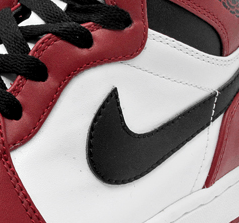
In the case of this Nike Air Jordan 1 Retro edition you can see almost all the material edges are rolled. This is very well done, the curving eyestay parts with tight corners are neat and even without bumps or wrinkles.  This fine work is done with the aid of a machine.

To get clean edges like this Air Jordan you need two operations.  First, the material edge must be skived to reduce the thickness.  This leather maybe 1.2mm to 1.5mm – the skived edge, maybe 5mm wide will be .5 to .7mm thick.  This will allow the edge to be rolled without making a huge fat edge.  Once the material is skived down the cut parts will be taken to an edge rolling machine.

Screen Shot 2015-08-08 at 12.20.24 PM


The edge rolling machine neatly folds and glues the edges, then a pressure roller flattens parts for clean look.  The glue holds the edge until the stitching department can make the shoes.


New Course
Sneaker Authentication

13 Authentication lessons.
3 hours of video instruction.
In-depth study of footwear inspection techniques.
Authentication Text Book included.
Learn more On Sale $199

The Tuned edge or Turned seam:

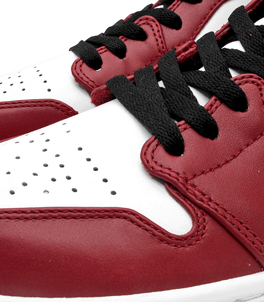
The last shoe is the Nike ID Air Jordan 1.  This model is made with different materials and uses different techniques. Made of synthetic panels this shoes is entirely “turned out”.
The shoe parts are cut, laid down face to face then stitched.   The resulting seam is then hammered flat to remove wrinkles.

The turned seam may also require skiving, depending on the material thickness. This Nike shoe has some many turned out seams I expect the are not all skived.

This shoe is so neatly made you would think some parts may be welded on.  Like the logo

Nike air Jordan 1 shoe design review

Over all when you design a shoe you need to consider how to handle the edges, What materials will require special finishing, skiving, glueing or hammering?

Leather parts can be die cut, fabric parts can not.   Synthetic material cut clean but may not handle the skiving operations.

Rolled seams and turn out seams can make crisp pattern lines line a die cut pattern part.  Rolled and turned seams require more equipment, time and labor making them more expensive.  You will have to find the technique suits for design, material and price.

Are these Vans Real?

Learn how to authenticate shoes. We give the Vans Old Skool a complete shake down. Piece by piece we will study every part. Don’t get burned! Learn more On Sale $199
Posted on

Shoe Pattern Parts

How to make a flat pattern parts of a shoe names

The Basic Shoe Pattern Parts

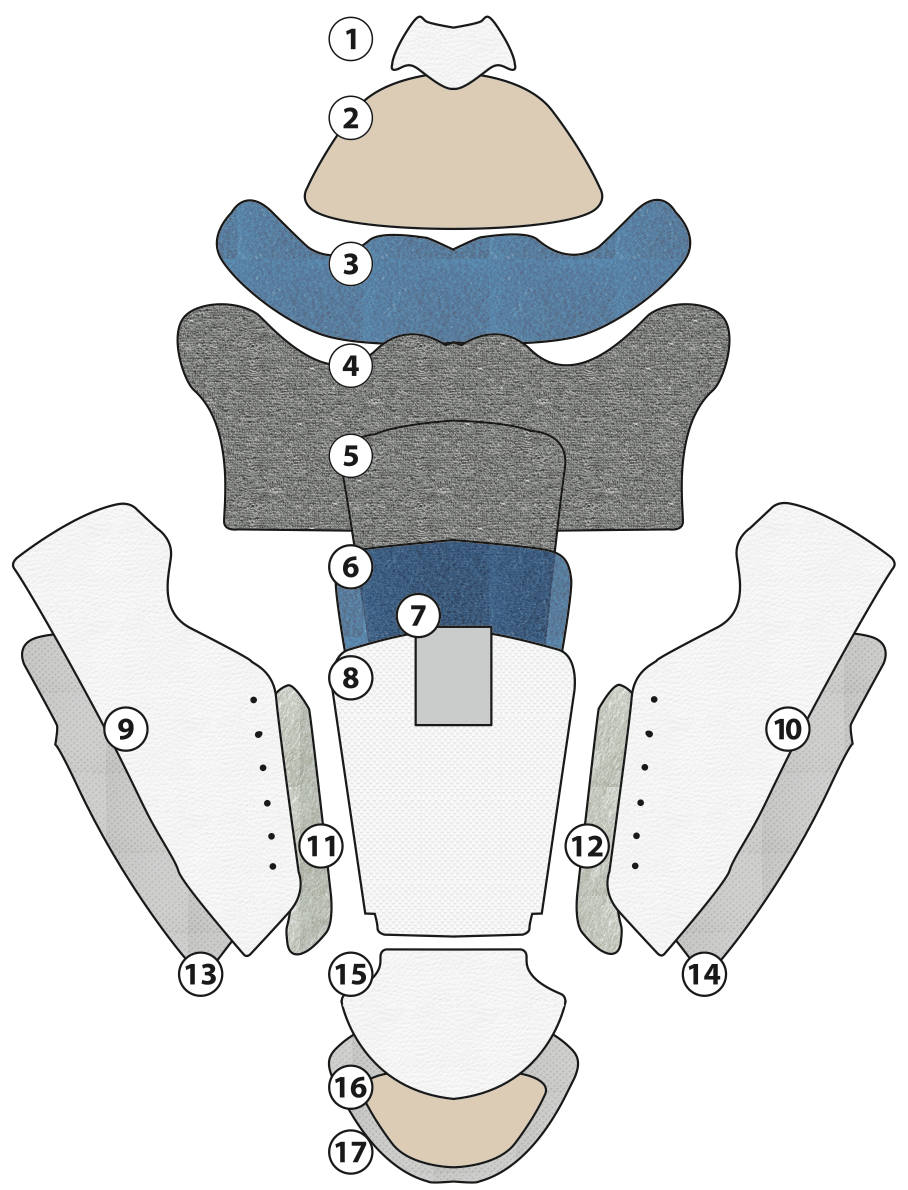
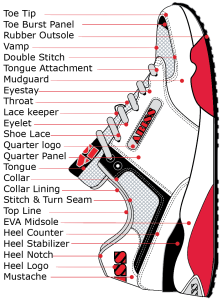
If you want to learn more about shoe pattern making or shoe pattern cutting you will need to know the correct names for the anatomy of the shoe.  You will also need to understand how many parts are in a complete shoe pattern. Here you can see that this simple shoe has 17 pattern parts, not including any quarter logo designs. Now, imagine the pair will have 32 pattern parts and the entire size run could have 14 sizes! You can see the number of shoe pattern parts and cutting dies grows quickly into the hundreds. Another point to consider is the popular shoe sizes 9-10-11 may need more than one set of cuttings dies to quickly make big orders.

Shoe Pattern Parts

Shoe pattern shoe design parts of a shoe diagram
The anatomy of the shoe

Parts of a sneaker

1.  Heel Patch or Mustache:  Leather
2.  Heel counter reinforcement:  heat moldable plastic
3.  Collar padding: KF Soft PU sponge foam
4.  Heel lining: nylex, visa terry or jersey fabric
5.  Tongue lining: nylex, visa terry or jersey fabric
6.  Tongue padding: KF Soft PU sponge foam
7.  Tongue logo panel: Woven label logo or leather patch
8.  Tongue face:  Textile mesh fabric
9.  Quarter panel medial side:  Leather
10.  Quarter panel lateral side:  Leather
11.  Eyestay reinforcement medial side: Non woven super tuff reinforcement
12.  Eyestay reinforcement lateral side: Non woven super tuff reinforcement
13.  Quarter panel lining medial side: Non woven textile
14.  Quarter panel lining lateral side: Non woven textile
15.  Toe Cap:  Leather with Vamp vent holes
16.  Toe Puff reinforcement: heat moldable plastic
17.  Vamp / Toe cap lining: Non-woven textile

New Online Course!
Shoemaking for Designers & Brand Builders

Created for footwear newcomers and professionals alike, this course delivers the basic shoemaking knowledge you need to get your career and brand started.
Course Details
Enroll Now $99

Shoemaking
TextbooksBuy Now
Shoemaking
SuppliesBuy Now
Shoemaking
CoursesCourse Details

Previous
Next
Shoemaking
TextbooksLearn More
Shoemaking
SuppliesClick Here
Shoemaking
CoursesLearn More

Previous
Next

Posted on

How to Design Shoes

How to design shoes

How to Design Shoes: Drawing Technique

How to design a running shoeIf you want to learn how to design shoes you must first learn the names of the basic shoe parts! Secondly,  You must learn how to draw shoes.  Drawing by hand or by computer is how you will detail and communicate your shoe design.
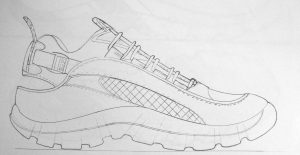
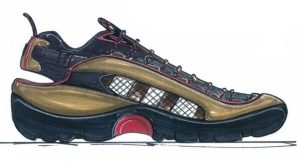
Shoe sketching How to Design Shoes

This is the most important part in learning how to design shoes.  For your shoe to come to life you must be able to describe every detail.  If you can’t show what makes your shoe design unique and special it will always be just an idea in your mind and not a shoe.  A drawing will also help you discover the details of your shoe design.

Shoe-Rendering How to Design ShoesA highly detailed shoe drawing will show design features and flaws, allowing your shoe design evolve.  Your shoe drawings must also communicate the design details to your co-workers, managers, buyers, customers and shoe factory technicians.  From start to finish in the shoe design process, many people will need to understand your ideas if they are going to help you make your shoe idea into a real shoe!
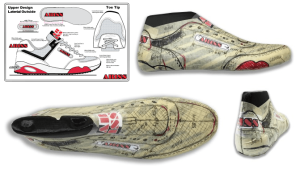
How to design shoes

Once you have the design compete it’s time to create the product specification.  All the details that turn a  shoe drawing into a shoe are required.  Materials Specs, color numbers, foam density, rubber hardness need to be defined.

How to Design Shoes: Footwear Materials

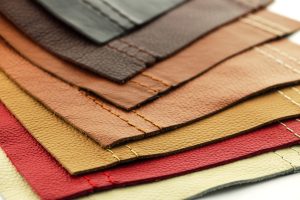
Designers Guide to leatherFor your new shoe design to really come to life you will need to specify  the shoe materials.  A huge part in learning how to design shoes is understanding how and why to select particular materials for your shoe.   Your material choice will decide how expensive or inexpensive your shoes will be in the store.  Your material choices will also effect flexibility, durability, comfort and import duties.   You will need to understand the design qualities and limitations of leather, textiles, synthetics, foam and rubber as they relate to shoe design.   The material you select for your shoe design will have an impact on the fabrication techniques, stitching procedures, reinforcements, and even the type of glue used to assemble the outsole to the upper.
You can learn more here The Designer’s Guide to Shoe Leather, here How to Design shoes – Synthetic Leather , here Textiles for Shoe Design, here Importing Shoes : HTS Shoe Import Duty and Shoe Tariffs and here How much does it cost to make a sneaker?

How to Design Shoes: Shoe Lasts

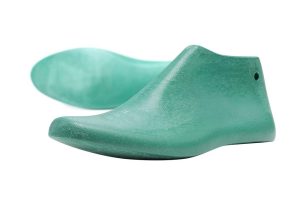
shoe lastsThe shoe last is the most important part of your shoe design.  The shoe last is the form used to create the 3D shape of your shoe design. The shoe last can be made of wood, plastic or metal.  In the design phase, the last is used to transform your 2D line art in a flat pattern that can be assembled, then stretched into a 3D shape. The shape and adjustments to last dimensions are where the art and science of shoe making collide.  The perfect last will make your shoe look, fit and flex great!  The wrong last will make a great shoe design into a wreck.  In production, the last is used to stretch the sewn upper into shape, then hold it in place while the outsole is bonded.  The last must be a strong material to withstand the lasting pressure and hydraulic pressure used to secure the outsoles.  The shoe last must also be smooth and clean so the shoe lining is not damaged during the assembly process.
Posted on

How to Design Shoes – Synthetic Leather

Synthetics For Shoe Designers

Whatever you call it, synthetic, synthetic leather, PU leather, pleather or just PU this material is another must have for modern sport shoes.  If you want to learn how to design shoes you must have an understanding of modern synthetic materials.  This class of material offers the shoe designer a huge variety of colors, textures and features at a range of prices.  While synthetics were once considered to be cheap junk not suitable for high quality shoes, times have changed!

These synthetic materials are now high performance and are  often a composite made of two layers.  A backing layer made of woven or non-woven polyester fibers combined with an external surface by “dry” lamination process or by liquid “wet” processes.  The least expensive synthetics have a fibrous woven backing with PVC skin made by wet process.

This shoe has a mix of synthetic PU materials

The high-end PU leather starts with a water-resistant micro fiber PU backing.  This backing has a smooth surface, cuts cleanly, and can be dyed to match the surface materials. The micro fiber style backing can be ordered in .5 to 2.00mm thicknesses, has some stretch, and can have a water-resistant treatment.  On top of this backing the skin can be applied.

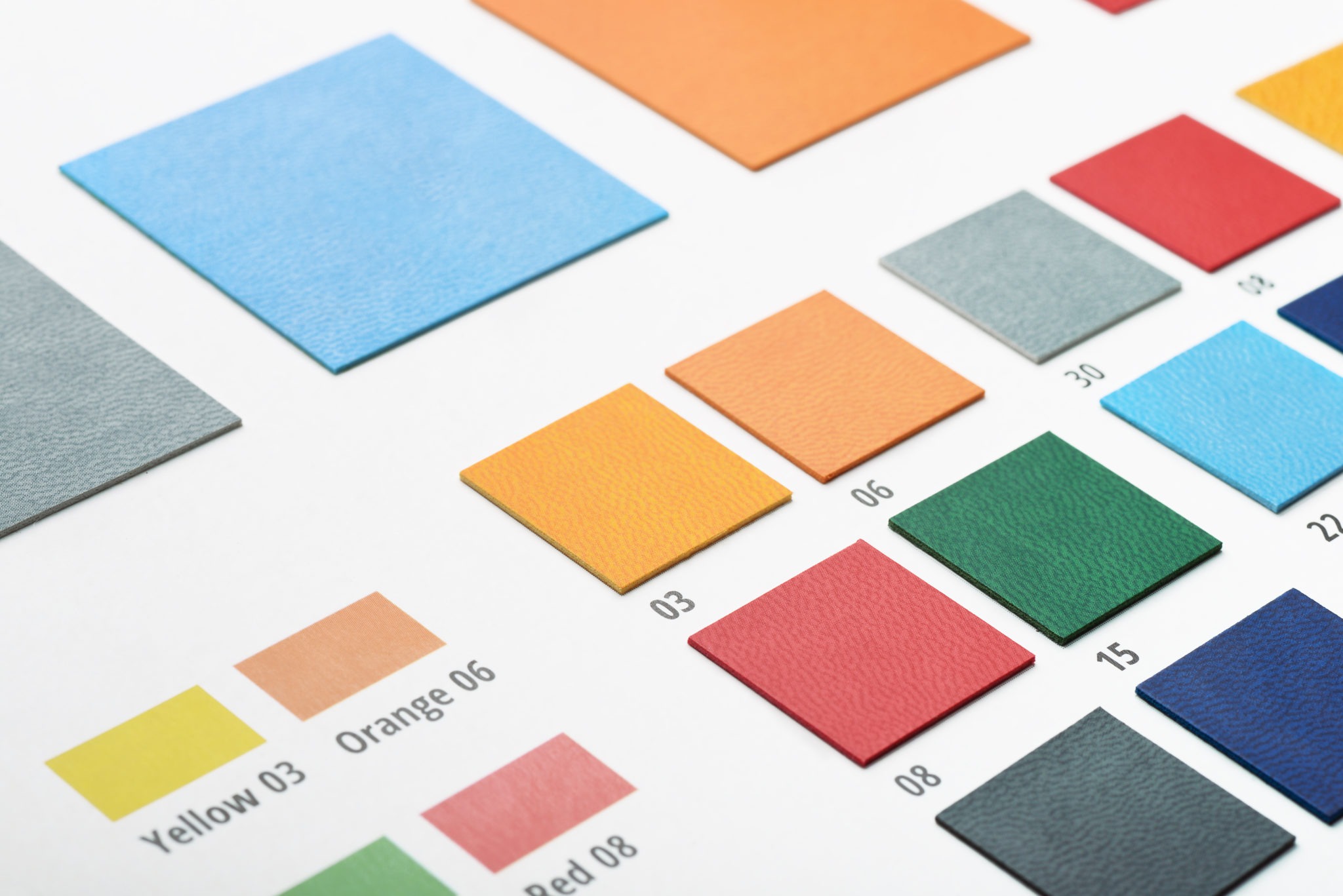
Polyurethane plastic film .2 to .5mm thick is made in a separate operation and the two layers are then rolled together with heat and pressure.  The PU outer skin is then printed, embossed, scuffed or polished to create one of the millions of surface options.  The largest PU maker has hundreds of different emboss patterns that can be applied to hundreds of different surfaces. If you can meet the order volume required, you can pick any color you want!

So lets look at some other features of synthetic leather.  There are four common surface materials, PVC (Polyvinyl Chloride) is the cheapest, PU (Poly-Urethane) can be of higher quality with many surface options, TPU (Thermo-Plastic Urethane) and there is also a class of materials made of PU fibers without a surface skin. Of these four types PVC and PU are similar in construction, a skin with backing.  The TPU material tends to be single layer material with a finer emboss.  PU materials are also offered as a solid, skinless material, this can have a brushed surface to look like suede or nubuck.

Inexpensive PVC with woven backing

PVC leather is the most basic synthetic leather, made by wet process the surface is a sealed skin usually embossed.  Liquid PVC is poured on a textured release paper then a cloth is rolled on while the surface is still wet.  PVC leather will often have a woven backing with limited stretchability. This no problem for shoes with pieced together toe and vamp construction but not so good for smooth toe lasted shoes. This material is the cheap stuff found on inexpensive shoes. When it’s pulled tight it may wrinkle and the backing surface will X-Ray through the surface.   Perfect for cheap shoes and can be found mixed on some shoes used as a cost cutting feature.  I would never spec PVC leather for shoes that retail for more than $75.00 USD. Thickness ranges from .8mm to 2.00mm depending on the backing layers and surface treatment.   Surface texture is limited due to the release paper process.

PU_material-with-Non-Woven Backing
PU material with high quality non-woven backing

PU leather is another miracle material for shoes. Available in almost any color, surface finish, and can be treated with many special features. Thickness ranges from .8mm to 2.00mm depending on the backing layers.  PU leather is made with a sealed skin like full grain leather but can be brushed to look like nubuck or fine suede.  The PU skin is made by release paper process but is dry when combined with the backing. A heated steel roller with the emboss pattern is used to laminate the skin and backing. This allows for a deeper, crisper emboss pattern. The PU surface readily accepts embossing and printing effects. The PU skin is stretchable and durable so it can be combined with a lastable backing material.  This allows PU to be used on toe caps of sports and casual shoes.

High Abrasion PU leather
High Abrasion PU leather with emboss

PU leather is also made in high abrasion versions and can have water-resistant backing.  PU material with micro fiber backing cuts cleanly and looks great when perforated. Backings can be color matched so cut edges look clean – they can even be ordered with accent colors for a neat “TRON” effect.

Synthetic suede- how to design shoes
Synthetic suede- in many colors

The PU fiber backing materials are also made without the skin layer.  This material has a brushed surface and is known as “Ultra suede,” “Alcantara™,” Hi-skin Chamude or Amara Microfiber Synthetic Leather.  These high quality micro fiber suede materials can be expensive but they are great for use on shoes, gloves, linings and trim.  Being colorfast and waterproof ultra suede quickly replaced suede in sports shoes that will be exposed to water.

TPU sheeting for seamless welding

The TPU materials are used for accent parts and for RF welding applications.  The TPU materials are not for use in structural parts of the shoe.  TPU can be transparent white the PVC and PU must be opaque.  TPU is also offered very thin.  .3mm to .8mm.

Posted on

Download Shoe Last for 3D Printing

shoe last download file

Download a Sneaker Last for 3D Printing:

Can I 3D print a shoe last
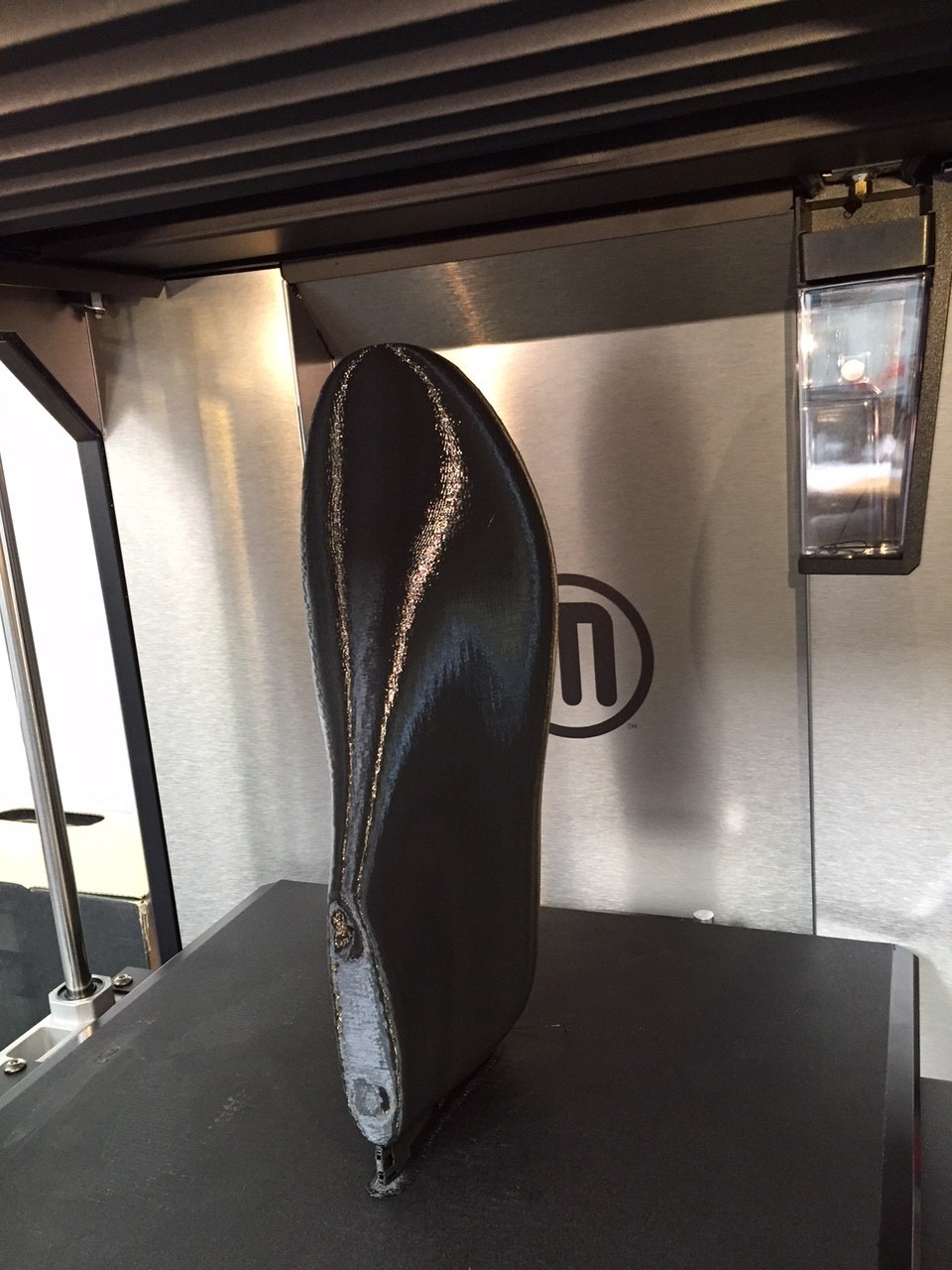
3D printed Last Shoe size 9 MakerBot Z18

I’ve had many requests to offer a shoe last for purchase (sorry we don’t have this ready yet).  So, while we are working on a way to cost effectively supply you lasts and outsoles, we have put together a .STL 3D printing file of a great shoe last for you to download.
This last is great for your DIY shoe projects.  This last has a standard athletic outline with a well curved arch, plenty of toe space and is relatively thick on the lateral side so its fit is accommodating.  Heel lift is 6mm and the last has a toe spring of 8mm.  The feather edge is in the middle between sharp and round so you an make a stobel pattern or board last without difficulty.
The file is a Men’s size 9 last.  You can make your own size with a little creativity.  The .STL file can be scaled in X, Y and Z.  While a technically perfect last grade is not made by direct scaling, this size 9 can be graded into a 8 or 10 without getting too far off the standards for last making.
If you have access to a decent sized 3D printer you can print this last full size in about 5 hours. We have a really slick MakerBot Model Z18 on hand so we tested the file.  We printed the sneaker last with 0% fill, 2 shells and scaled to 275MM Long USA size 9.  With 0% fill the last is fragile but perfect for filling with expandable foam, casting resin or plaster for a more durable last.

[purchase_link id=”4886″ text=”Purchase” style=”button” color=”blue”]

Posted on

The Shoe Design Brief

A design brief for a shoe design. How Shoes are Made

The Shoe Design Brief:

How does the shoe design process really work?  Does a brilliant young shoe designer just create the new Adidas Power Boost shoe design out of thin air?  Not really, our designer can’t do it all alone. Our brilliant young shoe designer is just one part of a team of professionals that may include the Product Line Manager (PLM), the Product Manager (PM), Footwear Developer, pattern maker and Engineer.  The Design brief is the document the entire team will use to create the new shoe.

The footwear design brief is the instruction sheet and road map the product team will follow as they create the shoe. The design brief has information that each of our team members will need to get the job done right and to make the shoe a success. The design brief is often submitted to the company’s management for review before a project starts. With the manager’s approval, the design brief becomes a written record of the shoe development teams goals for the project.

how high heel shoes are madeWho makes the shoe design brief?  There are no rules to this process, every company has their own process. In many companies the shoe Design Brief is a collaboration. The Product Manager is usually tasked with creating the brief, but he may meet with the designers or his design manager to collect style ideas, the PM should also be talking to his sales manager and sales reps for any price information or market intelligence about competitors.

A design brief for shoes can be a 1 page document, a 20 page report or pasted up concept board. The format I have used has the design brief broken down into two parts. The first part covering the price, demographics, competitors and technical details. The second part is the “Visual brief” and it can detail stylistic direction for the shoe.

So what questions should the shoe design brief answer? The answer is…it depends on the type of shoe you are working on. The running shoe design brief will be different from an army boot. So lets look at the basics.

What is the function of this shoe?
Running, Basketball, Snowboarding, Tennis or Skating

Do the shoe have a special feature?
thick midsole, thin midsole, fat tongue, no tongue etc.

Who is this shoe for?
Men, Women, a new Professional athlete, mall rats

What retail price is planned for the finished shoe?
Price point, Mid range, Deluxe or High end

When will it arrive in stores?
Spring , Summer, Winter, Fall or holiday selling seasons

What is the silhouette?
Ultra low, Low cut, Mid cut, High top

What is the target environment for this shoes?
Forest , Office, Desert, track, school, mountains?

What trends are up and coming?
Neon, earth tone , transparent, plaid

What countries will this shoe be sold in?
USA, Canada, China, Europe, Australia

What materials should be used?
High tech synthetic or classic leather

This there a competitor’s item doing well?

How many different color ways are required?

 Is there something new technology your engineers are working on?

 Is there a plan for import duty?

 Are there existing outsole molds that can be or must be used?

 Is there a particular new design element or material to try on this new shoe.

A design brief for a shoe design. How shoes are Made A simple Visual Design Brief

The Visual Design Brief
The visual brief will include photos of other shoes, cars, clothing or anything the PM thinks can help the footwear designer set the style or specific design details.  In some cases if the shoe is for a pro athlete, you may be inspired by the athlete’s personal style or something they like.

This information should all be in the designer’s mind when pen hits the paper.  First step the rough concept drawings.  Just get the idea first.  Once the design direction has been set the designer may create a CAD drawing to refine the concept.

Step by Step Guide
Footwear Brand Building

Learn more about the cost to make a sneaker and the rules for importing shoes by checkout How To Start Your Own Shoe Company. 195 pages, 330 color photos.
Buy Now
On Sale $39.99