Posted on

Shoemaking Hand Tools

a shoemakers Lasting Pliers

Shoemaking Hand Tools

Let’s look at shoemaking tools you will need for any DIY shoe projects. These are the shoemaking tools you will find in any shoe repair or handmade shoe shop. Of course, we can also call these cobblers tools. While you will have a hard time finding these tools in your local Home Depot, they can all be found online.

13Pcs Leather Craft Hand Stitching Sewing Tool Thread Awl Waxed Thimble Kit:

$11.09 on Amazon

13 pcs LeatherCraft shoemaking hand tools
Stitching Sewing Tool Thread Awl Waxed Thimble Kit:
1Pc x black pressure cloth tooth distance of 4 mm 1Pc x log pressure cloth tooth distance of 2 mm 1Pc x solid wood awl
1Pc x straight head awl 1Pc x hook the awl 1Pc x Grooving device 1Pc x hollow awl 1Pc x beeswax
1Pc x thimble 1Pc x leather needle 1Pc x ecru flat wax rope 1Pc x black flat wax rope
1Pc x coffee flat wax rope 1Pc x scissors

Cobbler Pliers
$19.99 Sneaker Factory Bookstore

Lasting Pliers: This is the classic shoemaking hand tool.
Beaked pincers with a built-in hammer face. Used for shoe lasting and sole nailing. Durable economical construction. Built for production factory use. Steel with black painted handle. 21cm long, 6 cm opening with 14cm handle.
Package includes: 1 x Lasting Pliers

Hand Tools for Shoemaking
$64.95 on Amazon

Lasting Pliers: Shoe lasting pliers are a very practical tool. The pliers grasp the shoe material while the hooked end lets you lever and roll the material down onto the lasting board. Then, without having to change tools, the material and/or a lasting tack can be hammered in. While they look semi wicked, shoe lasting pliers are very common in both production shoe factories and handmade shoe shops.


Last Measuring Step: Shoe last measuring step. Measures last heel lift from 1cm to 11.5 cm. Durable injection-molded plastic.
Step measures 12cm x 12cm

$49.95 on  Amazon

Cobblers Shoe Hammer: For shoemaking, a good hammer is a must. To drive tacks and nails for lasting and seating heels, a cobbler’s hammer is the tool of choice.


$34.95 on Amazon

French Shoe Hammer: The flat smooth face of the french shoe hammer is designed to flatten seams and stitching. Even careful handling will leave some humps and bumps. The French shoe hammer and some gentle work will make seams flat and even.

$35.50 on Amazon

Shoe Makers Tool Kit:
Steel Cutter
Iron Pliers
Brass Handle Awl
Scissors
Hammer
Punches (1.5MM,2.5MM)
Rasp Tool

$35.90 on Amazon

Eyelet setter: To set lace and vent eyelets you will need a punch and setter. In the factory, they will have a hydraulic press but at home, a hand setter will work.

$9.03 on Amazon

Awl Leather Punch: For punching holes and marking leather you will need an awl.

$8.80 on Amazon

Spacer Embossing System: This handy tool allows you to evenly mark stitch locations.  Once marked, the leather can be punched and sewn.

$2.65 on Amazon

Leather Edge Skiving Tools: To trim and refine leather edges a skiving tool is a must. Used to remove any rough edges,  you will find these tools in every leather works toolbox.

Basic Hand Stiching Leathercraft Set (12 Items):
$27.39 on Amazon

Basic Hand Stitching Leathercraft Set (12 Items):
1 Adjustable Leather Edge Stitching Groover Tool(1mm ) 1 Edge Beveler No.2(1.0mm) 1 Pro-Stitching Grooving & Edge Beveler Tool (1mm ) 1 Pro Leather Edge Edger Beveler Skiving Tool
1 Adjustable Edge Creaser up to 1.5cm 1 Japanese Style Skiving Knife 1 Wood Multi-Size Edge Slicker 1 Skiving Tool+10 Replacement Blades
1 Multi-Size Hole Punch1.5mm/2mm/2.5mm/3mm/3.5mm/4mm 1 Awl 2 Leather-craft


Shoe Last Measuring Tape
$14.99 Sneaker Factory Bookstore

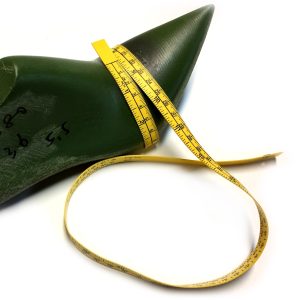
Last measuring tape: Designed specifically for measuring shoe lasts this 24-inch tape features a durable fabric reinforced non-stretch construction. Printed on both sides this tape is marked with centimeters, inches, English sizes, and stitch count. Steel grommet for hanging. Made in Germany. Free shipping in the USA.

Posted on

How much does it cost to produce a pair of Air Jordan XXXI’s?

How much does it cost to produce a pair of Jordans?

How much does it really cost Nike to produce a flashy pair of Air Jordan XXXI’s? Does Nike make big bucks on every pair of shoes they sell? Why does a basketball shoe cost $185? What is the real cost to make such high-end sneakers?

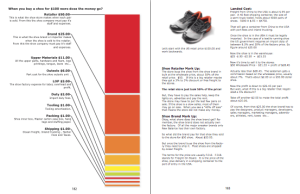
The article then reveals a Cost to Produce Air Jordan XXXI graphic, stating that retail price for the shoes is $185. Wholesale price is about 50% off retail, around $90-$92.50. Retailers might negotiate a 3-5% discount or free freight. Retailers, having employees to pay, rent to cover, and other expenses, take 50% off the top. The article concludes by asserting that although the Air Jordan XXXI will sell out quickly, the store still has other shoes to sell at a discount.

New Online Course
Sneaker Authentication

13 Authentication lessons.
3 hours of video instruction.
In-depth study of footwear inspection techniques.
Authentication textbook included.
Course Details
enroll now $199

How Much Money Does Nike Get?

So, how much money does Nike get? Remember, Nike does not actually own the shoe factory. Of all the major shoe brands, only New Balance owns a shoe factory. So, what did Nike pay the factory for that $185.00 shoe? They paid roughly $25.00 USD per pair.

How can Nike sell a $25.00 shoe for $92.50?

Cost to make shoes Once Nike buys the Air Jordan XXXI from the factory in China, they need to ship it. Nike ships most of its shoes by ocean freight from China, Vietnam, or Indonesia to the USA. An ocean container can cost $4000 to ship and will hold around 3000 pairs of high-top shoes. Shipping plus other fees can cost about $1.50 per pair.

When the Air Jordan XXXI arrives in the USA, it must be imported. In the case of a textile and leather sneaker, the US government requires an import duty of 20% of the F.O.B. price. So add $5.00 to the cost.

Now the shoe is in the warehouse: $25 + $1.50 + $5.00 = $31.50.

Build Your Dreams!Air Jordan DIY Kit:
Last & Outsole

Stop searching! We have the Classic Air Jordan style last and outsole in stock. Ready for your Air Jordan 1 restoration and DIY shoe projects. We have your size in stock!
Buy Now
On sale $119

Now they need to pay Michael his royalty for being the greatest basketball player that ever lived and for being on their shoe.
It’s hard to know exactly what that royalty amount is. The Jordan brand is selling about 2.6 billion dollars of product and Michael is paid about 100 million. To keep it simple we can figure he gets 5% of the wholesale price. Maybe $4.63 per pair, maybe more.

So, to make the Air Jordan XXXI, ship it, and pay Michael, the total comes to about $41.30.

The $92.50 wholesale price minus $41.30 leaves Nike a profit of $51.20  or about 55%.
This is pretty standard for shoes. Fashion shoes may be more, discount shoes a bit less.

Of course, from their $51.20, Nike brand has to pay the designers, product managers, developers, sales managers, marketing managers, administrators, floor sweepers, advertisers, quality control staff, athletes, etc…

Cost to make shoes shoe design book
To learn more about the cost of making a basketball shoe and the rules for importing shoes, check out How to Start Your own Shoe Business

New Online Course
How much does it cost to
make a shoe?

Step-by-step how to create and analyze footwear costing sheets. 5 shoe cost calculation lessons. Over 1 1/2 hours of video instruction.
Course Details
enroll now $149

Posted on

Marbury Makes A Sneaker As Cheap As Possible, Will It Sell? The Starbury

Stephon Marbury

The Starbury Basketball Shoe

Stephon MarburySneaker Factory came across this interesting podcast to share from NPR’s Planet Money, Episode 785: The Starbury.

Stephon Marbury Makes a $15 Sneaker

Back in 2006, New York Knicks player, Stephon Marbury, had an opportunity to license and sell his own basketball shoe, The Starbury, as cheap as possible. It sold for $15. Did people buy it? Did it perform? Planet Money reviews the details of this sneaker experiment, including an analysis from cutting a Starbury basketball shoe in half to compare it to the materials used to make a $100 Nike Air Jordan.

Download or listen to the entire story here:

http://www.npr.org/sections/money/2017/07/21/538621509/episode-785-the-starbury

When Stephon Marbury was eight years old, the Nike Air Jordan sneakers came out. Kids everywhere wanted to fly

NBA Stephon Marbury Cheap As Possible Starbury Basketball Sneaker Review
NBA Player Marbury wearing his Starbury Sneakers

like Michael Jordan on the basketball court, and they wanted to wear the sneakers with his name on them too. But they were pricey. Stephon couldn’t afford them. Lots of kids couldn’t. For years, he wondered if there was a different way.

Two decades later, he had a chance to try a different way himself. When he was an NBA star, Marbury got approached by clothing company Steve & Barry’s. They had a crazy idea for a sneaker, and they thought Marbury might be just the celebrity to get behind it.

Today on the show: The story of what happened when an athlete used his name not to make a shoe more expensive than it needed to be but to make it as cheap as humanly possible.

We look at this experiment and the strange problems that arise when you make a shoe that’s so much cheaper than the competition. We also find out what Stephon Marbury is doing right now, on the other side of the world, with another big plan to try a different way of doing things.

Story from NPR Planet Money Episode 785: The Starbury, July 21, 2017, By Kenny Malone/NPR


http://www.npr.org/sections/money/2017/07/21/538621509/episode-785-the-starbury

Continue reading Marbury Makes A Sneaker As Cheap As Possible, Will It Sell? The Starbury

Posted on

How to Make Shoe Cutting Dies

shoe cuttings die

Making cuttinges for shoes

cutting dies leather cutting dies
sneaker Cutting dies
shoe making equipment

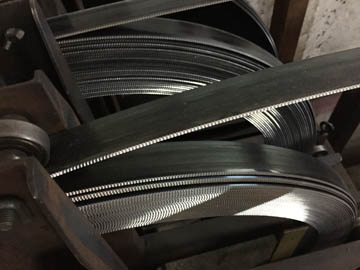
Mass production of footwear requires cutting every type of shoe material. Shoe leather, fabric, foam, and reinforcing materials must all be cut into the shoe pattern shapes. While there are many new technologies for cutting shoe materials such as a laser, water jet, and CNC drag knife; the steel rule cutting die is still the most common for footwear production.


Shoe parts cutting dies

 
Photo of steel for cutting dies

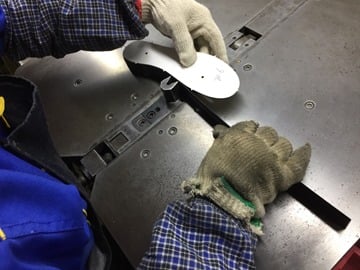
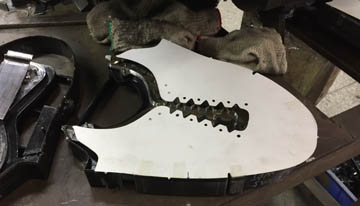
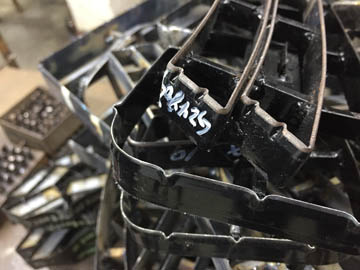
Used to cut out shoe parts, these steel cutting dies look just like cookie cutters. Each die is made of sharpened rule steel then coated with rust proof paint and marked with the shoe size and model number. Making a shoe requires hundreds of dies. One die for each part, for every size of a shoe. For high volume shoe production, the shoe factory may need many sets of cutting dies.


Making footwear cutting dies

Making footwear cutting die
leather cutting dies

The cutting die maker starts with the cut paper pattern templates of the shoe pattern. The worker will then bend the rule steel into shape using the paper pattern as a guide.


The worker uses a special bench that will help bend the metal. The bench has a foot-operated anvil that moves the tool head to make the bends. A skilled worker can make each cutting die outline in just a few minutes.

Learn about the Shoe Business

Aspiring shoemakers start here! How Shoes are Made is your entry into the world of modern shoe making. Tour a real shoe factory and learn the process from design to manufacturing. Learn more Download $19.99
 
shoe pattern size marks How to make shoe cutting dies
leather cutting dies

Once the outline is made, the worker will add the shoe size marks to the edge with notches. The raw ends of the dies are then welded together. Afterwards, any bracing bars or plates are welded on.


Pins for perforations are also added to the cutting dies. Once the die is fully assembled a worker will test it to make sure the cutting surface is aligned flat and level.

 
footwear cutting dies
Cutting dies getting a coat of paint

The final operations to make the shoe cutting dies include coating it with rust proof paint and a final check to make sure the cutting edge is very sharp. While there are many operations required to make shoe cuttings dies the production is fast, the materials and labor are relatively inexpensive. For small orders, a cutting die fee may be charged by the shoe factory, but usually, the cost of the cutting dies are accounted for the LOP (labor, overhead and profit) charges.

New Course!
Shoemaking for Designers & Brand Builders

Created for footwear beginners and career changers alike, this course delivers the basic shoemaking knowledge you need to get you career in the shoe trades started. Learn more On sale $99

Tour a shoe cutting die factory in China

Start Building Your Shoe Business

A must-have for anyone serious about launching a footwear company. 4 text books, shoe business documents and downloadable content not available anywhere else! The Shoe Company Start-Up Pro Pack is all you need to get your shoe business off the ground. Learn more Download Today
Posted on

Shoe Parts Diagram

anatomy of a running shoe

The Anatomy of a shoe: What parts make up the sneaker?

Every student of shoe design should know the correct names for shoe parts.
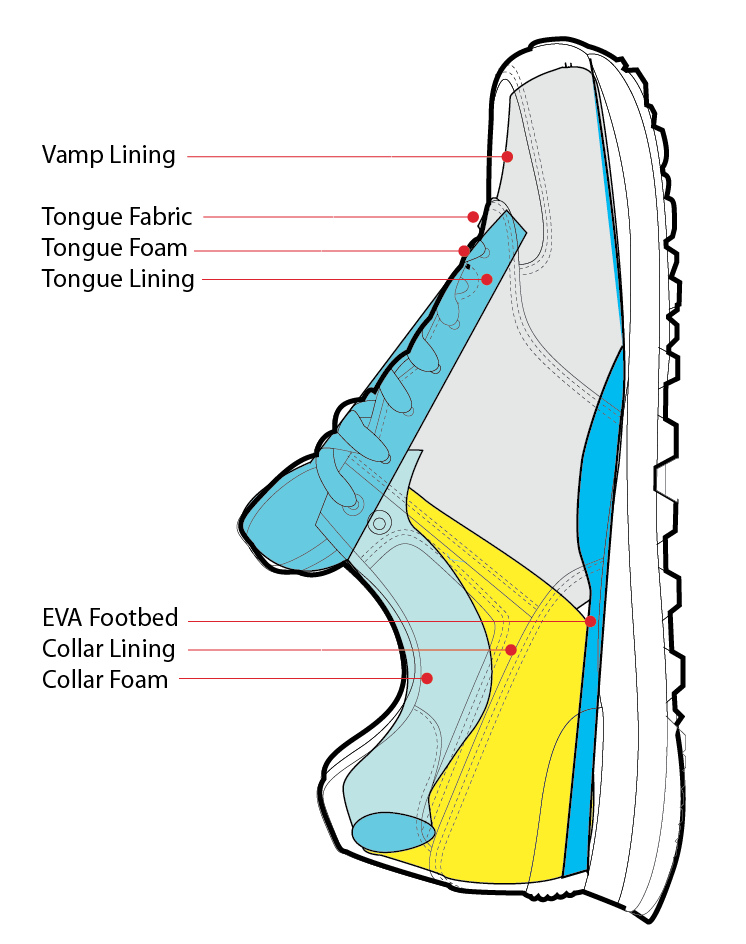
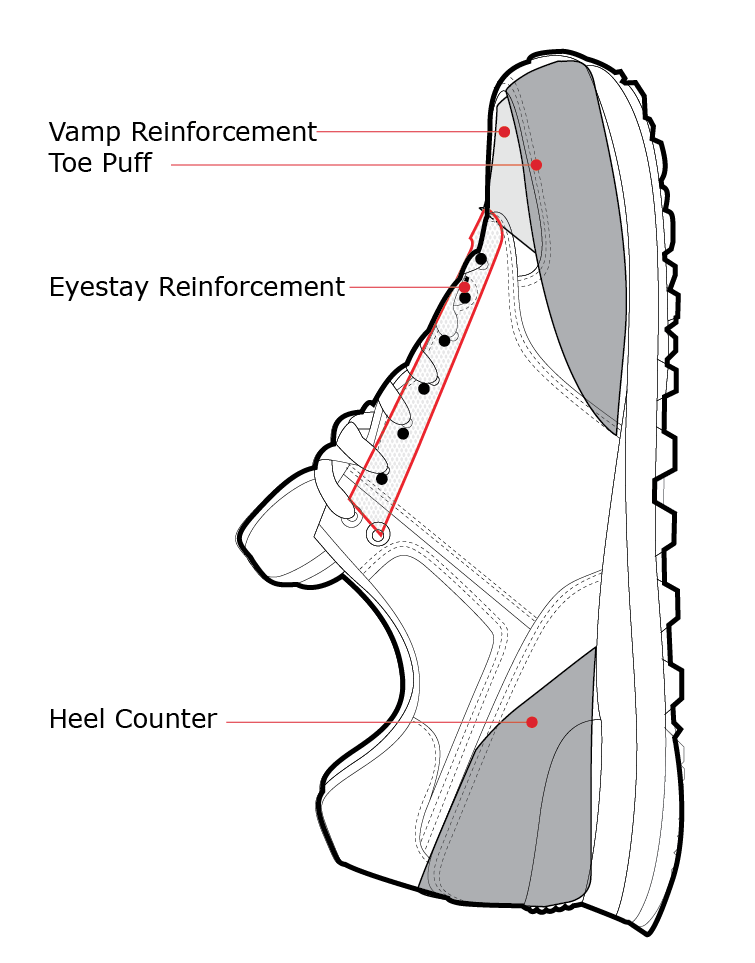
Here is a shoe parts diagram showing you the standard names for shoe parts. What is an eyestay, outsole, or vamp? Here is a list of shoe terminology. If you are designing a shoe you must know the correct names for the shoe pattern parts. Now you can see the anatomy of the shoe inside and out!  Here you can see a complete list of footwear pattern components.

External shoe pattern part names:

How to design a running shoe

Learn more!

You can find these shoe parts diagrams and tons of other shoemaking information in the best selling book How Shoes Are Made

Check out the Shoe Construction 101 Cheat Sheet!


Download Cheat Sheet


How Shoes are Made PDF ebook

Internal Shoe pattern part names:
Vamp Lining Tongue Fabric Tongue Foam Tongue Lining EVA Footbed Collar Lining Collar Foam

Internal Shoe Reinforcements:Shoe_Parts_reinforcements

Shoe Outsole Parts:

Learn Shoe Parts

List of shoe pattern parts found in the shoe parts diagram drawing.

Rubber Outsole, Channel stitch, Toe Tip, Triple Stitch, Vamp, Perforation Vents, Eyestay, Single stitch, Eyelet, Throat, Shoe Lace, Mudguard, Quarter, Lace, Aglet, Tongue, Collar, Collar lining, Midsole Stitch, Turn seam, Mustache, Heel Notch, Top Line, EVA Midsole, Heel Counter, and Heel stabilizer.

Learn more about sneaker parts:

See the Shoe Terms Dictionary

Learn more now!

New Online Course
How to Select Shoe Materials

14 Shoe Material lessons. Over 4 hours of video instruction. In-depth study of leather, textiles, synthetics, and plastics for footwear. Material Design Guide Textbook included.
Course Details
enroll now $399

Posted on

How to Start a Shoe Business Without Money

running shoe last, dress shoe last
Can I start a company with no money?

It is not an easy task to start a shoe business. You will need lots of determination and energy. Will you need lots of money? Not necessarily.

Start a shoe business

You can start a shoe company without much money. A successful brand will need a unique feature or market niche to stand out and compete with the big dogs. You will also need a unique name for your brand, a clear brand statement, and a distinctive logo. These key starting points are all accessible to you at no cost. Work on them on your own or solicit the help of a friend with some design skills. If you can nail the brand name, statement, and visual identity correctly you will be well on your way to success. Make sure to invest plenty of time in perfecting them. Your product needs to appeal to a large number of people.


Get The Word Out There

You need to get the word out there and analyze the public response to your shoe brand. The fastest way to do this without any money is thru social media. Facebook, Instagram, or whatever platform your friends and target customers will look at and tell their friends to look at. A Facebook page with great photos and some text which clearly communicates your shoe brands’ unique identity should do the trick. If you publish the photos and pages and the response is low you will need to reevaluate and possibly start over. Don’t rush the idea, proceed with confidence in your brand and you will be able to lock in some seed money to get your footwear product produced.

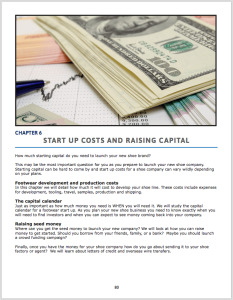
How to Start Your Own Shoe CompanyYou will need to raise some seed money to cover the product development, materials, and production costs for your new shoe company. There is no way to acquire product without paying for it. You can expect to pay at least 50% of the total purchase price of the shoes when you place your production order. Should you borrow from your friends, family or a bank? Maybe you should launch a crowd-funding campaign? Crowdfunding is a great way to reach out to customers, gain exposure, refine your sales pitch and secure backing for your new shoe company. Look into Crowdfunder™, Kickstarter™, and Peerbackers™. Learn more about the successes and pitfalls of these online services plus more information on raising capital and start-up costs in Chapter 6 of How To Start Your Own Shoe Company.

The Cost Involved in Selling Your Shoes

There is also a cost involved in selling your shoes. Luckily, you don’t have to spend big to have a decent online selling platform. Instead of hiring a web designer to build a specialized website you can take advantage of a low cost and easy DIY online store platforms such as WordPress, Shopify, or eBay which can process payments through PayPal. Once you have made a few sales and have a growing customer base you can feel proud that your brand has successfully joined the ranks to become a scaleable business!

To learn more about How To Start Your Own Shoe Company and How Shoes Are Made check out our bookstore. Books now available in softcover or PDF Download.

Step by Step Guide
Footwear Brand Building

Learn in-depth about the costs to make a shoe and the rules for importing footwear. Check out How To Start Your Own Shoe Company. 195 pages, 330 color photos.
Buy Now
On Sale $39.99

Posted on

Cómo convertirse en un diseñador de calzado: 10 pasos

Cómo convertirte en un diseñador de calzado: 10 pasos

¿Quieres aprender cómo convertirte en un diseñador de calzado para Nike, Adidas o Vans?  ¡Puedes hacerlo!

Shoe Design Rendering

Estos son los 10 pasos para convertirte en un diseñador de calzado.

Aprende a dibujar…

1. Aprende a dibujar… zapatos, y tambien todo lo demás:

Si quieres ser un diseñador de calzado, por supuesto que tendrás que aprender a dibujar. Este será tu nuevo idioma, por lo que deberás conocerlo bien. Tus dibujos son la manera en la que comunicas tus ideas. Deberás ser bueno, ya que tus dibujos van a reflejar tu pasión y tu creatividad hacia los demás. En una reunión de diseño, el dibujo que esté hecho con imaginación y muestre las posibilidades reales será el diseño que gane.

Necesitarás dominar conceptos sobre dibujo, y algunas habilidades de rendering. ¿Crees que los dibujos a mano están pasados de moda? ¡Piénsatelo bien!

2. Ve a la escuela:

¿Es la escuela de diseño obligatoria para los diseñadores de calzado? …a lo mejor no es obligatorio. Pero las habilidades y la experiencia adquirida en cuatro años de universidad, o en una escuela de diseño, te darán bastante ventaja. Existen muchos programas que son muy buenos para Diseño Industrial; formarte en diseño industrial es lo que debes buscar, NO una ingeniería. Los programas de diseño industrial incluyen clases sobre materiales, dibujo, ergonomía, etc. En la escuela de diseño, tendrás la oportunidad de trabajar con muchas personas creativas que te desafiarán. La escuela de diseño te ayudará a convertirte en un diseñador de calzado.

Encuentra a un mentor…

3. Necesitarás un mentor de zapatos:

He tenido mucha suerte en mi carrera como profesional del calzado. En el trayecto me he encontrado y he trabajado con muchas personas maravillosas. Si no tienes miedo de hacer preguntas, y eres lo bastante paciente como para escuchar a tu entorno, aprenderás mucho de los mentores y de tus compañeros de trabajo. Te garantizo que trabajando en la industria del calzado conocerás personas de todo el mundo con muchas experiencias diferentes. Me viene a la mente un canadiense, un inglés, un coreano, y muchos hombres y mujeres chinos como grandes amigos y mentores en la industria del calzado.

4. Aprende a trabajar con software: Empieza con Adobe Illustrator

Existen muchos programas de dibujo que puedes utilizar, Adobe Illustrator es fácil de aprender, y es una gran herramienta para poder trabajar con pulcritud y detallar tus diseños. Si bien Illustrator no es un programa de CAD en 3D, es muy importante saber dominarlo. Si eres ingeniero, utilizarás un software de modelado 3D, pero como diseñador, deberás comenzar con Adobe Illustrator para dibujar calzado.

5. Haz un gran portfolio para poder abrirte paso:

Existen muchas maneras de hacerse notar y comenzar, pero un gran portfolio de diseño será un buen punto de partida para poder empezar. En estos días, tener los trabajos en una plataforma online es imprescindible; con un portfolio en línea podrás mostrar cientos de dibujos, ¡deja que la gente vea lo que puedes hacer! ¿Otras herramientas? Navega a través de LinkedIn.com para obtener algunos contactos.

Estudia

6. Estudia los clásicos:

Estudia los clásicos, no las obras maestras de los pintores italianos, sino los zapatos clásicos. Aprende la historia moderna del calzado. Existen muy buenos libros ahí fuera, en el mercado. Conoce las siluetas clásicas de las grandes marcas. No tengas miedo de basarte en los grandes del diseño de calzado.

7. Llena tu mente con grandes diseños:

Para ser un gran diseñador de calzado, deberás mirar más allá de los zapatos. Existe un gran contenido de diseño industrial que llenará tu mente con imágenes: Ferrari, Prada, Frank Gehry, Philippe Starck, Apple, Porsche, etc. Existen una infinidad de sitios web donde podrás ver grandes diseños de producto además de zapatos. Llena tu mente y deja que tus ojos beban ese guiso de diseño.

8. Libros, libros, y más libros:

He recopilado docenas de libros sobre diseño, historia de diseño, fabricación, arquitectura, desarrollo de marca y diseño de embalaje o packaging. Sumérgete en este mundo, si tengo un problema de diseño que no puedo resolver, simplemente me sumerjo y comienzo a hojear las páginas. La respuesta está ahí dentro, solo necesitas encontrar una nueva forma de dejarlo salir a la superficie.

9. Corta los zapatos viejos:

Necesitas ver cómo se elaboran de verdad los zapatos. Aprende el por qué y el cómo del montaje de los zapatos. Un gran dibujo de un zapato que no puede elaborarse jamás podrá hacerse. Dicho eso, un nuevo diseño de zapato que sea impresionante y desafíe a tu equipo de desarrollo, también puede ser una buena opción.

Arriésgate

10. ¡La suerte favorece los que se arriesgan!

Arriésgate, tus diseños deben perseguir la perfección sin importar qué tipo de zapato sea. Haz algo nuevo y diferente. Trabaja duro para entender los desafíos del diseño, y después trabájalo desde una nueva perspectiva. Encuentra un nuevo material para tu diseño, o utiliza un material viejo de una manera innovadora. Visita la fábrica de calzado, mira lo que pueden hacer y observa también lo que no pueden hacer. No aceptes un no por respuesta.

Puedes llegar a ser un gran diseñador de calzado. Solo necesitas tener pasión por el diseño de producto, y la imaginación para ver algo que cobre vida.
Para mí, esta es la mejor parte de ser un diseñador de calzado, ver el futuro en mi mente y trabajar para crearlo.


Aprende más sobre hacer zapatos:

¿Quieres aprender cómo las grandes marcas fabrican zapatos? ¡Ahora lo puedes saber! ¿Cómo se hacen los zapatos? te mostrará cómo los zapatos de hoy en día cobran vida. El libro va más allá de solo un recorrido por una fábrica de zapatos, y más allá que el típico libro sobre la fabricación de zapatos. Este es el manual de diseño de calzado perfecto para los diseñadores de calzado. Desde dibujar diseños hasta el desarrollo de muestras y su fabricación, aprenderás cómo se hace todo. Escrito por profesionales experimentados en la fabricación de calzado, ¿Cómo se hacen los zapatos? te dará una mirada real dentro del mundo del diseño, desarrollo y producción en masa de calzado. 220 páginas con más de 400 fotografías en color y dibujos. 26 capítulos que explican el diseño de calzado, la creación de patrones de calzado, el desarrollo de muestras, la selección de materiales para el calzado, el cosido del corte superior, el diseño de las suelas y las herramientas, las hormas de los zapatos, los escandallos, las inspecciones de calidad, y mucho más. ¡Es sin duda una lectura obligatoria para los jóvenes diseñadores de calzado, o para cualquier fanático del calzado! Pagos seguros vía Visa, MasterCard y PayPal. ¡Más de 3.500 copias vendidas!

Avance Cómo se hacen los zapatos 

Posted on

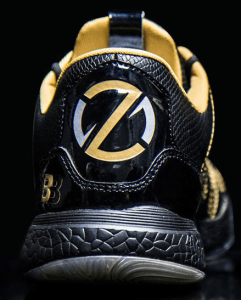
How Much Does it Cost to Make A Big Baller Brand ZO2 Prime Sneaker?

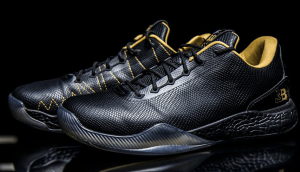
Lonzo Ball Prime Big Baller Brand Z02

Is Lonzo Ball’s $495 Sneaker worth it?

Lonzo Ball Prime Big Baller Brand Prime: Z02
Is this really a $495 dollar shoe?

The upstart shoe company Big Baller Brand™ is making a big splash with its release of Lonzo Ball’s sneaker. The ZO2 Prime signature basketball shoe is priced at $495.00. Meanwhile, the company’s founder, LaVar Ball, has become a controversial figure in the sports marketing world with his BILLION dollar contract demands. We are going to take a closer look at the new shoe.
Love it or hate it, let’s see if the  ZO2 Prime’s $495 price tag is justified by the design.

The Big Baller Brand ZO2 Prime: Price $495.00

Before we dive into the Big Baller Brand design, let’s do a quick breakdown on a basic sneaker costing model. If Nike™ released a $495 shoe into the normal retail distribution chain, the retail store would earn $250 of the $495 selling price. This $250 is a normal wholesale price for a $495.00 shoe. If you keep working the numbers backward you can assume $1.50 for shipping, 20% for import duty, and the industry standard margin of 50%. Thus, a $250 wholesale cost would mean the shoe costs Nike about $90.00 to produce. If you look at the $695.00 price of the larger sizes (sizes 14 and 15) you can figure a factory price of $130.00.
Does the Big Baller Brand  ZO2 Prime really cost $90 to produce in the factory?  Maybe not.
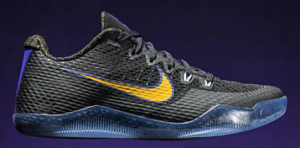
Let’s look at a very comparable shoe, the Nike Kobe 11. The Nike Kobe 11 retails for $159.00. If we follow the same logic working the price backward, we calculate a factory price of around $30.00 USD. Nike has an army of footwear technicians and costing engineers, so I have no doubt they can build and buy a comparable shoe at a cost lower than any upstart brand.
Now, considering the ZO2 Prime is being sold directly from the Big Baller Brand’s website, this upstart brand is most likely guilty of the price gouging that Nike is often accused of. If the ZO2 Prime really does cost $90.00 to produce, and another $25.00 to ship into the USA, then Big Baller brand is making over $350.00 per pair.

Nike Kobe 11 retails for $159.00
Nike Kobe 11, $159.00: FOB$ 30?

Lonzo Ball Big Baller Brand Z02 Prime
BBB ZO2 Prime $495.00: FOB$ 90?

The Design of Big Baller ZO2 Prime VS Kobe

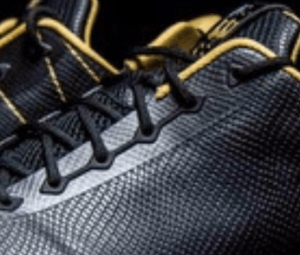
The Design of Big Baller ZO2 Prime VS KobeLet’s look at the design of these two shoes. Is there really is a justification for the price difference? The material specification for the Z02 Prime is listed as microfiber with Python emboss. This type of PU synthetic material ranges in price from $8.00 USD to $15.00 USD per yard. The amount required to make a low cut shoe will cost between $2.00 to $4.00 USD. This PU material is not particularly exotic. The Nike shoes’ 4D flyknit upper with TPU welds will cost about the same if not a little more. Both shoes have welded eye stays, but the Nike has more welding on the upper.
 Lonzo Ball’s Big Baller ZO2 Prime really a $495.00 Shoe?
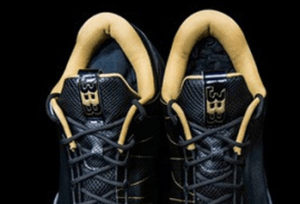
Both shoes have textile linings. There is nothing special in either case. Looking at the crease in the foam at the heel, I do think the Z02 Prime may be a little over-stuffed. This is a shortcoming I would not expect to see in a $495 shoe, or even a $150 or $100 shoe.
 Lonzo Ball’s Big Baller ZO2 Prime really a $495.00 Shoe?The rubber outsole designs are VERY similar. Single color crystal rubber with no logo embellishments. Thus, neither is exotic or expensive to make.
I will be a bit critical of the midsole design of the Big Baller Z02 Prime. The texture pattern is designed to resemble the Adidas™ Boost foam. The real material is made by BASF™. The distinctive BASF material bubble pattern is inherent to how the foam beads are expanded into the mold. The Z02 Prime fakes this look, but you can see clean, straight lines, on the upper edge of the midsole.  If this were the actual BASF™ Boost foam material the bubble texture would extend over the entire midsole.

Is Lonzo Ball’s Big Baller ZO2 Prime really a $495.00 Shoe?

If you are buying the hype and are a super fan of Lonzo Ball….then maybe. Looking at the build price of the shoe, I would say, “No way.” The shoe looks to have the same, if not a lower, build price as the Nike Kobe 11. I would also say that Big Ball Brand is way out of their league if they think they can go head to head with Nike’s marketing and shoe making machine. Furthermore, while the two shoe designs may look similar, there is no doubt that the quality and fit of the Nike shoe will be superior.
I do appreciate the idea of new brands launching into a very competitive market. Unfortunately, the exorbitant price tag for what looks like a very conventional shoe may have people asking, “What is the hype really worth?”
Come November, when the Z02 Prime hits retail, we are going to find out.

New Online Course
How much does it cost to
make a shoe?

Step-by-step how to create and analyze footwear costing sheets. 5 shoe cost calculation lessons. Over 1 1/2 hours of video instruction.
Course Details
enroll now $149

Posted on

Shoe Designer Interview : Franck Boistel

How to be a shoe designer

Professional shoe designer Shoe Designer Interview: Franck Boistel

Do you want to hear how a top gun professional shoe designer got his start? I sat down with my good friend Franck Boistel to talk about his work and to get his advice for young shoe designers looking to get started.

The shoe dog: Hey Franck, thanks for having me over! Can you give us a short bio?
Franck: I come from a family of 3 brothers, my Dad was in the French army and my mom was an opera singer.

The shoe dog: Where were you born?
Franck: I was born in Nantes, on the west coast of France. I lived there until 1997 then moved to the USA.

The shoe dog: Did you go to school to be a shoe designer? Where did you go to school?
Franck: I went to graphic design school for 3 years. I was about 19 and once I finished school I started in advertising in Nantes.

The shoe dog: What was your first shoe design job and how did you get it?
Franck: During my 3 years at school we were asked to do internships and I did mine in an advertising agency in Nantes called at Luour Med. It was a very good agency at the time.

After school they took me in for a few months but then they told me that someone 60k away in a town called Chalet was looking for a graphic designer, so I applied for the job, met the owner, and I started my first job ever there. Chalet is still known today at the fashion capital of France for clothing, footwear, everything!  All the clients were fashion companies.

In 1997, I was visiting California and I met the founder of Etnies, Pierre Andre. He was looking at my marketing stuff and asked me if I could design shoes. I said I would try it! I went to the store and bought some papers and pencils, then went back to my hotel. I was feeling sick at the time, so I sat in the hotel, ate a bag of oranges, and drew shoes over the weekend. When I went back to Etnies on Monday and showed my designs they asked me to start.  I was a shoe designer. Just like that!

The shoe dog: At Etnies, where you and I worked together, we would get the shoe design and the directive that the shoe needs to be on the market for $75. We would take the drawing and figure out materials, specifications, how to match the target price, do the pricing and the import duty… things that are not that much fun but important to running the business.
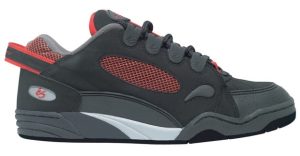
Franck: Yes! shoe design is not a one-man show, it is teamwork. It takes many people working on a design and you can’t really claim it as yours. It’s important to know that as a designer you work with product managers, product developers, pro-riders, marketing, salespeople. They are all giving you what needs to be done and you are a little magician to put all those pieces together and come up with something, but you are not alone, you have a team of people around you.
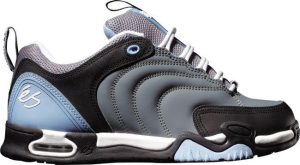
I’m really proud of all the designs I worked on with Es footwear: Virial, Tribal, Scheme. The shoe dog: Tell us about your shoe design accomplishments?
Franck: I’m really proud of all the designs I worked on with Es footwear: Varial, Tribo, Scheme. There was an era, 1999/2000, where we were blessed with favorable economics, we were exploding the market, we were researching the ideal skateboard shoe and those times were blessed with opportunities, explorations and that’s probably where I did my best work as far as going totally out of the box. So, I’m proud of all the things I designed for Es but also for Etnies, Emerica and 32 snowboard boots. With 32 we launched the whole lightweight process and product and look where 32 is now…they continued that lightweight process and 32 boots are amazing, probably the best on the market, so I’m pretty proud of that. The best sellers.
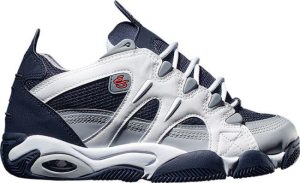
Marc Johnson, Ed Templeton, Erik Ellington, Bob BurnquistI designed skateboarding footwear for all the pro riders there: Marc Johnson, Ed Templeton, Erik Ellington, Bob Burnquist…I worked on the Koston 2 for Eric Kosten. Eric was a designer and he used to come up with 80% of the design on his own. We helped him to make up his vision. The Koston 2, 3, 4 are really my collaboration with Eric. Some of the riders need more help with their designs, like Arto Saari. I had a bunch of designs to put on the line and Arto picked one and that became a huge hit. It’s surprising. Some guys come to us with half a vision so we need to read their mind and understand what they need and what they want. On the technical side it’s easy but as far as styling it’s another ballgame so we have to pull all the information together and come up with something they are going to like. That’s the design part of it and when the shoe comes back they have to test it and sometimes they may not like the aesthetic but they like how the shoe performs and vice versa.

The shoe dog: I would tell the listeners to go look at the history of Es. The shoes from the mid-2000’s are amazing and there is nothing like that available now. It’s a very different time.  For shoe designers, it’s a worthwhile study.

The shoe dog: Do you have any shoe design fails?
Franck:  During the blessed times that we were designing freely without any restraints, just exploring, there were also some pretty bad messed up things. We were so free that we came up with really bad stuff but surprisingly those shoes that I don’t like, today I recognize as classics and I don’t know what to think. There was some commercial failure because the shoes we put on the market were too ahead of the times and it didn’t work, or the salespeople didn’t put the effort in to sell it because they didn’t believe in it, but it doesn’t mean the shoes were bad. In 2002/3 we started to realize that we needed to tune it down a little bit and make shoes at a more affordable price. We were starting to design more simple shoes and the salespeople were coming to us and saying, “No, no, what are you doing?” “We need another product like the Scheme.” They live in the moment and we (designers) live 2 years ahead, they didn’t see what was coming and it came. The trends went back to simple and price-conscious footwear and we saw that and we tried to put it in the line but it didn’t work at the moment we needed it to. It’s a group failure which happens all the time.

The shoe dog:  Do you have any advice for students?
Franck: I think when you start designing shoes for a company you have to get rid of the ego because the ego is not going to help you. Footwear design is teamwork and that’s very important to understand.  When you approach a company and when you start designing a product that works and makes money, don’t get a big head – that will lead you nowhere. Keep your head low, keep cranking, do your best work and best designs. I have met designers and I have been confronted with my ego and that doesn’t work at all. Design is teamwork, you work with several teams.

The shoe dog: Do you have any advice for designers on the job?
Franck: Students, don’t focus too much on the sketching…it’s good, you need to know how to sketch but you need to “think design” and think about your product before you get into sketching and that’s something that I learned through the years. I don’t make tons and tons of sketches before I get something. I think about my design for a couple of weeks, it builds in my head, and I can basically see my design before I sketch it and when I sketch it’s because it’s pretty much ready. When you think about the design, don’t just think about the aesthetic, think about the function and all aspects of the product you have to design and the sketching is just a tool for you to formalize what you’ve seen in your head. Sketching is just the communication part of it. Don’t base your design just on sketching. I’ve seen so many beautiful sketches but there’s nothing original in the sketches, they don’t bring anything new to the table. I’m telling you – lots of students with beautiful sketchbooks with spiders and tons of sketches but just nothing new because they keep sketching but they don’t “see it.”

The shoe dog: New designs you like?  Anything? Shoes?
Franck: I’ve been wearing Clae footwear and I really like them. The leather is amazing, the comfort is amazing, the style is pure and simplified and there are some really good lines. Everything on the shoe is great – like the footbed is comfy, it’s like buttery footwear. I like Clae footwear. Recently I’ve been wearing the NMD’s from Adidas and Ultra Boost, they are fricken amazing and I’m amazed by the amount of technology. I was fortunate to work at the Adidas factory in China and I’ve seen how the product is made and how the Yeezy’s are made and it’s just mindblowing how much thinking goes into the product. I’ve been wearing it to try it and it’s just mindblowing, the comfort is amazing, the styling is questionable, you may like it or don’t like it. I like those a lot and Adidas has been introducing a new generation of designs and forcing us to go into a new direction. Next, I like the Nike Huarache sandal that they did, very nice. I like Alexander Wang from Adidas.
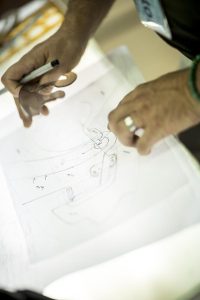
The shoe dog: New designs you hate?  Anything? Shoes?
Franck: There’s a shoe that just launched a couple of days ago, the Nike Vapor Max, it has a crazy airbag midsole and the upper is very simple and I just don’t think it is aesthetically very pleasing. I don’t like the overall look and don’t think it’s the right direction. For example, the NMD’s and Ultra Boost by Adidas are sexy looking.

The shoe dog: It reminds me of the Reebok DMX from back in the day.
Franck: It’s very predictable but not in a good way. I think it’s a step back. It may feel good but it’s unappealing to me.
The shoe dog: I’m not sure I like that one either.

The shoe dog: Best Air Jordan ever, #1 or #3?
Franck: #1, I’ll tell you why. The #1 you can wear for centuries, it will never go out of style and you can wear it all the time. Beautiful design. It’s timeless.

The shoe dog: Worst shoe ever, Air Jordan 13 or The Kobe Two?
Franck: Kobe Two!  I kinda like the Air Jordan 13 but the Kobe Two, no. I understand the concept behind it but it should have stayed a concept.
The shoe dog: A lot of big shoemaking mistakes never see the light of day but that one did. Should have stayed on paper.
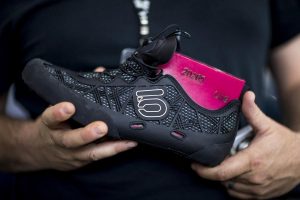
The shoe dog: What shoe design projects are you working on now?
Franck: I’m working for Five Ten. A climbing shoe company that was established 30 years ago. Adidas bought them in 2011. They have been doing climbing shoes, outdoor shoes, and mountain biking shoes. I am the lead footwear designer for this company and I manage a team of two designers and we have been working on really interesting technical stuff like a canyoneering shoe.

A canyoneering shoe has to have the features of a climbing shoe as far as the grip on the outsole, gripping rocks a certain way, and the outsole has to let water flow in and out without any sand entering. When you go canyoneering you have that ultra-fine sand that gets in your shoe and builds up inside so we needed to find a way for the water to come in and the sand to stay out. So, a combination of materials and layers that work towards that. The shoe looks really nice and works well. It has been tested recently in Zion Canyon and the response has been amazing.

I’m working on an outdoor hiking and climbing shoe. A pure hiking shoe but with features so you can climb and boulder in that shoe if you need to. I’ve also been working on mountain biking cleatless shoes. That’s something I never did before and I had to fix the previous work of a designer and I had to really put my head down on that and actually successfully design a clipless shoe.

Mountain biking, outdoor, and I also am trying climbing shoes but this is another ballgame, it’s a completely different approach and technology from what I’m used to. The ergonomics are crazy, the materials are crazy, the requirements are crazy! You need to be a climber. It’s a completely separate thing. Of course, anyone can do pretty designs of a climbing shoe but to actually make it work – I’m not there yet. And that’s great because as a designer we keep learning and year to year you tackle challenges and go over obstacles and you make something that you wouldn’t think you could have designed 2 years before.

The shoe dog: Give us a shoe design web link to follow?
Franck: There’s one I check every day, www.highsnobiety.com. They have the best looking shoes coming to the market every day. They post new footwear every day, they are aware in advance of everything that’s going to come out. It’s really cool.

The shoe dog: What shoes are you wearing now?
Franck: I’m always barefoot on weekends. When I work I put on my best shoes, but weekends I’m always barefoot and that’s the best feeling ever.

The shoe dog: Any parting shots?
Franck: Be humble, be great at what you do, keep learning, be curious. That’s the main thing, to be curious and try to travel as much as you can. It refreshes the spirit and the mind and helps you tackle problems differently when you travel. Even short travel. You will come back refreshed and this is key for a designer. Stay open to the world and learn new stuff.

The shoe dog: If you want to see more of Francks shoe design work check out:
FB design  Shoe design portfolio
Chomp on Kicks Shoe designer Interview
Ripped Laces – Ripped Laces Speaks to One of the Most Iconic Shoe Designers in Skateboarding

You can contact Franck on LinkedIn

Posted on

How to Start Your Own Shoe Company in Print!

How to Start your Own Shoe Company Book

how to start your own shoe company starting your own footwear businessDo you dream about creating a shoe brand and starting a company? How to Start Your Own Shoe Company was written for you! You will follow the complete design, development, delivery, and retail marketing of two very different start-up shoe companies. Each company has its own style of shoes and business plan. Every  chapter will introduce a new business requirement or manufacturing process and then explain how each of our two start-up shoe brands will tackle this challenge for their growing business.
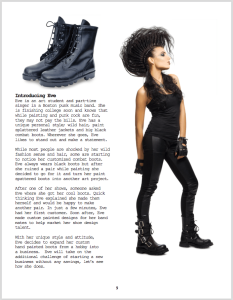
How to Start Your Own Shoe Company will guide you through creating your shoe brand identity, legally setting up your shoe company, and how to register your trademarks. You will learn how to get your shoes designed, how to find a factory to produce your shoes, and how to best go about selling your shoes. You will also find information on topics such as; calculating profit margins, importing your shoes, paying overseas vendors, working with international distributors, and capital requirements.

How To Start Your Own Show Company is arranged in chronological order following the complete start-up process from design, development, production, sales, on through web and retail marketing and distribution. The Book contains a sample shoe manufacturing business plan template. This book will help you understand all these challenges and be your guide as you build your own shoe company and watch it come to life!

12 chapters, 170 pages, 115 full color photos, charts, and infographics.


How to Start Your Own Shoe Company

Part 1: DESIGN – DEVELOPMENT – PRODUCTION

How to start a shoe brand Shoe business ideasChapter 1 : Your Shoes and Your Brand
Starting your own footwear business
Does the world need another shoe company?
Create your own shoe brand.
Create your business plan.
Footwear brand identity development.
Footwear target markets.
Shoe business ideas.


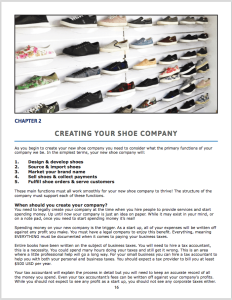
How to start a shoe business from home How to start a small shoe businessChapter 2 : Creating Your Shoe Company
When do you need to create your shoe company?
What kind of company best fits your needs?  What is an LLC?
Creating and protecting your trademarks.
Finding and buying web domains.
Permits for a new shoe business.


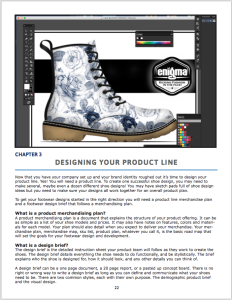
designing-your-product-line How to Make Your Own Shoe Line?Chapter 3 : Designing Your Product Line
Two kinds of shoe design briefs.
Footwear merchandise plans.
How to hire a shoe designer.
Do you need a footwear patent? Design vs utility patents.
Designing your own custom shoes.
How to find a shoe designer.


planning-your-shoe-business Shoe Pricing – From Cost of Production to Retail PriceChapter 4 : Planning Your Shoe Business
When and how to launch your shoes into the market.
Footwear delivery seasons.
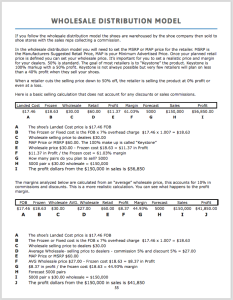
Financial modeling for your shoe business.
Calculating profit margins for footwear sales.
Shoe Pricing:  the cost of production and retail market pricing.
How to start a small shoe business.


manufacturing-and-importing-your-shoes How to start a shoe line from scratchChapter 5 : Manufacturing and importing Your Shoes
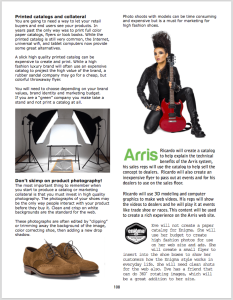
Finding a factory to make your shoes.
Footwear agents and trading companies.
The shoe development process.
Import duty and shipping rates for shoes.
Shoe manufacturing business plan.


start-up-costs-and-raising-capitalChapter 6 : Start-Up Costs and Raising Capital
Footwear development expenses.
The capital calendar for shoe start-ups.
Raising money for your shoe company.
Letter of credit and wire transfers.
How much money do I need to start my own shoe brand ?
How to start a shoe business with no money?


Part 2:  Marketing – Sales – Distribution

brand-promotion-and-footwear-marketingChapter 7 : Brand Promotion and Footwear Marketing
What is marketing? Traditional, guerrilla and social.
Footwear marketing strategies.
Making your shoe company catalog.
Print and digital media.
Shoe trade shows and alternatives.


Wholesale distributors of shoesChapter 8 : Footwear Sales and Distribution
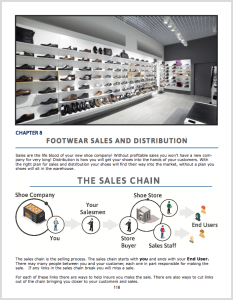
The footwear sales chain.
The language of footwear sales.
Footwear buyers.
Sales and distribution models for shoes.
Wholesale distributors of shoes.
Web direct internet shoe sales.
How to start a shoe business online.
Sell shoes online for cash.


shoe-company-operations How to Start a Shoe Manufacturing CompanyChapter 9 : Shoe Company Operations
Serving your consumers and shoe dealers.
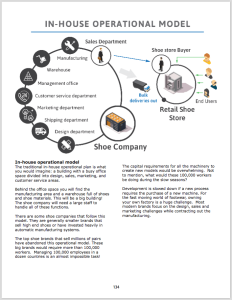
Operational models for shoe companies.
E-commerce platforms.
Third party logistics service providers.


whats-next-for-your-brandChapter 10: What’s Next for Your Shoe Brand?
Strategies for growing your footwear brand.
Selling shoes into new markets.
Diversifying your product offering.
Vertical integration.


going-internationalChapter 11: Going international
Defending your trademarks overseas.
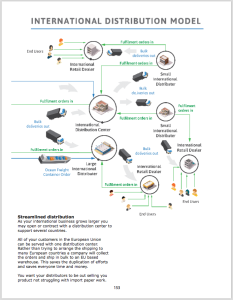
Distribution models for shoes.
Finding the right footwear distributors.
Purchase terms for shoe distributors.


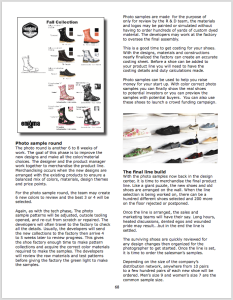
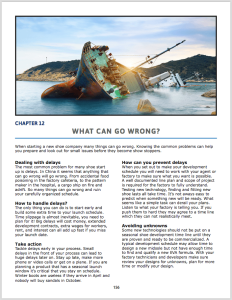
what-can-go-wrongChapter 12 : What Can Go Wrong?
Dealing with footwear manufacturing delays.
Shoe quality issues.
Lost trademarks.
Damaged shoemaking equipment.


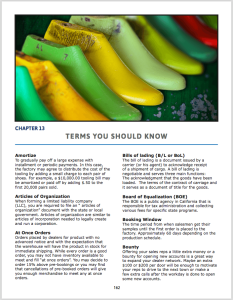
terms-your-should-knowChapter 13 : Shoe Making Terms You Should Know
Strengths, Weaknesses, Opportunities, and Threats
Stock keeping units (SKU)
Sales representatives and sub reps
Minimum advertised price (MAP)
Limited liability company (LLC)


sample-documentsChapter 14 : Sample Documents
Non disclosure agreement
U.S. tax form
DBA forms


Shoemaking
TextbooksBuy Now
Shoemaking
SuppliesBuy Now
Shoemaking
CoursesCourse Details

Previous
Next