


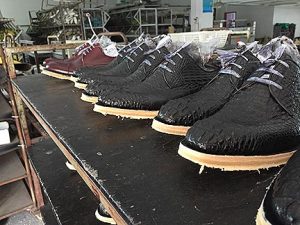
 Italian High Quality Shoes
Can high quality handcrafted shoes be made in China? Yes! The modern shoemaking trades have been thriving in China for more than 30 years. Shoemaking is a mature industry in China and there are thousands of skilled shoemakers with many years of experience. While China is known for the mass production of millions of glittering sport shoes, the manufacturing of handcrafted fine leather shoes is also well developed.
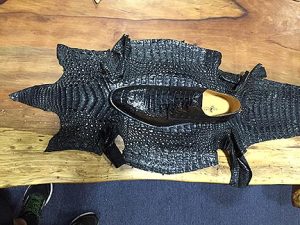 The typical shoe factory in China will have hundreds, even thousands of workers, but there is a new class of small factories now producing the highest quality custom and semi-custom shoes. On a recent visit to China, I toured the show room of the custom shoe maker Top Owen. Owen, the founder of the brand, learned his trade in mass production of athletic footwear, but then changed course.
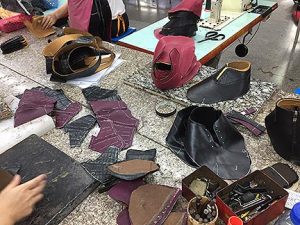 With a desire to create european craftsmanship in China, Owen left his job at a huge shoe factory to build his own micro factory. Owen hired on a staff of 25 expert shoe makers to operate his new custom shoe factory. After careful study of the highest quality European hand crafted shoes, Owen and his team now offer custom hand crafted footwear for shoe connoisseurs lucky enough to find him.
Owen now has many exotic leathers available for custom “one off” creations including ostrich, crocodile, alligator, snake, lizard and others.
Without any advertising or a website, Owen has created a loyal following for his exquisitely made custom shoes. Beyond shoes, Owen offers his customers other leather goods complementary to the footwear. If you would like a wallet, handbag, briefcase, belt or even a leather golf bag custom made to complement your shoes, Top Owen can deliver!
Top Owen offers a wide range of offshore making services and shoe styles.
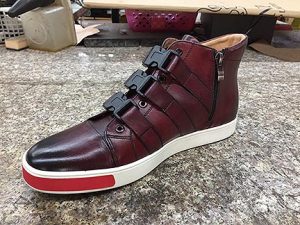 Are you looking for some custom made kicks? Owen has a section of mock vulc stitch down soles, classic trainer wedge, and classic basketball sole units available. For around $400 USD you can get your own pattern custom made in full grain leather. For an extra $125 USD you can have a test pattern sent to you for fitting.
Other options include a custom wooden box.
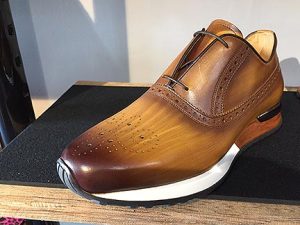 Send Owen a design for dress shoes and his team will create exactly what you want. You pick the design, last shape, leathers and any extra styling work you desire. Prices start around $400 USD – depending on your material and design requirements. For an extra $125 USD you can have a test pattern sent to you for fitting.
Other options include a custom wooden box.
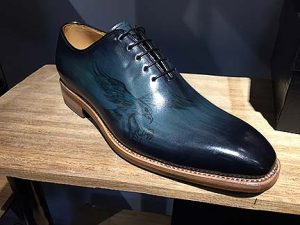 Are you looking for a full custom fit? For a 100% hand made last fit just for you? The full custom program brings the high end European custom made service to you at a fraction of the European price. Send Owen and his team photographs of your foot and record the critical measurements. Then, send Owen your design for the dress shoes and his team will create them to your specifications. Once again, you pick the design, last shape, leathers and any extra styling work you desire.
This Full Custom Service includes a lifetime service, warranty, repair and refresh service.
Prices start around $1000 USD – depending on your material and design requirements.
Shoemaking
TextbooksBuy NowShoemaking
SuppliesBuy NowShoemaking
CoursesCourse Details
Previous
Next

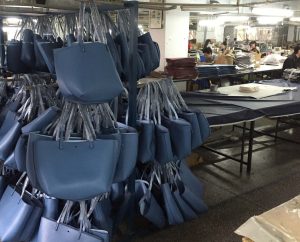
On a recent factory tour in China I was invited to visit a friend’s designer handbag factory. Since I was formerly bag designer, I was especially excited to have a look inside to see what was going on. The purse factory we toured was making medium priced leather and fabric bags for export to the USA and Europe.
Purses and bags follow many of the same techniques found in shoemaking. Material selection, cutting, processing and assembly processes are similar to footwear. One thing you will commonly see in a handbag factory is particular attention being paid to the edges of the material. Every edge gets some type of finishing treatment. A large portion of the factory was filled with racks of painted parts hanging to dry. You will not see this in a shoe factory.
This particular factory has a huge selection of available models. The store house has hundreds of different cutting dies and a massive collection of stock materials.


Shoemaking
TextbooksBuy NowShoemaking
SuppliesBuy NowShoemaking
CoursesCourse Details
Previous
Next


 How Designer Handbags are Made
As a shoe designer you may be called upon to work on many different soft goods projects. My design career started with bag design, moved on to footwear design, and now I work in both fields every day.
You will find that footwear and fashion handbags have a lot in common. Many of the design and manufacturing aspects are the same. Footwear and designer handbag materials and constructions are very similar. While shoe patterns and handbag patterns are very different they do have many of the same processing requirements.
When I saw the crew over at FASHIONARY
You can pick up this book from Amazon.com


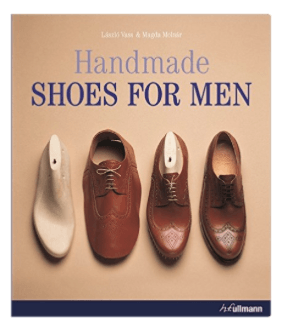
Hard Cover: 216 Pages Published 2015
What Amazon says: Handmade Shoes for Men elucidates the entire process of creating classic men’s shoes, while the detailed color photographs document every stage of production. It is a worthy introduction, for both the professional and the layman, to the wealth of tradition that is waiting to be discovered in the shoemaker’s workshop.
What The Sneaker Factory Crew has to say: We really like this book. Handmade shoes for Men is a great read. The book is well written and we found it very interesting. Laszlo Vass and Magda Molnar have done a nice job detailing the process for making hand made shoes. This is the classical ART of shoe making not the heartless mass production of china. Laszlo Vass is a real shoe maker practicing the highest form of our art.
From measuring feet, to lasts making, to leather tanning, shoe design, cutting, stitching, lasting and finishings this book has it all. If you are interested the art of Handmade shoes for Men then this is the book for you.
We give this book 5 Stars. Now Available on Amazon
László Vass, born in Budapest in 1946, worked in the Hungarian fashion house of Magyar Divatintezet as a clicker, closer, shoemaker, and designer from 1964 until 1969. In 1970, having gained his professional shoemaking qualification, he joined a private workshop specializing in handmade shoes and ladies’ boots as assistant chief designer and shoemaker. In 1978, Vass founded his own workshop and opened a business in the centrt of Budapest. Since 1988, he and his 20 staff have concentrated on traditional shoemaking. Today, the exquisite quality of the shoes made by the firm of Vass has earned the workshop enormous respect throughout Europe.


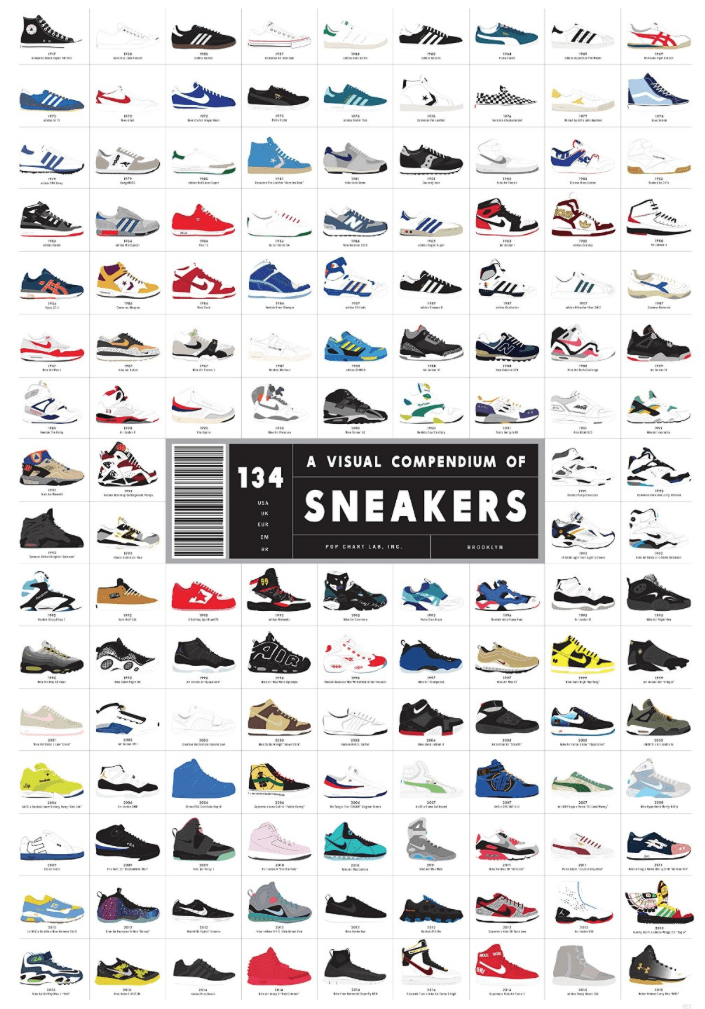
I love this History of sneakers poster! I have a copy hanging in my own in my design studio. This is poster features a meticulously illustrated collection of the 134 greatest sneakers in human history, starting with the Chuck Taylor way back in 1917, progressing through the styling low-tops of the 60s and 70s, delving deep into the great sneaker explosion of the 1980s, and carrying through the instant classics of the modern day.
This Sneaker history poster has everything from ageless Adidas designs, the many, many permutations of Air Jordans, groundbreaking skate shoes like Vans and monsters from the golden age of Reebok (such as the Shaq Attack and Alien Stomper) Just $35 bucks at Amazon!
Each print comes packaged in a Pop Chart Lab Test Tube.
Using 100 lb. archival stock certified by The Forest Stewardship Council, this poster is pressed on an offset lithographic press with vegetable-based inks in Long Island City, New York.

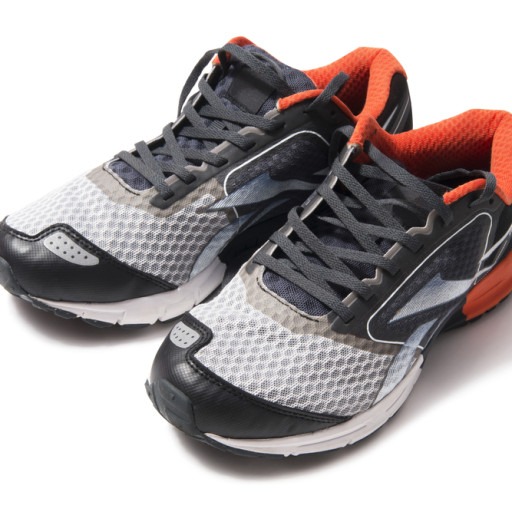 All running shoes are made by the cold cement construction process. If you want to learn how to design shoes you need to know this basic shoe making process. Cold cement is the modern updated style of shoe construction. Due to the low temperatures required for bonding the upper to the shoe sole, it allows the use of modern lightweight plastic, foam and mesh materials. Every modern high performance running shoe is made by this cold cement process.
 What are the best materials for running shoes? Most running shoes are constructed with breathable knit Polyester or Nylon mesh. Knit fabric allow the material to smoothly follow the last curves. Running shoe uppers often with PU leather reinforcements. Pu or synthetic leathers are great for running shoes as they have some stretch and are damaged by water. The classic running shoe is made from suede with some mesh inserts. While suede is comfortable and conforming, it’s not weather resistant and it’s very heavy when wet.
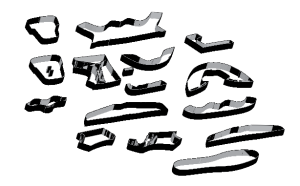
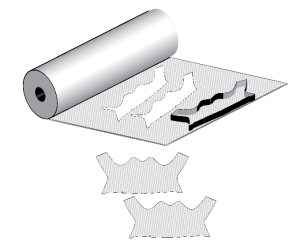 The pattern parts for the shoe are made into steel cutting dies. A cutting die is required for every part and every size. Each shoe part is cut from rolls of fabric or from leather hides. Fabric parts may be layered so many can be cut at the same time. Leather parts must be cut one by one to avoid having scars or other imperfections in the leather show on the final product.
The factories cutting department cuts all the parts for each running shoe, then gathers the parts into kits. One kit for each pair of shoes. After several hundred or even 1000 kits are complete they are passed to the stitching department for assembly.
The stitching department builds the parts of the running shoe sewing then together, finally closing the shoe and adding the tongue.

The running shoe upper is prepared with the strobel bottom. The outsole covers the edge of the upper so a strobel bottom can be used to make the shoe lighter and more flexible.
The running shoe upper is steamed to soften the materials and the last is inserted and pulled tight. Once the last is tight inside the upper a second lasting machine pulls the heel edge. Once the last is secured inside the upper, temporary shoes laces are pulled tight, and the upper is cooled which allows the upper to shrink and fit tight to the last.
The shoe may have a plastic or fabric part installed on top of the tongue to protect the surface from damage and drift during the lasting operations.
While the upper is being lasted, the sole unit is being prepared. In this case, a rubber sheet sole is combined with the EVA foam cushioning component cemented inside. This is done in a separate process that’s called stock fitting.
Running shoe midsoles will be made from weight EVA foam. A thin layer of rubber will allow the EVA to flex, but protect the midsole from wear.
Now that the upper is lasted tightly and the outside unit is compete, the two pieces come together. The rubber sole unit will receive coatings of primer and cement. The outsole will get its own special primer designed for EVA and rubber. The shoe upper is also prepared with its own special primer and cement.

After the contact cement and primer have been completely dried in the heating tunnels, the two pieces are joined together by hand. A skilled worker aligns the upper and outsole together then places the shoe in a hydraulic press.
The running shoe will have 3 pressing operations, usually all done with one machine: a vertical press, toe and heel press, and side pressing. This insures full contact between the upper and outsole uit. Once the shoe is pressed together it’s often put in the cooling tunnel to set the glue.
After the cooling tunnel, a shoe de-lasting machine is used to push the last out of the shoe without wrinkling the running shoe upper.
Now the running shoe is complete! At this point you can insert the footbed. The footbed may be molded EVA with a fabric cover or flat sheet cut foam. The flat die-cut footbed is usually cemented inside the shoe, while molded footbeds are most often removable.
The new runner is ready for a final QC inspection – a quick check for any loose threads, cleaning and then packing.

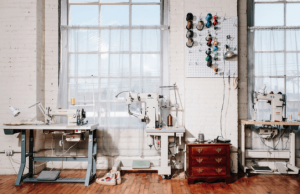
There is a small but growing group of young shoe makers that are making high end custom shoes. These shoe makers started repairing and replicating Nike™ classic kicks but some have moved onto the creation of unique custom one-off shoes.
Wired™ magazine recently ran a story on custom shoe maker Jacob Ferrato. The article “Go Inside the Workshop of the Custom-Sneaker King” appears in the June 2016 Issue. Read it Here!
See the Video here: JB Customs: Interview with Jacob Ferrato.
What we are interested in is what shoe making equipment do you need to run a mini custom sneaker factory. You can see in the article and videos a few different machines. These are real industrial machines you will find in any sample room of a large shoe factory. These shoe sewing machines may be a little hard to find but they are all available in the USA, Europe and Asia. If you want to start a small shoe factory these are the machines you will need.
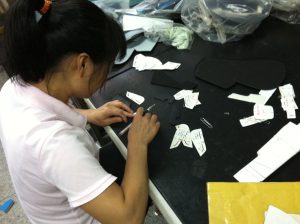 For the custom shoe making process you can hand cut every piece with scissors or a sharp blade. Most shoe factories don’t actually buy cutting blades, they sharpen a small piece of steel in a few different shapes to suit what they are cutting. In the video you can see a paper pattern template is used to trace the design onto the shoe materials. The materials are then cut by hand. This process is used on all the leather and mesh parts.
Factory sample rooms have been looking at ways to speed up this process. A large shoe factory will use a computer driven plotter cutter, water jet cutter, or even lasers to cut materials. For a hand made shoe made without the use of a computer generated pattern, a machine like the new $2,300.00USD Glowforge machine may be the answer. This laser will cut any design you draw on the materials. This has the potential to revolutionize the custom shoe market. Check it out!
 Once the parts are cut you can see the edges are being skived. In the video this is done by hand. This is a time consuming process and it’s very easy to damage the cut shoe parts. A shoe factory sample room will have a small electric skiver like this one, they don’t cost very much and will save time in our mini shoe factory.
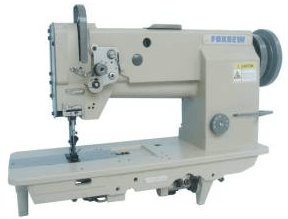 In the Wired™ article you can see some of these the machines lined up. The flat bed machine is the standard most recognizable type of machine. The machine is built into a table and run by an electric motor and has a foot control to advance the stitches automatically or one stitch at a time. This is the most common machine for assembling the flat pattern parts of the shoe.
Once the up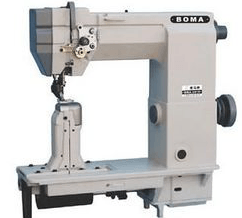 per of the shoe has been stitched together, it needs to be “closed”. This closing operation creates an upper that cannot fit under the standard flat bed machine. The second most common sewing machine you will see in a shoe factory is the “Post” style. Bulky items can fit under the machine for easy assembly. This type of post sewing machine will be used to attach the tongue to the shoe or to secure the lining inside the shoe once it has been assembled into the final 3D shape.
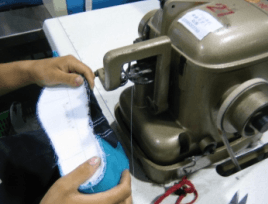 With the upper almost complete we will need a special sewing machine to finish it. This machine is used to sew the bottom fabric onto the upper. This closes the upper. Now the upper is ready for lasting and assembly.
Now it’s time to assemble the sole onto the custom shoe. There are two more pieces of shoe making equipment our mini footwear factory will need. A sole press and a channel stitching machine.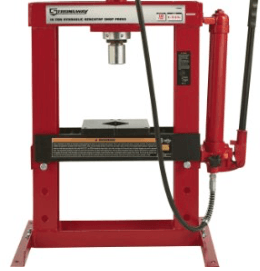
After the glue is applied to the upper and sole of the shoe it’s best to use a small press to make sure the bond is very strong. A bench top shop press is not expensive and can generate enough force to press the parts together.
The final must have piece of equipment for a small custom shoe factory may be the most expensive. This is a heavy duty channel stitching machine used to secure the upper to the shoe sole. This 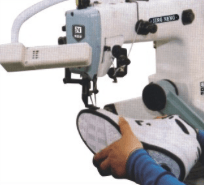 machine is very powerful and can easily drive the needle and thread through the leather and rubber.
Because sole bonding with shoe cement is difficult for a mini factory, this machine insures the shoe bottom does not separate from the upper. This machine has a long arm that can reach inside the shoe allowing the stitches to secure the rubber and upper together.
Shoemaking
TextbooksLearn MoreShoemaking
SuppliesClick HereShoemaking
CoursesLearn More
Previous
Next

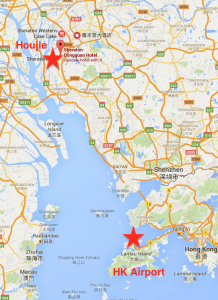 In the major shoe making centers in China you will find thriving local markets for shoe materials. The local markets are store fronts large and small with every type of shoe material, shoe component and manufacturing equipment available. You will find many store fronts displaying the material swatches available to order from a nearby factory or you will find shoe materials in stock that you can purchase immediately for use making samples. These market areas are very well organized, you will find streets lined with shoe material suppliers and even shopping malls crammed with all types of shoe materials.
I’m going to describe a busy shoe material market area in the town of Houjie. Houjie is located about 2 hours drive from the Hong Kong airport. Houjie is an industrial city which is common to find in China. The city has a robust footwear and furniture industry. Located within a 5 minutes walk from the Sheraton™ Hotel you will find hundreds of shoe material and equipment dealers.


Almost everything! Except you won’t find many dealers that speak english and you may need help with translations. Make sure to take some business cards or catalogs so the dealer can see what kind of shoes you’re making. Also you should have your Pantone book to check colors and bring a drawing of your shoes, this can help the dealer understand your needs.
The local material market is a great place to look for new ideas. The material market is also a good place to find materials for your sample shoes or a small production run. If you have a large production run, the material supplier will be happy help place an order directly with the factory. You must be careful when purchasing shoe materials from the local market. The supply factory information may not always be available and there may not be material test reports. Therefore, before you use any local shoe material in your production, you need to get some lab tests done to make sure the material is suitable for your shoes.
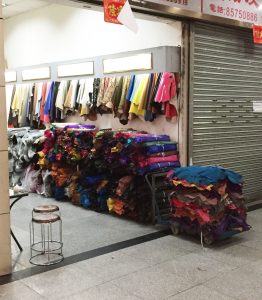 The material market in Houjie is a great place to find shoe leather. There are many different suppliers with all different types of leather. You will find leather in every color of the rainbow, from thick to thin, and in many different finishes. You can buy leather by the hide or a dozen hides at once. Of course, if you have a production order they can help you with that too.
Textiles for shoes are also plentiful in the local market. You can buy swatch cuttings or 100 meter rolls. You will find mesh for shoe uppers, shoe lining materials, and entire stores with reinforcing fabrics and strobal bottoms for shoes.
Shoe outsoles are also available in the local market. You will find dealers with hundreds of outsole models on display. These are “open” mold outsole units. You can find flat treads, platform heels for women’s shoes, work boot bottoms, soccer cleats, casual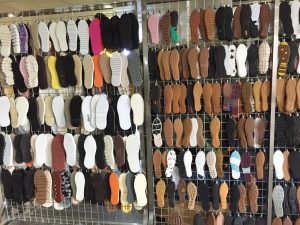 bottoms and running shoe bottoms. In the local market you will find “copy” bottoms of the latest shoe designs (without logos). You cannot buy a single outsole 1 but you can order small runs of 5 to 10 units to make samples, then of course more for production. The only issue with the local market outsole is the last bottom is already set. This may or may not work for your market. You can buy the last with the outsoles or you can have a local last maker help you model the last to fit the outsoles.
Can you find shoe laces? Yes, by the thousand!
Can you find metal hardware? Yes!


Start with In-depth study of material types available in modern shoemaking. Learn the Technical details of shoe material specification. 195 pages or 300 color photos.
Buy Now
on sale $39.99


14 Shoe material lessons.
Over 4 1/2 hours of video instruction.
In-depth study of leather, textiles, synthetics and plastics for footwear.
Material Design Guide Textbook included.
Course Details
enroll now $399

