There are many shoe construction methods from which a shoe designer can choose. Depending on the function and style of your shoe design, you have many options for connecting the upper to the outsole unit. The classic Goodyear welt, the heavy-duty Norwegian welt, and the modern cold cemented Strobel construction, to name a few.
Whether you are designing running shoes, Alpine mountaineering boots, or posh office shoes, you will need an understanding of shoe construction methods. Here we will review these common forms of footwear construction including board-lasted construction, Strobel construction, Blake Construction (also called McKay Welt), Blake/Rapid Construction, Goodyear welt construction, Norwegian Storm Construction, Stitch down Construction, and Bologna Constructions.
Need to know Footwear Construction Terms:
Welt: A welt is a strip of leather, rubber, or plastic that runs along the perimeter of a shoe outsole. The machinery used for this process was invented in 1869 by Charles Goodyear Jr., the son of Charles Goodyear. Outsole: Can be made of rubber or leather. Midsole: Can be made of leather, cork, or foam.
Board Lasted Construction: A very common shoe construction technique that can be made by machine or by hand. The upper is pulled tight and bonded to a fiber board. The outsole unit is firmly cemented to the upper, securing the upper to the sole. Board lasting construction can be used on almost any style of shoe, being suitable for many upper material types and outsole styles. Strobel Construction: Used for most athletic shoes, Strobel requires the upper material to be sewn to a fabric bottom creating a “sock.” The upper and bottom are joined by a Strobel stitch, using a Strobel machine.
With the upper sock tightly lasted, the upper is cemented to the outsole completing the shoe. Blake Construction: Used to make flexible leather shoes, the Blake construction starts with a board-lasted upper. Glue the sole in place then with the last removed, sew the upper directly through the outsole unit. The outsole may be leather or rubber and have a groove molded into its surface to guide the Blake stitch. You will find Blake construction on weltless leather dress shoes, moccasins, and boat shoes. Blake construction is not waterproof. Blake/Rapid Construction: Similar to the standard Blake construction, but with a “rapid” perimeter stitch attaching the outsole. The outsole covers the Blake stitching. This allows for a thicker sole and is easier to resole. The extra layer can be rubber, making the shoe more durable. Goodyear Welt Construction: The Goodyear welt is often used to make waterproof soles, the stitch that attaches the sole to the shoe runs around the outside edge and does not make stitch holes in the upper. The upper is sewn to the welts that attach to the insole and the outsole. During assembly, the welts are attached first by a horizontal “Goodyear” stitch, named for the inventor of the stitching machine, Charles Goodyear Jr. (also the son of the famous rubber inventor, Charles Goodyear Sr.). The Goodyear welt construction method is ideal for heavy-duty boots for hiking or service. Norwegian Storm Welt Construction: Similar to the Goodyear welt construction method but the upper is turned outside and is sandwiched between the outer welt and the outsole. Used to make the heaviest waterproof boots, the Norwegian Storm Welt is difficult to make and is found almost exclusively in the workshops of Italian bootmakers. Stitch down Veldtschoen welt Construction: Again, the Veldtschoen welt is related to the Goodyear and Norwegian welt constructions. In this case, an inner welt or rapid stitch line sewn through the midsole is paired with a second rapid stitch that attaches the outsole. The outsole is attached after the first welt, the bottom stitch is protected by the outsole. Bologna Construction: Developed in Italy and used primarily for dress or fashion shoes, the Bologna construction creates a smooth, comfortable shoe. The shoe lining is joined into a sock fitting the last tightly. The leather upper is then attached to the sole via the Blake stitching method. The Bologna shoe construction method is ideal for making very clean looking and flexible shoes.
New Course! Shoemaking for Designers & Brand Builders
Created for footwear beginners and career changers alike, this course delivers the basic shoemaking knowledge you need to get you career in the shoe trades started.
Learn more
On sale $99
Start Building Your Shoe Business
A must-have for anyone serious about launching a footwear company. 4 text books, shoe business documents and downloadable content not available anywhere else! The Shoe Company Start-Up Pro Pack is all you need to get your shoe business off the ground.
Learn more
Download Today
What is the Process of Making New Balance Classic Shoes? Most New Balance shoes are made by Cold Cement Construction process. The New Balance classic trainer styles have a Sheet Cut EVA midsole. This Midsole is attached by the Cold cement process. Cold cement is the modern updated style of shoe construction. Cold cement is the opposite of the classic high heat vulcanized shoe construction, as found in Vans and Converse shoes. Cold Cement shoe construction allows the use of modern lightweight plastic, foam and mesh materials due to the low temperatures required for bonding the upper to the shoe sole. Every modern high performance athletic shoe manufactured by New Balance for Running, Basketball etc… is made by this cold cement process.
Cold Cement / Sheet CUT EVA Shoe Assembly Process:
New Balance Classic with a sheet cut EVA Midsole the shoe upper must be prepared by board lasting. For this running shoe the outsole will not cover the edge upper so it must be tucked under. This is called “board lasting”. The lasting board is made of treated fabric or paper board.
The shoe upper is steamed to soften the materials and the last is inserted and pulled tight. A lasting machine is used to pull the upper tight. The Lasting machine pulls the upper tight, while securely bonding the upper to the lasting board. The lasting board remain inside the shoe, you can see it under the footbed.
The shoe may have a plastic or fabric part installed on top of the tongue to protect the surface from damage and drift during the lasting operations.
Sheet but EVA sole – Cut and Buffed and ready
While the upper is being lasted the sole unit being prepared. In this case a the rubber sheet sole is combined with the EVA foam cushioning component cemented to the underside. This is done in a separate process that’s called stock fitting.
The sheet cut EVA material is cut into a profile then machined to follow the outside bottom shape. A shaped grinding stone buffs the edge profile.
Now that the upper is lasted tightly and the outside unit is compete, the two pieces come together. The rubber sole unit will receive a coating of primer and cement. The outsole will get it’s own special primer designed for EVA and rubber. The shoe upper is also prepared with its own special primer and cement.
After the contact cement and primer has been completely dried in the heating tunnels the two pieces are joined together by hand. The skilled worked aligns the upper and outsole together then places the shoe is a hydraulic press.
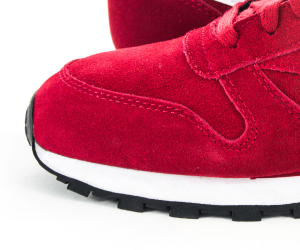
The toe tip will get extra pressing[/caption]
The shoe will have some pressing operations, usually all done with one machine. A vertical press, toe and heel press and Side presses. This insures there is full contact between the upper and outsole. Once the shoe is pressed together it’s often put in the cooling tunnel to set the glue.
After the cooling tunnel a shoe de-lasting machine is used to push the last out of the shoe without wrinkling the upper.
Now the sneaker is complete at this point you can insert the foot bed. The footbed may be molded EVA with a fabric cover or flat sheet cut foam. The flat die-cut footed is usually cemented inside the shoe, while molded footbeds are most often removable.
The new sneaker is ready for a final QC inspection, a quick check for any loose threads, cleaning and packing.
I’ve read a great many shoe design books, so I would like you to see what is out there and available. I have picked a selection of shoe trade books on shoe design, manufacturing, and engineering. Here is a list of great footwear design books. Included are few books about shoemaking and shoe design that are available on Amazon.com now:
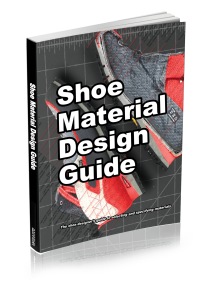
The shoe designers complete guide to selecting and specifying footwear materials by Wade Motawi $39.99 Softcover
What Amazon says:“Do you want to be a professional shoe designer? You must learn how to select and specify shoe materials correctly. The Shoe Material Design Guide details all the materials you will need to make modern athletic, classic casuals and high fashion footwear. Written as a companion to our best selling How Shoes are Made, The Shoe Material Design Guide digs deep into the world of footwear materials and design. A must-read for young shoe designers! “
What I have to say: If you want to see what Nike shoes are made of? Then the Shoe Material Design guide is just for you. I really like the cut shoe cross-sections. I recommend it for sure, this is a shoe design book that definitely belongs in your library.
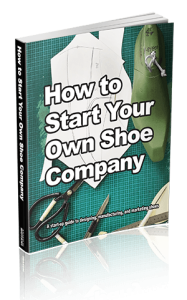
A start-up guide to designing, manufacturing, and marketing shoes. by Wade Motawi $39.99 Softcover
What Amazon says:“Do you dream of creating a shoe brand and starting a company? In the book, How to Start Your Own Shoe Company, you follow two start-up companies from initial launch to retail sales and marketing. Both companies have a unique style, budget, and business plan. In each of the 14 chapters, a requirement or process is clearly described and you will learn how each of the two new shoe brands will best tackle this challenge. How to Start Your Own Shoe Company will guide you through creating your brand identity, legally setting up your shoe company, and registering your trademarks. You will also learn how to design and manufacture your shoes, how to find the best shoe factory, and how to go about selling your shoes.
Many other topics such as importing shoes, working with international distributors, calculating profit margins, paying overseas vendors, and necessary capital requirements will also be covered so you can get your startup moving forward right away. How to Start Your Own Shoe Company is arranged in chronological order, following the shoe company start-up process from initial design, through development, production, sales, marketing, and distribution.
There are more than 100 full-color drawings, photos, charts, infographics, spreadsheets, and sample forms to clearly illustrate the complete process. This book will help you meet many challenges and be your complete guide to making your own shoe company come to life!
What I have to say: If you are thinking about starting your own shoe businesses, read this book! Tons of great information you won’t find anywhere else. This is a shoemaking book that belongs in your bookcase!
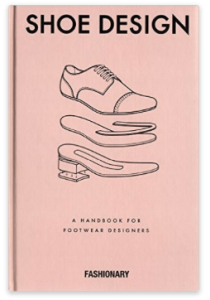
What Amazon says:“Differing from ordinary shoe design books, this is a complete handbook geared towards practical usage by footwear designers. It includes three main sections: Shoe Style Library, Shoe Encyclopaedia, and Shoe Templates for Tracing. The first section features more than 300 styles of shoes, ranging from historical archetypes to the most signature styles in todays footwear industry. The second focuses on essential and practical information on shoe design, from materials and construction to labels and international fairs. The templates section includes both basic templates and templates for 60 styles of common footwear, from flats and boots to high heels.”
What I have to say: I think you will really like this book. Plenty of cool stuff to keep you busy. Great templates for both tracing and sketching. A good warmup on basic shoe design and shoemaking. A great book that belongs in your library.
A behind the scenes look at a real Shoe Factory
by Wade Motawi $39.99 Softcover Newly Updated 3d Edition
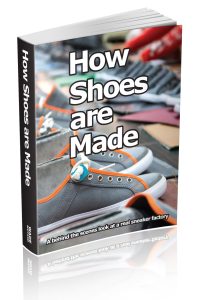
What Amazon says:“Do you want to learn about how modern athletic shoes are really made? This is the shoe design book for you. Now you can really see how the big shoe brands design and produce shoes. More than just a guided tour through a sneaker factory, How Shoes are Made will show you how modern sports shoes come to life from drawing designs to sample development and manufacturing. Footwear design and manufacturing is simply explained for sneakerheads, students, young professionals, or anyone interested in the shoe trades. Written by a veteran shoe professional, How Shoes are Made will give you a look inside the real world of shoe production. 28 Chapters explain Shoe Design, Development, Materials, Stitching, Outsoles and Tooling, EVA Forming, Final Assembly, Shoe lasts, Shoe prices, Quality control, and much more! 250 Pages with over 400 color photos.
If you are a sneaker collector, design student, or just interested in shoes, read on. “
What I have to say: I think you will really like this book. Much more than a “how to” book, How Shoes are Made has tons of inside information. It teaches you about how to prepare your design for production, the stages of design, and materials. It is a very solid primer for the world of production shoemaking. This is a shoe design book with much more! A great book for shoe designers. A must read in order to jump-start a career in the shoe trades! I recommend it.
Drawing and Sketching Shoes using templates and guidelines.
by Mark Kokavec $33.00 Hardcover What Amazon says: “The Render Demo How to Draw ATHLETIC SHOES sketchbook is a great tool for students, sneaker enthusiasts and designers looking to learn how to draw and sketch shoes. This unique sketchbook shows you how to set up different perspective views including side, front, heel, top down, bottom and more. It contains over 100 photo-blue templates and guidelines that you can use as underlays to sketch your own unique creative shoe designs. The goal with this book is that once your finished, you will not need to rely on any guidelines for sketching your concepts. This sketchbook also contains general footwear knowledge, terms, industry information, reference materials and more. Its more than just a typical plain old sketchbook filled with blank pages. • Anatomy of the Foot: Understanding the basic parts of the human foot • Anatomy of the Shoe: Break down of the different parts of a shoe • Shoe Types: A look at some common shoe types • Proportions: Step-by-step description on how to build the shape of a shoe. •Perspectives: Step-by-step description on how to set up the shoe using different angle • Templates: Our unique “Phase-out” template system”
What I have to say: The Render Demo How to Draw ATHLETIC SHOES sketchbook is exactly that – a great sketchbook. I really like it for that aspect, however, it’s very thin on details of shoe designing and has nothing to say about what it takes to make that drawing into a real shoe. I still do recommend this book to get your drawings skills up to scratch. I own the books and I use it often to keep my sketching skills crisp. Even though there are many shoe design books, this is a good one, and it belongs in your library.
by Henrik Klingel (Author), Daniel Jarosch (Author)
$19.95 Paperback
What Amazon says: “A coloring book for grown-ups, The Sneaker Coloring Book is a collection of 100 black and white line drawings of popular sneaker designs, shown in side view, to color, alter, or customize. The models featured are 100 of the most popular designs from 1916 to the present day from 18 major brands including Adidas, Converse, New Balance, Nike, Onitsuka Tiger, Puma, Reebok, and Vans. Brand, model name, launch date, and category are listed for each sneaker. The drawings are printed on high-quality drawing paper and the pages are perforated so that a drawing can be removed once completed. Taking a fun and highly original approach to sneaker culture, the book will appeal to anyone who likes to color and customize their sneakers, to fashion and footwear designers, illustrators, graphic designers and, above all, to the sneaker fanatics who want to own every book about their favorite subject.”
What I have to say: This is a must for shoe designers! All the classics are in here ready to be used as an underlay for your new shoe designs. Nice dark lines will show through tracing paper. Lots of fun and not expensive. I have a very well used copy of this book. I recommend it.
What Amazon says: “Footwear design has become the new dream career, and this book is the first guide to show the key skills and tips behind the trade, for both budding designers and anyone interested in shoes. Illustrated throughout with inspirational sketchbooks detailing the design process and specially commissioned images of cutting-edge shoe design, the book also contains case studies featuring an array of international shoe designers.”
What I have to say: Footwear Design (Portfolio Skills: Fashion & Textiles) is a well-written book that is focused on women’s fashion shoes. Some very nice exploded views and shoe pattern part layouts. I like the views of shoe patterns on lasts. Not such a fan of fashion designer interviews, but I say worth a look if fashion shoes are your interest. I recommend it.
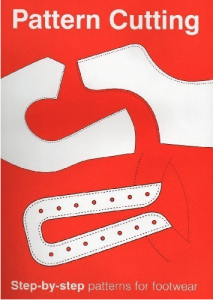
What Amazon says: “Pattern Cutting replaces the Pattern Cutter’s Handbook which since 1991 has become the standard textbook on many college and university courses covering footwear, all over the English speaking world. The new book covers everything in the earlier book plus much more. Not only are there whole new chapters covering further styles of footwear, there is a chapter on Bottom Patterns, an extended chapter on Grading, and a chapter on dealing with more advanced pattern problems such as a bellows-tongue.
In the past, books on pattern cutting have often reflected the mystique which tends to surround the subject. Pattern Cutting takes a completely different approach. The whole book is written as an easy to use, step-by-step guide to producing patterns for shoemaking.
Each major type of footwear has a complete chapter devoted to it. The twelve basic types covered include trainers, basketball boots and an aerobic shoe. Most pages have two or three diagrams, illustrating each step in the process.
With each footwear type there is a detailed description of the process with measurements given wherever appropriate. Points to watch for and pitfalls to avoid are spelled out, so as to ensure the reader will stand the best possible chance of producing a workable pattern first time.”
What I have to say: I do own the book and have found it very useful. It has 17 chapters covering the many types of footwear patterns. I found chapter 2 on the Forme cutting of the shell last to be the most important for my projects. If you are going to cut your own patterns, I recommend Pattern Cutting: Step by Step Patterns for Footwear. This can be hard to find online, as on amazon the price is crazy. I had to order directly from the UK www.noblefootwear.com.
(Woodhead Publishing Series in Textiles) Hardcover
by A Luximon (Editor) $237.00 Hard Cover What Amazon says: “Understanding footwear design and manufacture is vital for improving the functionality, aesthetics and marketability of a product. The Handbook of footwear design and manufacture provides a comprehensive review of footwear production and design and explores how these processes are used across a variety of application areas.
Part one, an introductory section, reviews the fundamentals of footwear anatomy; chapters discuss the anatomy of the human foot, biomechanics and gait, foot models and measurements, the development of the foot in childhood and adolescence, and foot problems and their implications for footwear design. Part two examines footwear design including the development of shoe design, foot sketch templates, and footwear drawing templates. Aspects of footwear manufacture are highlighted in part three including the design, manufacture, and sizing and grading of shoe lasts. Further chapters focus on the footwear business, advertising, and the environmental impact of footwear manufacture. Part four explores the design and manufacture of footwear for specific applications and includes chapters on footwear for cold weather, textiles and other materials used in the production of protective military and orthopaedic footwear, and design issues in geriatric footwear.
The Handbook of footwear design and manufacture is a wide-ranging and technical resource for footwear designers, materials scientists and researchers involved in the production of footwear, and professionals in the footwear industry looking to expand their knowledge of design and manufacture processes. Discusses foot anatomy in detail and considers its implications for footwear design.”
What I have to say: The Handbook of Footwear Design and Manufacture is very dense. It may belong in your book-case but it’s definitely not a page-turner. Its massive price tag is also a bummer, making it well out of reach for anyone not in the trades. I’m not sure I can recommend it.
by Ravindra S. Goonetilleke (Editor) $150.00 Hardcover What Amazon says: “Although we now have sophisticated algorithms and techniques for determining the shapes and sizes and for matching the fit between shoes and feet, few, if any, of the books currently available cover these new technologies until now. Bringing together high-quality and state-of-the-art contributions from designers, biomechanists, ergonomists, engineers, podiatrists, and scientists from industry and academia, The Science of Footwear provides an in-depth understanding of the technology and techniques involved in the design and development of a popular and demanding consumer product.
This book introduces the design, development, manufacturing, and marketing of footwear. The chapters contain data from past research and the state-of-the art methodologies. They not only cover every aspect of the product design, but also how the footwear industry caters to the wide-ranging needs of sophisticated and demanding customers.
The footwear industry has rapidly changed over the last 10 years. Mass production has changed to personalization and mass customization, areas that are not well-understood. This book explores these different concepts in a coherent way, drawing on differing views that give a holistic view of the science behind footwear. Collating information from different disciplines, the book provides the tools to develop the next generation of footwear.”
What I have to say: I have to say I’ve not gotten my hands on The Science of Footwear. Looking forward to reading it this summer!
Your new shoe design isn’t complete until you have detailed the logos. A beautiful set of logos will add value, give information to your customers, or be that unique and special twist. A great logo can provide the centerpiece for your shoe design. Adding logos will cost money, so we better make sure you are getting your money’s worth.
Selecting logos for your shoe design:
When you are working with a new shoe factory, it is very helpful to know their capabilities. For example, if the factory does not have an embroidery machine in-house, it will cost more to send the cut part out for processing. Or, if the factory has a great relationship with the woven label supplier, it will be worth your while to arrange a visit to see what they can do.
Here we will review the most common types of logos found on sports shoes. We will discuss what the logo parts cost, set up charges, and design tips.
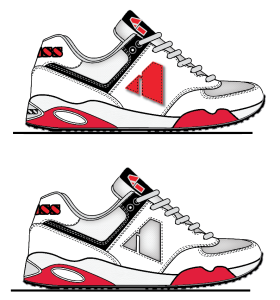
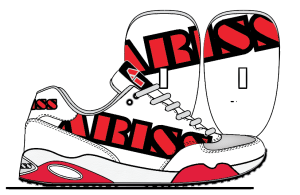
Die Cut Logo: The die cut shoe logo is the most common found on shoe quarter or side panels. The logo is simply cut out from a piece of material and sewn on. The Nike “Swoosh”, Adidas “Stripes”, New Balance “N”, Vans “V” and Puma “Formstrip” are classics. Die cut logos are great for high visibility applications and can be made of almost any material. The die cut logo is a perfect overlay on top of any seam or pattern breaks and can also be reversed so the logo is now a window to the inside of the shoe. The downside is details are limited to what can be sewn down. Price is low, only being the cost of the material.
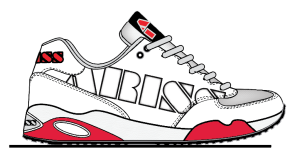
Screen Printed Shoe Logos : Screen printing is a very common logo application for shoes. Set up is nearly zero, colors are almost unlimited. There are many finishes available such as matte, gloss, puff, or 3D styles. However, there are limits to the surfaces you can print on. Rough or suede surfaces will not take prints smoothly. Elastic fabrics will cause cracks in the ink. Any waxed or oiled surface is also not suitable for screen printing. On the flip side, printing is great for big, high contrast logos. Screen printed logos can be several colors but be aware registration can be difficult. Every factory will have a screen printing department. The logo can cost from $.25 to $.75 per unit, depending on the size and number of colors. There are usually no setup charges for silk screen printing logos.
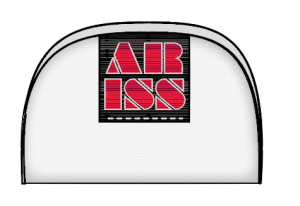
Print + Emboss Logo: An inexpensive, but great logo effect for shoes can be created by screen printing, then using an RF welding machine to emboss the logo for a 3D effect. The RF welding machine is an inexpensive tool and the cut brass welding heads don’t cost much. Inexpensive to set up and when it’s done in-house at the factory it’s cheap! The emboss tools may cost $300 depending on the logo size.
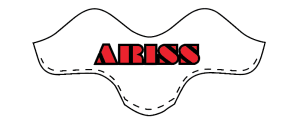
Woven Labels: The woven label is another great way to create colorful logo effects. This type of label is machine-made by computer control. The Resolution is great for fine details and small crisp text. Colors are nearly unlimited and one logo can have as many as 15 colors. The basic tongue logos on New Balance or classic Nikes are made by this process. This process can be used to create an informational label on its shoes. Setup charges are low, possibly zero. These woven label logos are not expensive, with prices starting at $.05 and running to $1.00 for a large multicolor patch.
The Ultimate Shoe Material Textbook
Start with an in-depth study of material types available for modern shoemaking. Learn the technical details of material specifications. 195 pages and 300 color photos.
Buy Now
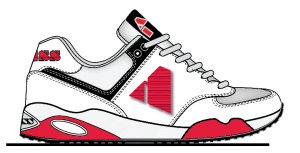
on sale $39.99 Embroidered Logo: Another very common shoe logo treatment. Embroidery or computer stitching can add a touch of class to a shoe. Silky threads can create rich looking logo applications. Colors are limited only to your imagination, most machines can handle 8 to 10 colors! This is a great logo application but it needs to be used wisely. Embroidery is priced out by the stitch, with extra cost for more colors. The logo can also run off the side of a panel part, and light colors can be soiled easily with threads being snagged. Use with care in waterproof shoes, the stitching will let water in. Price can vary wildly for this type of logo treatment, depending on if the factory has its own embroidery department or not. There are usually no setup charges. The logo can cost from $.25 to $.75 depending on the stitch count and the number of colors. 3D Embroidery:
This is a stunning way to make an amazing 3D effect logo. A small piece of EVA foam is placed under the embroidery head, and the threads cut the edges when they are stitched, leaving behind a logo with a 2 or 3mm 3D effect. A great effect but prone to snags and soiling when used on shoes. Usually no setup charges. The logo can cost from $.25 to $.75 depending on the stitch count and the number of colors. TPR Micro Injection:
Often called rubber badges, Micro Injection, or simply “TPR” (Thermo Plastic Rubber) logos are a great way to add fine detail to your shoe’s design. TPR logos come in all shapes and sizes. Details can be tiny and colors are nearly unlimited. These little logos can be used as under or overlays, placed on tongue or outsole bottoms. They are durable, colorful, and relatively cheap. $.25 USD. They can have clear gel bubbles over them, or can have fabric backing. These are great for sport and outdoor shoes. The downside is they will require molds, but TPS molds are cheap to set up. Less than $200 USD. Dye Sublimation Printing:
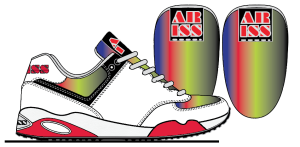
A printing process that uses a computer to print a full color design onto transfer paper. When the paper is applied to the material surface and heated, the ink turns into a gas (actually sublimes) and transfers to the shoe material. Dye sublimation is great for 4 color process photographic designs. Setup for sublimation can be zero for computer print, or $500 per color if made by roller print. Part price can be as high as $1.00 or more. PVC Gel Bubbles:
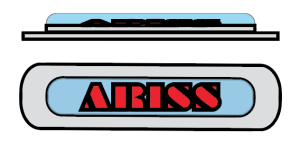
A simple way to make a unique logo is the Gel bubble. These are made by adding a clear PVC gel bubble onto a woven label, or printed sticker. These logos can have a stitch flange to use as an underlay or can be self adhesive for attachment to midsole or outsoles. Setup is low. Part price can be $.05 to $.25, depending on size.
Shoemaking Material Kit
All the hard find parts for your DIY shoemaking project are here in one place. Lasting board, strobel material, lining mesh B&W, collar foam and all the reinforcing parts you need for one pair.
Learn more
On sale $39.99
Chrome-Plated ABS Plastic:
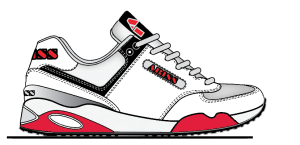
If you want a chrome logo, you will need to go with metal or injection molded ABS plastic. ABS plastic has a unique surface character that allows vacuum metal coating, so you can get a nice chrome-plated surface. Injection molds for ABS cost from $500 to $1500. Per unit price can be $.25 to $.75 depending on the size. Metal Hardware:
Metal hardware is a great place to get some custom logos on your shoe. Logo plates, custom eyelets or lace fobs give you another place to add your logo. This hardware can be cast, stamped, painted, plated, polished, or anodized. You will have many metal choices from steel, to brass, to zinc, or even aluminium. Custom metal hardware will have some setup charges. Tooling prices depend on the metal type and process required but could be anywhere from $300 to $3000. The part price could vary from $.10 to $.50. Molded Logos:
The modern sport shoe may have several molded components, some being EVA midsoles, plastic stabilizers, rubber outsoles, etc… Each of these is an opportunity for a crisp logo. These logos cost you nothing once they are machined into the mold. Backprinting Effects: If your shoe design has any transparent upper parts or a clear rubber outsole, you can use back printing to add a unique logo application. These can be simple screen prints or pad prints with low setup charges and low unit cost.
Cut Weld: The cut weld is related to the RF weld. The welding die has a crisp edge, and when the TPU material is welded down and the waste is peeled away, it leaves behind the material. The colors and surfaces are limited to what you can get in the weldable TPU material. This is a strong way to get a glossy logo on rough mesh or even chrome! The cutting weld tools may cost $300 to $1000 depending on the logo size. Pressed TPR Pressed TPR is the high-tech version of the basic TPR logo. In this case, while the TPR material is still in the mold, the shoe material gets laid onto the mold, and with heat and pressure is fused to the material. This can be used to make small logos or large reinforcing panels. Laser Engraving or Cutting: A new way to cut logos, the laser, is a unique way to make a high-resolution logo. Color is limited to that of the burned substrate. Laser technology is expensive but is getting more popular. A neat feature is the laser can be programmed to make marks or make cuts depending on the power setting. There are usually minor setup charges for the programming, in addition to a higher per-unit charge depending on the time required for each logo.
What logo is right for your shoe design?
As you can see, there are many great options for applying logos to your new shoe design, regardless of your target price, including everything from the basic printing and embroidery to the complicated laser and injection mold. For low volume shoe designs you may want to select logos with no setup charges, while for high volume shoes it is more feasible to go with injection style logos or others that require more expensive tooling before they can get put on shoes.
New Online Course How to Select Shoe Materials
14 Shoe Material lessons. Over 4 hours of video instruction. In-depth study of leather, textiles, synthetics, and plastics for footwear. Material Design Guide Textbook included.
Course Details
enroll now $399
A supply of high-quality shoe materials and subcomponents is key to great looking and long lasting shoes. Your shoe material suppliers will be your best partners as you design and develop your shoe lines. A good relationship with your shoe material suppliers has many benefits. They can help recommend materials for your shoes and can also help you make or find new or unique materials. A supply factory with steady material orders from you will move your production to the head of the line or may be more accommodating if there is ever a problem.
Finding Shoe Material Suppliers:
A great place to start is your shoe factory’s existing material supply partners. Ask your shoe factory development department to order swatch books and sample cards for your study. They will have many types of leather, textile, PU leather, and plastic swatch books. Don’t forget to ask for the price sheets! If they can’t get you material books, snap a photo of the book so you can make contact yourself. If you don’t see anything you like, don’t be afraid to strike out on your own to find new suppliers! There are great material shows full of vendors looking for new customers. The Material Show and Alibaba.com are great tools for findings materials close to your shoe factory.
Shoe Material Suppliers Will Come to You:
Once you get started material suppliers will be coming to you. If you work for a major brand you may need to turn suppliers away! Longtime relationships with material supply reps is also a great way to get some “inside” information. “Oh, yea we are making tons of this material for ……….and ………” Your material rep is also a great source of industry gossip. “Did you hear that so and so has moved to the new shoe company in Portland?” Keep your eyes and ears open!
Local Market Shoe Material Suppliers:
Depending on the location of your shoe factory you may be close to local shoe material markets. These market areas are a great place to seek inspiration, and everything is for sale! But watch out for the material quality, make sure you test any local market materials before production.
Visiting Your Shoe Material Suppliers:
When traveling overseas make time visit your existing material suppliers to see how they really make their products. Supplier visits are always a worthwhile use of your time. You will gain insights as to the vendor’s capabilities and processes. You may see something that peeks your imagination! A new machine, or process, an old machine, a competitors material in production, there is much to see if you are there on the ground with your eyes and ears open.
Here is a short list of the many shoe material suppliers available to you.
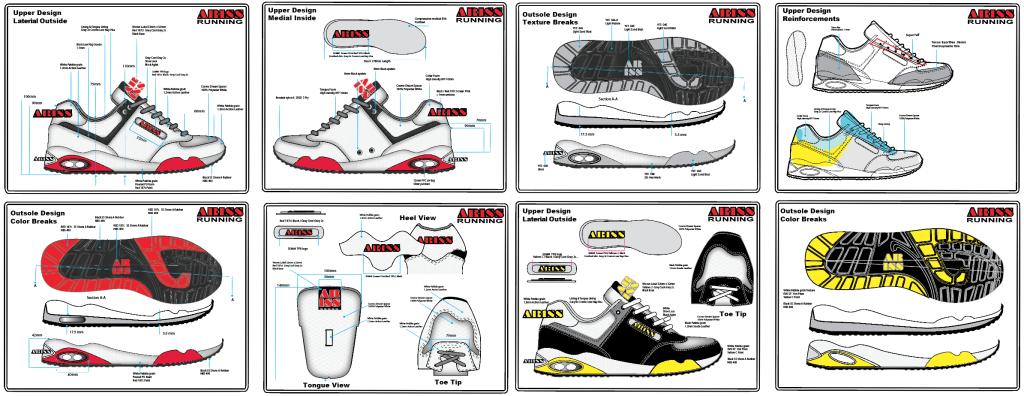
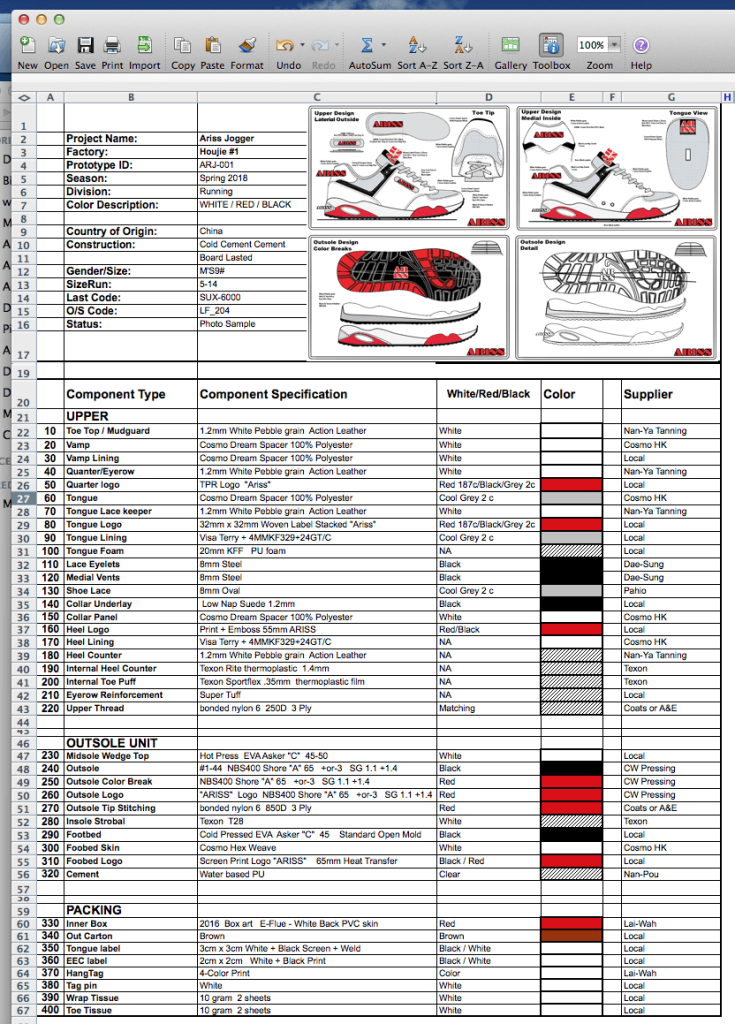
Once a new shoe design has been approved for development the shoe designer and developer will work together to create a detailed set of specification drawings or “tech pack” or “specs”. The shoe technical drawings may be done by the designer alone but often a developer will fill in the technical details. These drawings and documents detail every part of the sneaker from the upper to the outsole bottom. The line item specifications include the name of each part, the material, material vendor, thickness, and color reference. The Spec includes the shoe last information, logo art, design details, emboss effects, etc. The spec may also include sample shoes, material swatches, photos, or any other notes to help build the samples. All of these items together make a complete footwear design tech pack. You can see a complete line item shoe specification here.
Spec sheet for Ariss Trainer .xls format download
The Spec drawings and line item spec may be e-mailed, sent by courier service, or hand-carried by the developer to the factory. At this point in the process, the shoe developer is responsible for getting the sample sneakers built.
A complete shoe specification drawing will contain the following items:
Shoe Design Tech Pack
Lateral view (outside of the Shoe) Medial View (inside of the shoe) Heel View (view from the back) Tongue View (showing any logo art) Vamp View (looking down on the toe) Detail views of any small plastic parts Material Map of the upper Color map of the first sample colorway to be made. Outsole Side Profile Outsole Bottom View Outsole Top net View Detailed view of injection parts Cross-section view of the sole Diagram of Internal parts Diagram of Internal reinforcements Color map showing future plans for color breaks
Shoe Specification Pack Download
This shoe specification drawing pack is all you need to get started detailing your own shoe designs. This footwear spec pack contains a technical specification drawing for a fully detailed shoe design, ready for your creative touch. Upper views, outsole designs, material specs, colors. This is how a pro prepares a shoe design for the factory. This 8 page drawing set is in Adobe .pdf format and Adobe Illustrator .ai live vector file. $9.99 Download
Yes! You are in the right place. The Sneaker Factory offers options to suit your level. Self-paced online learning for free, supplemental books and shoemaking materials, live virtual classes, and private consulting with the Shoe Dog. Free shoe school is outlined below. Please send us an email for more information on the live classes and consulting with The Shoe Dog.
Shoe school – Free and Self-Paced: We have pulled together an online curriculum of shoemaking articles in a sequence that will take you from the basics of shoe design and shoemaking to advanced material selection topics. Step-by-step you will learn how to design shoes. This collection of articles teaches shoe making for beginner students of the trade.
Learn how to make shoes with this short online course where you study the basics of shoe design and techniques for mass production. Get a firm grasp of shoemaking terminology, shoe patterns, and construction. Our shoe making tutorial takes just a few hours to read. Of course, we also offer additional books and instruction for shoe designers.
Welcome to the Sneaker Factory Online shoe school, let’s get started! We have taken great care to make learning easy! Throughout our articles you will see many shoemaking terms like “last” and “eyestay,” are highlighted in blue. Simply move your mouse over the highlighted terms to see the definitions. So easy! You can also see all the shoemaking terms together in our Shoe Terms Dictionary.
Our shoe school course is free! If want to learn how to make shoes you are in the right place! This short online course will cover the basics of shoe design and techniques for mass production and give you a firm grasp of shoemaking terminology, shoe patterns, and construction. Our shoe making tutorial takes just a few hours to read. Of course, we have books for shoe designers.
Welcome to the Sneaker Factory Online shoe school, let’s get started! We have taken great care to make learning easy! Throughout our articles you will see many shoemaking terms like “last” and “eyestay,” are highlighted in blue. Simply move your mouse over the highlighted terms to see the definitions. So easy! You can also see all the shoemaking terms together in our Shoe Terms Dictionary.
Part 1: Learn The Basics of Shoemaking
In this part of our shoemaking course, you will learn the basics of shoemaking and construction step-by-step. You will learn what a shoe last is and how it determines the shape of your shoe. More importantly, you will learn the parts of a shoe. If you want to learn how to make shoes…you are in the right place!
With your new design drawn up, let’s dig deeper and learn how to make a real factory ready shoe specification. A detailed shoe specification, (or Spec sheet,) will allow the shoe factory to create just what you are looking for. This section of the shoemaking course will teach you the language and give you the tools to create a proper and professional shoe design specification.
There is always more to learn in the field of shoemaking! In this section of the course, we have a few more articles that will help you on your way to becoming a real shoe pro!
If you want to learn more we have written three books that every young shoe designer should read.
How Shoes are Made: Covers the basics of shoe design and manufacturing. Everything you need to know if you are starting in a shoe design office. This is a shoe design handbook for footwear designers.
Shoe Material Design Guide: This will complete your shoe design book library. This book is a master class dedicated entirely to the selection and sourcing of shoe materials. An ideal handbook for footwear designers and manufacturers.
How To Start Your Own Shoe Company: This book is written for shoe entrepreneurs young and old. Not just for shoe designers, How To Start Your Own Shoe Company is a perfect training aid for footwear product line managers and shoe company brand managers.
Shoe Agents: What to expect in a shoe development contract
Question: Do I really need a shoe sourcing agent to start my own shoe business? If you are new to the shoe trades you are going to need some help! The answer is YES!
Question: What will it really cost to develop my shoe ideas and get them into production?
Read on! This is the question we will be answering.
A trusted Shoe Agent will be your partner:
Have you heard horror stories of a factory in China shipping a load of rocks instead of shoes? YES, so have we,but we have friends on the ground in China so that can’t happen to us!!
If you are ready to start a shoe company but don’t have shoe design, development, or manufacturing experience, you are going to need a footwear sourcing agent. The shoe manufacturing agent can help you make contact with a shoe factory suitable for your project and help you manage your shoe development projects. Footwear buying agents will have relationships with several shoe factories, sample rooms, and outsole mold suppliers. A qualified shoe sourcing agent will have technicians that help develop your design and make your ideas into a real shoe.
Finding a shoe manufacturer is very hard but you are lucky! Having been in the shoe trade for many years, I have worked with many fine people inside the major shoe brands. Some of my friends now have their own shoe sourcing businesses in China. I’m happy to make introductions. But only if you are ready.
Footwear Development contracts:
Here are the terms of a typical footwear development agreement or contract. You need to remember, footwear production setup charges are high and MOQ (minimum order quantities) will be required by the factories. These charges are:
Outsole Molds
Shoe Outsole Molds, 1 set (per size) $1500-2000 for rubber, $2000-2500 for EVA compression molds. You will need a minimum of 10 molds to cover the standard shoe sizes. During development, a samples mold will be needed to confirm the design before the set of production molds is opened. Prototype parts may be made from cast rubber or foam before a steel mold is made.
Factories may offer “open” molds but please note there are very few suitable for quality shoes. To ensure your shoes fit and function correctly we will not work with these “open” molds.
Footwear Sample Development
Sample development charges paid to the factory: To make your design come to life, plan on 3 samples stages, 45 pairs of samples, the total cost of $5000. This includes factory time and the shoemaking sample materials. The shoemaking expertise of pattern makers and mold technicians does not come for free.
Project Management Fees
Product Management time will be around $2000 per month for the project. This covers the agent’s development team following up with the shoe factory, last factories, material vendors, and outsole suppliers. This puts your representative in the factories working for you. A standard development project is expected to be around 6 months. This is enough time to make the pullover, samples, and tooling. Very complicated projects may require more time.
Basic terms you need to expect:
Confidentiality agreements will be signed. Your agent will protect your project from the eyes of competitors.
Sample delivery charges will be your responsibility. Fed-ex and UPS bills are not cheap for shoes shipping from Asia to the USA or Europe. Plan accordingly.
Costs for shoe outsole or upper molds must be paid in advance of tool cutting.
Costs for samples paid before each shipment.
Product Management Fees will be paid at the beginning of the month of development
Once you place your Production Orders a 9-month retainer fee of US$5,000 will apply.
This will see your shoes through pre-production and provide you QC and logistics support once your shoe production order is complete. The Project management time fee of US$2,000 will be waved for development from this time.
Production, MOQ 6000 per style, 1200 pairs per colorway.
Production lead time, 120 days. Then add time for shipping.
For any new customer, the shoes must be paid for in-full before shipping.
You will need a Letter of Credit or a Wire transfer.
So are you ready?
If you have made it this far you are one step closer to starting your own shoe company! Before I introduce you to an agent, we need to make one more cost calculation.
What is the purchase price of 6000 pairs of shoes?
This is the hard part! You are going to need some capital to bring your shoes home from the factory. Friends, family, kick starter- you are going to need some money. The shoe factory and agent will not give you delayed terms. You will need to pay the entire amount to get your shoes shipping. Roughly, your shoes will cost about 25% of the selling price to import from Asia. So, if your shoes will cost $100 in the store, plan on $25 for the shoe with shipping and import duty included. So….$25.00 X 6000 pairs = $150,000!!!!!
Do you want a job at a shoe factory? Probably not in a shoe factory. More likely you want a job at a shoe company or shoe brand that designs, markets and sell shoes! You want to work for a brand like Nike, Adidas, Puma, Vans or DC shoes. You want to be a sneaker designer not a sneaker sewer!
So, what kinds of jobs can you get at a shoe company and what do you need to know?
There are many shoe making jobs which do not require sitting in front of a sewing machine in Asia. I’m going to list a few of the common jobs you would find in a typical shoe development office at Nike or Vans.
Shoe Designers: Someone has to draw the shoes. Depending on who you ask, this is the easiest part or the hardest. The shoe designer has to draw what people want on their feet.
To be a shoe designer, art school would be a great help. There are many great design schools with ID, merchandising and fashion design. A degree in Industrial or Product design is a great place to start. But that said, if you can draw shoes like a bandit who needs higher education? The designers draw the shoes, then works with the developers to make the prototypes just right. Picking color trends and knowing what is cool are critical skills.
Shoe Design Manager: A successful shoe designer with best sellers in his or her portfolio will soon be asked to lead a team of designers. If you are a great shoe designer and have a talent for organization and leadership, you to can be a design manager. The footwear design manager is responsible for the training and guidance of younger designers and may also work to allocate projects, arrange inspiration trips and work to motivate your team. The Shoe Design Manager must also work closely with sales and marketing departments to review design briefs and schedules.
Shoe Developers: Not a designer but critical to getting the shoes made. It’s the developers job to take a nice drawing and make it into a real shoe you can wear on your feet. The developer is the guy that writes the technical specifications, checks the blue prints, and communicates with the shoe factory.
The developers job is to get the shoe made and keep the free thinking designers from making a beautiful shoe that is cruel to wear. Developers are the shoe prototype engineers and schedule keepers. To be a developer you may start as a designer, an intern or assistant. Be ready to travel!
Landing a job as an assistant shoe developer is a great way to get started. You don’t need any experience to started so if you are willing to learn, travel and work late calling Asia this is an awesome jumping off point!
Footwear Development Manager: With a few years of experience as a shoe developer you may be asked to take on more responsibilities. The Development manager will be responsible for allocating projects to developers, selecting factories for projects, schedule development operations, solve technical shoemaking problems, Design tooling, manage advanced technical projects, source new materials and handle price negotiations.
Advanced Technology Developer/Design: Shoe designers and developers with talent for technical details and a special imagination may join a team working on advanced technology projects. These projects may not be on any production schedule but will allow the shoe company to create new and unique designs. The Advanced Technology team will do patent research, visit new suppliers and trouble shoot new production processes.
Footwear CAD Technician: The shoe design department will need some Computer Aided Design support. All the tooling will need to be modeled to make molds. The shoe designers usually do not create the 3D CAD models, but instead will provide 2D and or hand drawings to the Footwear CAD Technician. Depending on the focus of your company you may have CAD Technicians in your office or rely on your factory partners to create the CAD models.
Footwear Product Managers / Product Line Managers: The Product Manager or “PM” is the person that sets designers and developers in motion. It’s the PM’s job to figure out what shoes to make. The PM will tell the designer what kind of shoe to make. PM’s responsibility is to work with the sales team and customers to find out what they need. The PM is also tasked with looking forward. What will people need next year? What color shoes will be trending? Experience in retail or sales is a big help. Shoes Designers and developers are often promoted to this position. A marketing degree will help.
SMU Product manager / SMU Developer The SMU (Special Make Up) or MTO (Made To Order) manager works with salesmen and big customers to make special production runs. Most often the SMO or MTO is a new color or logo treatment, Not a new shoe design. If the orders big of course the SMU Product manager will pull in a designer to help make a new shoe. SMU projects are a great way for designers and developers to get started on as product managers.
Start Building Your Brand. Get the Start-Up Pro Pack.
Sample Coordinator: A busy development office will have hundreds of shoes coming and going. The Sample Coordinator is the traffic cop that tracks where the shoes are. Are the samples still in China? When is the factory going to ship them? Does Fed-Ex need more paperwork to manage the import? Did the new sample get to the designer for study? When is the SMU customer going to see their samples. The sample coordinator position is a great entry level position for learning the operations of shoe development.
Sales Representative and Sub Rep: Selling shoes is great way to get involved. The sales force is exposed to many aspects of the shoe trade. An active sales rep can help shape the product line. On the front line selling the shoes, the salesmen know first hand what customers are looking for. A salesmen can get promoted into a Product Line Manager position.
Working at a shoe store: Believe it or not, working in a shoe store is a great place to start for a high school or college student. Learn about shoes, meet the local sales reps and sit in with the buyers when they review the new shoe lines.
Footwear Retail Buyer: Working you way up in shoe retailer you could move from selling shoes on the retail floor to buyer that fills the store. The retail buyer is responsible for making sure the store has the right assortment of the right shoes at the right price and right time! The footwear buyer for a sporting goods store will plan to have sandals and water shoes in summer, Boots in winter and fresh deliveries of shoes for the start of Baseball in the spring and Football in the fall. The buyer must study sales figures, have a eye for trends and skills to negotiate discounts. Buyers start out as assistants responsible for small categories then move up if the shoes sell through fast with no closeout sales.
Footwear Import Duty Classification Specialist: Any firm that imports shoes will need someone to help the development team and designers with product HTS duty classification. Without a classification specialist on hand, a shoe design could be 37.5% duty instead of 9% or 0% duty. The Classification Specialist works with the development team so they understand the rules to avoid high duty classes if possible.
Footwear QC Inspector: A proper footwear inspection program will have QC Inspectors reviewing the shoe making process from the beginning to end. While 90% of the inspections should be done in the factory, Inbound QC is done when the shoes arrive. This QC inspection will insure there has been no damage during shipping and catch any problems that may have slipped through in the factory. Usually a trusted warehouse worker is given some basic training, then works with the development staff if there are any questions. These inbound inspectors quickly learn what a makes a quality shoe and will develop a knowledge of shoe construction. From this position it’s just a small step to become an assistant developer.
New Online Course!
Shoemaking for Designers & Brand Builders
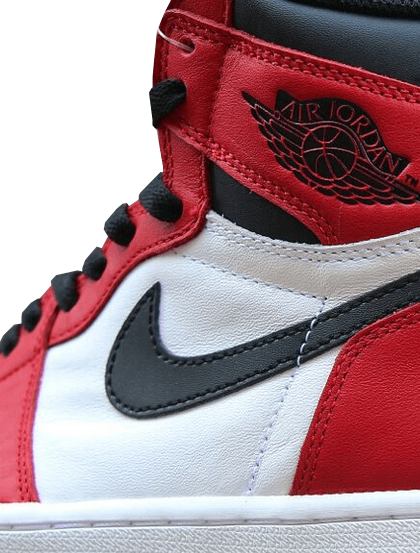
No doubt Nike makes great shoes, but today we are going to take a critical look at the Nike Air Jordan 1. Rather than review the styling from “Sneaker Freak” perspective or the performance of the shoe for actually playing basketball, I want to do comparison of the construction, materials and assembly the Original Air Jordan 1, the Retro Air Jordan 1 and the Nike ID Air Jordan 1.
A lot has been written about the Air Jordan 1, but I’m looking at a specific detail. The edges! How the shoe designer handles the material edges is critical to the look, costing and construction of a shoe design. Today we are looking at 3 different versions of the same Classic Nike Air Jordan 1. Each model of this shoe the Original Air Jordan 1, the Retro Air Jordan 1 and the Nike ID Air Jordan 1, all have a different edge treatments. These three version of the Nike Air Jordan 1 each show the common material edge treatments raw cut, rolled or turned out seam.
Raw Cut or Die Cut edges:
The most common way to treat a material edge is to do nothing, just cut it. For real leathers and PU synthetic leathers a clean-cut is usually okay. If the material backing is color matched to the skin and the backing material is not rough or fibrous a clean-cut edge is perfectly acceptable for high-end performance or fashion shoes. In fact an exposed contrast color edge can be a neat design element. The down side is the raw edge is more susceptible to wear or fraying and may show wear sooner. The die cut edge may also be painted or sprayed to cover a backing material not dyed through. This original air Jordan 1 is made from PU coated “action” leather. The edges are die cut clean. You can see the skin edge is perfectly clean as this is PU material, the backing edge does show shoe fibers from the leather.
In this Nike shoe you can see the White and Red materials are leather based while the Black Swoosh looks to be 100% synthetic material, as the edge is cut perfectly clean.
The raw, die cut edge is the least expensive way to handle the material edges. Mesh or Fabric edges can not be die cut.
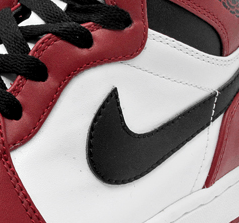
For a more finished looking treatment the material edges can be rolled. Fabric, Leather and PU material edges can be rolled. Extra labor is required and great care must be taken to insure the process results is a neat and clean edge. Not all shoe parts can be rolled neatly.
In the case of this Nike Air Jordan 1 Retro edition you can see almost all the material edges are rolled. This is very well done, the curving eyestay parts with tight corners are neat and even without bumps or wrinkles. This fine work is done with the aid of a machine.
To get clean edges like this Air Jordan you need two operations. First, the material edge must be skived to reduce the thickness. This leather maybe 1.2mm to 1.5mm – the skived edge, maybe 5mm wide will be .5 to .7mm thick. This will allow the edge to be rolled without making a huge fat edge. Once the material is skived down the cut parts will be taken to an edge rolling machine.
The edge rolling machine neatly folds and glues the edges, then a pressure roller flattens parts for clean look. The glue holds the edge until the stitching department can make the shoes.
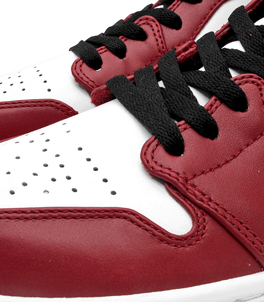
The last shoe is the Nike ID Air Jordan 1. This model is made with different materials and uses different techniques. Made of synthetic panels this shoes is entirely “turned out”. The shoe parts are cut, laid down face to face then stitched. The resulting seam is then hammered flat to remove wrinkles.
The turned seam may also require skiving, depending on the material thickness. This Nike shoe has some many turned out seams I expect the are not all skived.
This shoe is so neatly made you would think some parts may be welded on. Like the logo
Over all when you design a shoe you need to consider how to handle the edges, What materials will require special finishing, skiving, glueing or hammering?
Leather parts can be die cut, fabric parts can not. Synthetic material cut clean but may not handle the skiving operations.
Rolled seams and turn out seams can make crisp pattern lines line a die cut pattern part. Rolled and turned seams require more equipment, time and labor making them more expensive. You will have to find the technique suits for design, material and price.


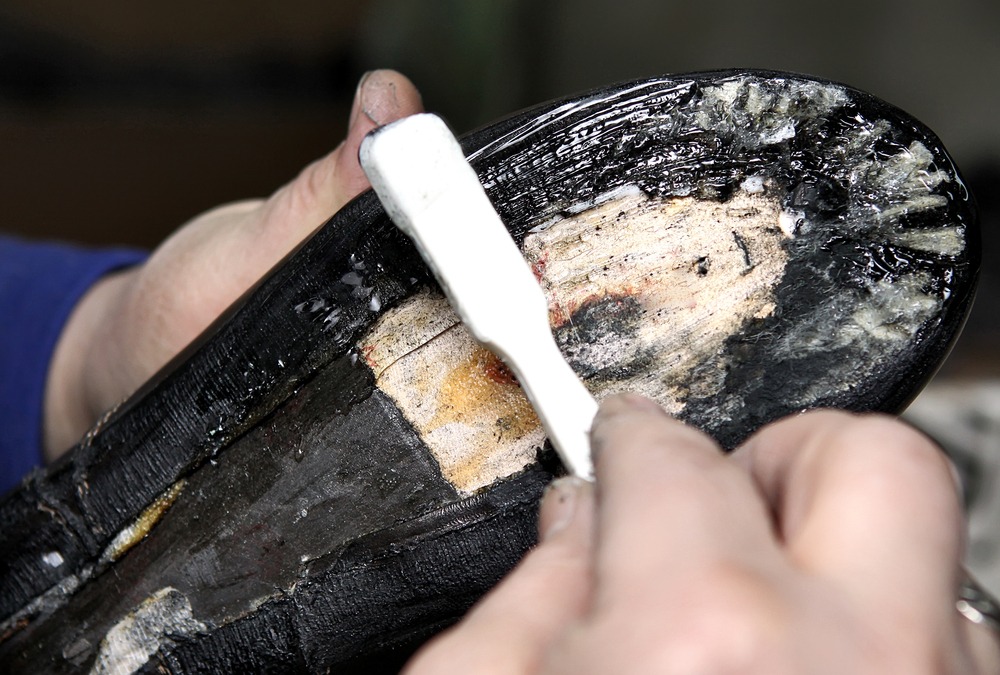 There are many shoe construction methods from which a shoe designer can choose. Depending on the function and style of your shoe design, you have many options for connecting the upper to the outsole unit. The classic Goodyear welt, the heavy-duty Norwegian welt, and the modern cold cemented Strobel construction, to name a few.
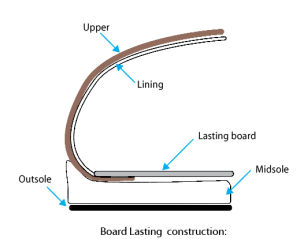 Board Lasted Construction: A very common shoe construction technique that can be made by machine or by hand. The upper is pulled tight and bonded to a fiber board. The outsole unit is firmly cemented to the upper, securing the upper to the sole. Board lasting construction can be used on almost any style of shoe, being suitable for many upper material types and outsole styles.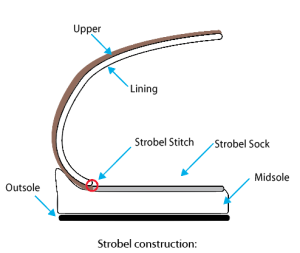
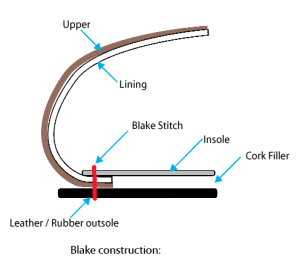 Blake Construction: Used to make flexible leather shoes, the Blake construction starts with a board-lasted upper. Glue the sole in place then with the last removed, sew the upper directly through the outsole unit. The outsole may be leather or rubber and have a groove molded into its surface to guide the Blake stitch. You will find Blake construction on weltless leather dress shoes, moccasins, and boat shoes. Blake construction is not waterproof.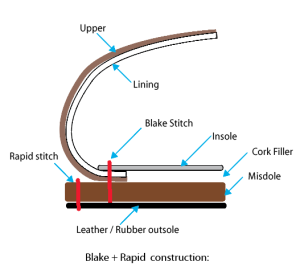
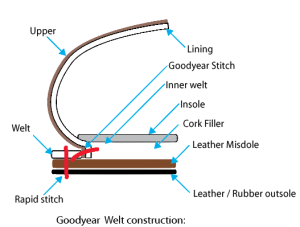 Goodyear Welt Construction: The Goodyear welt is often used to make waterproof soles, the stitch that attaches the sole to the shoe runs around the outside edge and does not make stitch holes in the upper. The upper is sewn to the welts that attach to the insole and the outsole. During assembly, the welts are attached first by a horizontal “Goodyear” stitch, named for the inventor of the stitching machine, Charles Goodyear Jr. (also the son of the famous rubber inventor, Charles Goodyear Sr.). The Goodyear welt construction method is ideal for heavy-duty boots for hiking or service.
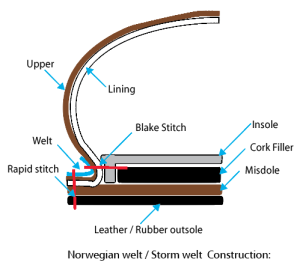 Norwegian Storm Welt Construction: Similar to the Goodyear welt construction method but the upper is turned outside and is sandwiched between the outer welt and the outsole. Used to make the heaviest waterproof boots, the Norwegian Storm Welt is difficult to make and is found almost exclusively in the workshops of Italian bootmakers.
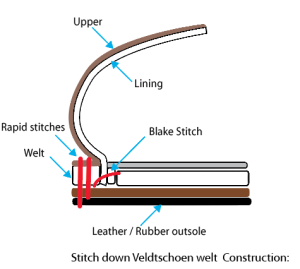 Stitch down Veldtschoen welt Construction: Again, the Veldtschoen welt is related to the Goodyear and Norwegian welt constructions. In this case, an inner welt or rapid stitch line sewn through the midsole is paired with a second rapid stitch that attaches the outsole. The outsole is attached after the first welt, the bottom stitch is protected by the outsole.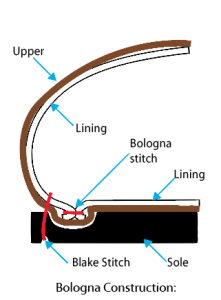

 Cold Cement / Sheet CUT EVA Shoe Assembly Process: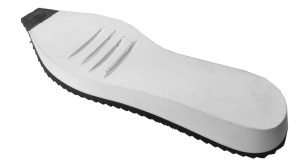
 The toe tip will get extra pressing[/caption]




 Die Cut Logo:
 Screen Printed Shoe Logos :
 Print + Emboss Logo:
 Woven Labels:
 Embroidered Logo:
 3D Embroidery:
 TPR Micro Injection:
 Dye Sublimation Printing:
 PVC Gel Bubbles:
 Chrome-Plated ABS Plastic:
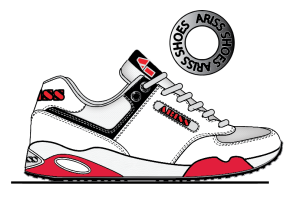 Metal Hardware:
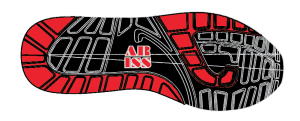 Molded Logos:
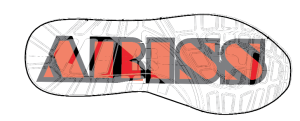 Backprinting Effects:
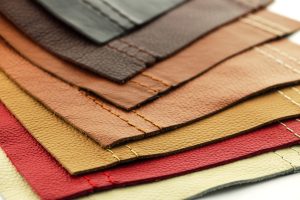 Real Leather for Shoes
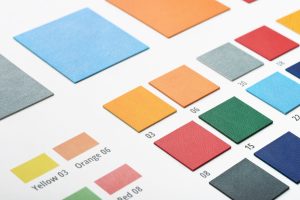 Synthetic leather for shoes
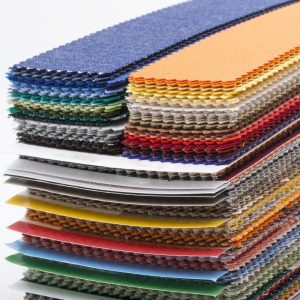 Textiles for Shoes
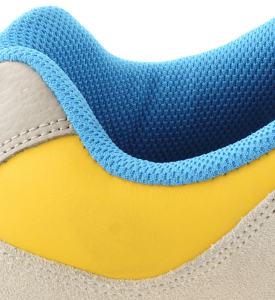 Lining Fabric for Shoes
 Thread for Shoemaking
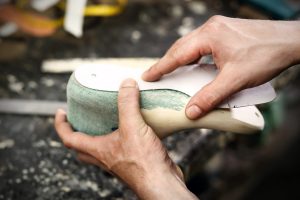 Lasting Board
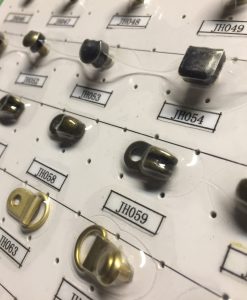 Metal Hardware
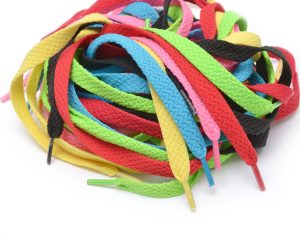 Shoe Laces/Webbing / Trims Etc./Reinforcements
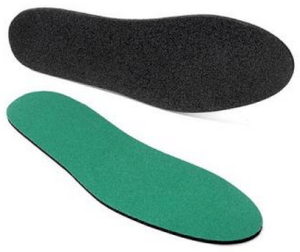 Footbed foam
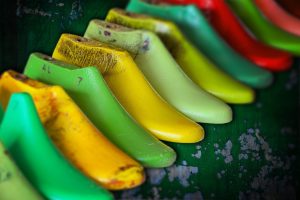 Lasts
Lasts Outsoles


 If you want to learn more we have written three books that every young shoe designer should read.
 This is the hard part! You are going to need some capital to bring your shoes home from the factory. Friends, family, kick starter- you are going to need some money. The shoe factory and agent will not give you delayed terms. You will need to pay the entire amount to get your shoes shipping. Roughly, your shoes will cost about 25% of the selling price to import from Asia. So, if your shoes will cost $100 in the store, plan on $25 for the shoe with shipping and import duty included. So….$25.00 X 6000 pairs = $150,000!!!!!